

Key takeaways
Compare one instruction—not two different jobs.
Align the subject, valuation date, basis, purpose and intended users before comparing firms or fees.
Know who takes responsibility.
Identify the responsible valuer, who performs the analysis, how material judgements are reviewed and who answers your questions.
Read the work behind the fee.
Scope, evidence, exclusions and follow-up explain the proposal. Firm size, report length and fixed pricing alone do not establish quality.
Confirm independence and permitted reliance.
Assess relationships and incentives for the actual engagement. Sharing a report does not automatically authorise another party to rely on it.
What are you actually buying?
When comparing business valuation companies, start with the decision the report must support—not the company’s size or the lowest quote. You are commissioning an assessment of a defined business, asset or ownership interest at a particular date. The useful result is not simply a number: it is a reasoned explanation that fits the agreed purpose and can be understood by the intended users.
This article focuses on choosing the firm and comparing its proposal. Our Choosing a Business Valuer guide covers individual qualifications and professional designations in greater depth. Neither a recognisable company name nor an impressive credential removes the need to examine the actual engagement.
Before seeking proposals, write down why you need the valuation. An owner considering a sale, an accountant advising on a related-party transfer and shareholders negotiating an exit may need different subjects, dates, assumptions and permitted uses. Asking each firm to quote against the same brief makes the comparison meaningful.
Specialist practice or larger advisory firm?
A specialist business valuation practice and a larger multidisciplinary firm can both be appropriate. The relevant question is whether the proposed team has the competence, capacity and independence needed for your particular instruction. Headcount alone does not establish quality, and a small practice is not automatically more independent or more attentive.
A straightforward private-business assignment may benefit from direct access to the responsible valuer. A complex group may require several disciplines: business interests, property, intellectual property, financial reporting or cross-border matters. Establish which expertise is included, which work requires another professional and who coordinates the conclusions.
Ask how the proposed team understands your business model. For an owner-operated company, commercial replacement costs and customer dependence may be important. For a subscription business, retention, contract rights and reinvestment may matter. A relevant explanation is more informative than a generic claim to cover every industry.
Geography should be assessed in the same practical way. Remote document review and scheduled discussions can be appropriate, while some assignments need inspections or location-specific evidence. Ask what the work requires rather than treating a city address as proof of suitable experience.
Know who will do the work—and who stands behind it
The person who speaks to you before engagement may not be the person undertaking the analysis. That is not necessarily a problem, but the responsibilities should be clear. Ask for the responsible valuer’s name, their role in the work and how you can raise a material factual issue with them.
Analysis and professional judgement
Establish who reviews the accounts, investigates adjustments, selects the methods and assesses the evidence. Support staff and software can assist, but ask who evaluates the material assumptions and takes responsibility for the conclusion. A platform-generated output is not a substitute for that judgement.
Review and communication
Ask how significant findings are reviewed and how questions are resolved before finalisation. A larger team may separate preparation and review; a specialist practice may use a different review process. The useful comparison is the actual process, not an assumed hierarchy of firm sizes.
Responsibility and continuity
Identify the contracting entity, responsible practitioner and agreed contact. Ask what happens if the lead person is unavailable, if additional expertise becomes necessary or if the instruction changes. Where appropriate, seek confirmation of professional indemnity cover relevant to the assignment; cover itself does not guarantee the quality or acceptance of a report.

Signed
A clear valuation conclusion starts with an agreed purpose, relevant evidence and disclosed assumptions. The report identifies the interest valued and explains the reasoning behind its conclusion.
Compare proposals against the same brief
A short quote can conceal a substantial difference in work. Ask each firm to address the same instruction in writing. The APES 225 Valuation Services standard distinguishes engagement types and addresses terms, reporting and documentation for members within its scope. A standards reference should be connected to the proposed work, not left as a badge on the proposal.
Subject, date and basis
Does the proposal value the operating business, specified assets, all company shares or a particular holding? Does it identify the valuation date and the meaning of value being used? Two proposals are not equivalent if one addresses the operating enterprise and the other addresses a shareholder’s interest.
Scope and evidence
Which records will be examined, which procedures are included and what limitations are anticipated? Ask how missing information will be handled. A limitation reasonably expected to materially affect the estimate needs more than a casual description as a “shorter report”. The engagement classification and implications must be explained.
Intended users and permitted reliance
Who may use the report, for which decision and subject to what conditions? Sending a document to your accountant, a buyer or another shareholder does not automatically authorise their reliance. Confirm any recipient-specific requirements before commissioning the work.
Deliverables and follow-up
What will you receive, who will sign it, and what discussion or clarification is included? Ask whether the engagement includes a review of factual information before finalisation. That review is an opportunity to correct facts and supply evidence—not to negotiate a preferred valuation conclusion.
Read the fee alongside the exclusions
The cheapest proposal may be appropriate if it answers the required question with suitable work. It may be unsuitable if it excludes an essential ownership analysis, the relevant date, a necessary asset assessment or the intended recipient. Equally, a higher price does not by itself establish a better valuation.
Compare the total professional fee, GST treatment, included discussions, additional specialists and the process for approving extra work. Ask what circumstances can change the fee: additional entities, a new valuation date, information arriving late or a changed instruction may affect the agreed work.
A Fixed Professional Fee makes the agreed cost clearer, but fixed pricing alone proves neither independence nor technical quality. Understand what is included and what triggers a variation. A useful proposal explains the scope sufficiently for you to decide whether the fee purchases the work you need.
At IBV™, the Fixed Professional Fee and engagement terms are agreed before work begins. The Fees page explains the current service options; suitability depends on purpose and reliance, not turnover alone. Do not select a lower scope merely because it costs less when your decision needs different work.
Independence is an engagement question
Ask whether the firm or relevant team has relationships with you, the other party, the business or the proposed transaction that require assessment. A practice offering other advisory services is not automatically disqualified, but the relationships, potential conflicts and safeguards should be considered for the actual engagement.
Understand how remuneration works. A fee contingent on the valuation outcome or transaction completion can create a different incentive from a professional fee agreed for the work. Independence also involves judgement, relationships and conduct; it cannot be reduced to the invoice format.
Do not choose a firm because it promises the highest value. An independent assessment may support, exceed or fall below your expectations. The practitioner should be willing to investigate evidence that changes the answer, rather than defend a target chosen in advance.
A practical comparison: two proposals, one owner decision
Consider a fictional owner preparing a shareholder exit. One proposal describes a valuation of the operating business at the current date. Another describes a valuation of a specified shareholding at the date required by the shareholder agreement, with the relevant rights and permitted users identified.
Both proposals may be competently prepared, but they are not answering the same question. An operating-business figure does not automatically establish the value of particular shares. The agreement may also require legal interpretation before the valuation instruction is finalised.
The owner’s next step is not to rank the firms by fee or report length. It is to confirm the legal instruction with their adviser, send an aligned brief to both firms and ask them to explain any remaining differences in scope. The original proposal may need revision, or the firm may explain that the requested work is outside its service offering.
The lesson: resolve a difference in instructions before treating it as a difference in value or quality. This illustration is invented, contains no client information and does not recommend a particular engagement for every shareholder exit.
What IBV offers—and what to confirm first
IBV™ is led by Dr Patrick Hillenbrand, AVI Certified Business Valuer, a designation issued by the Australian Valuers Institute. IBV voluntarily applies the relevant principles of APES 225, as documented in its engagement terms. This is not a claim that Patrick is a CPA or that voluntary application is a membership-based obligation.
The IBV™ Independence Guarantee includes professional fees agreed before work, no remuneration contingent on valuation outcome or transaction completion, and no business brokerage or transaction commissions. Engagement-specific relationships and conflicts still require assessment. Read the IBV™ Independence Guarantee for the practice’s stated commitments.
IBV provides business valuations within an agreed scope, including tax, ownership and succession matters. It does not provide broker appraisals, expert-witness or court-appointed valuations. Family-law work concerns non-litigious negotiations, voluntary mediation and settlement planning, with intended users and permitted reliance agreed.
A standards label does not guarantee that the ATO, a lender or another recipient will accept a report. The ATO’s market valuation guidance explains its evidence expectations for tax valuations. Your tax or legal adviser should confirm the governing requirements; the valuation is not a substitute for that advice.
Frequently asked questions about business valuation companies
Is a larger business valuation company always better?
No. Compare the proposed team’s competence, capacity, review process and understanding of the assignment. A complex instruction may need several disciplines, while another may suit a specialist practice. Firm size is not a quality ranking.
Should I choose a firm in my own city?
Not solely for its address. Ask whether remote review is appropriate, whether an inspection is needed and how local or industry evidence will be obtained. Location and professional suitability are different questions.
Who should be named in the proposal?
The contracting practice and the person responsible for the valuation should be clear. Ask who performs the analysis, makes material judgements, reviews the work and answers your questions.
Why do business valuation companies quote different fees?
They may be quoting for different subjects, dates, evidence, procedures, deliverables or reliance arrangements. Reconcile the instruction and exclusions before comparing price. Different fees alone do not establish different quality.
Can the lowest-priced report still be suitable?
Yes, if its scope and supporting work meet the actual purpose and intended use. Price alone does not establish suitability. Ask what has been excluded and whether those exclusions affect your decision.
Does APES 225 apply to every Australian business valuation company?
No. It establishes obligations for members of professional bodies that adopt it within its scope. Other practitioners may voluntarily apply relevant principles. Ask how the firm’s statement relates to the actual engagement and professional obligations.
Can my accountant or buyer automatically rely on the report?
No. Intended users, permitted purpose and reliance are governed by the engagement terms. Recipient-specific requirements should be checked before the work starts; sharing the report does not itself confer reliance.
Is a fixed fee enough to prove independence?
No. Relationships, conflicts, professional judgement and other incentives still need assessment. A fee agreed for the work can improve cost clarity, but the firm must assess independence for the particular engagement.
Should I favour the firm promising the highest value?
No. A promised result is not evidence. Select the firm whose instruction, evidence and reasoning fit the decision, and expect an independent conclusion rather than a figure negotiated to suit a party.
What should I send with my first enquiry?
Describe the purpose, business or interest, relevant date, expected users and any adviser or recipient requirements. Explain what records are available. Avoid sending sensitive customer records or personal documents until an appropriate information-sharing process has been agreed.
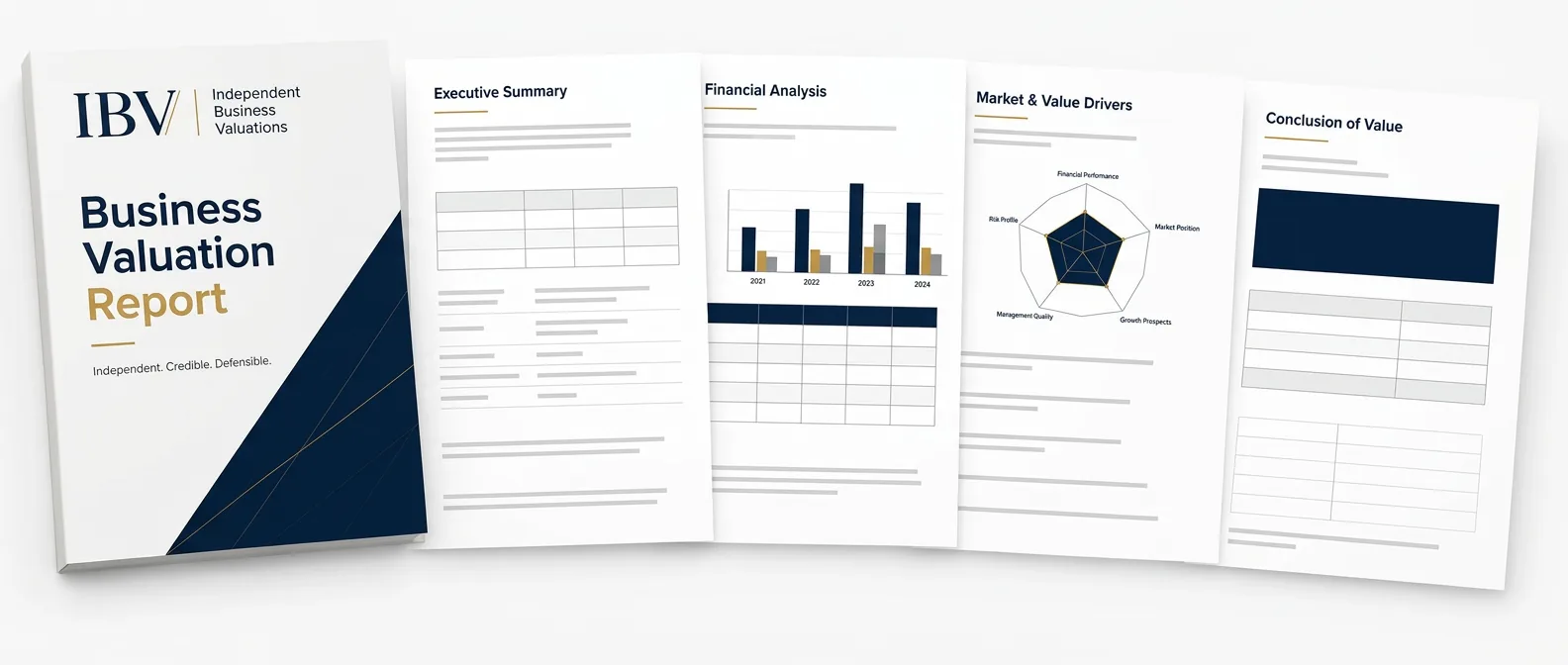
A clear, independent view of value — with the evidence behind it.
- Understand the conclusion — and what drives value.
- Gain an independent perspective. Move forward with confidence.
- Benchmark your business against industry performance.
- Identify strengths, risks and opportunities through SWOT analysis.
WHAT YOU GET IN A LIMITED SCOPE VALUATION REPORT
Inside your IBV™ report
Executive Summary
Conclusion of value · Method selected · Valuer qualifications
Detailed Report
Maintainable earnings · Cap rate / multiple · Premise of value
The Evidence Pack
SWOT analysis · Top Performers Report · RAVDA score
APES 225 voluntarily aligned. Report depth and supporting analysis follow your agreed package and engagement scope.
Free Valuation Call