Without Valuation Evidence, That Value May Be Difficult to Protect

If your business is later sold or transferred, an independent valuation at 30 June 2027 may be critical to separating its existing value from later gains. Without supportable valuation evidence, more of the eventual gain may be allocated to the post-reform period than the business evidence would otherwise support.

Sole trader or professional practice

Business goodwill, client book, practice name, intellectual property or other CGT assets.

Shares in a private company

A future sale of your shares may be affected. The value of the shares (not just the business) may be relevant.

Partnership interest

A partnership interest, business assets or interests held by partners may be affected.

Business held through a trust

Trust-held assets may be affected.

Sale, transfer or succession

Selling all or part of the business, transferring to family, employee buyout, shareholder exit or succession planning.

Significant goodwill accumulated

The more value created before 1 July 2027, the more important it may be to preserve evidence of that value.

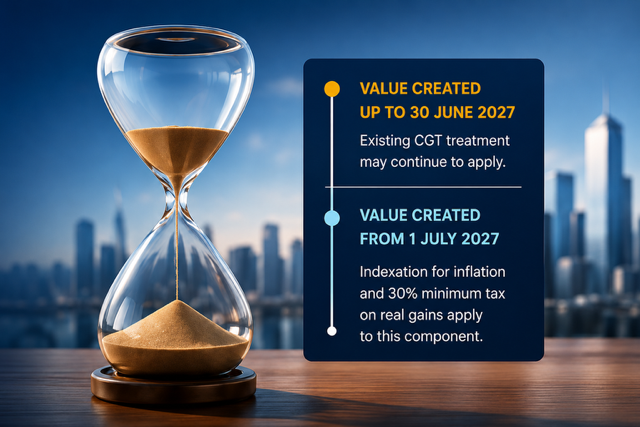
One business. Two periods of value.

The transition date matters

Value created up to 30 June 2027

Existing 50% CGT discount continues to apply (subject to eligibility and rules).

1
July
2027

Value created from 1 July 2027

Indexation for inflation and a minimum tax rate of 30% on real capital gains.

IBV|CGT Business Valuation
FREE PRACTICAL CGT GUIDE

Why your business value at 30 June 2027 matters

New CGT rules may make the value of your business at 30 June 2027 important – even if you do not plan to sell for years.

Inside the guide:

  • IBV | CGT Business Valuation Who may be affected
  • IBV | CGT Business Valuation What may need to be valued
  • IBV | CGT Business Valuation What evidence to preserve before the date

DOWNLOAD FREE GUIDE

General information only

The ATO calculation sees only time.

An independent valuation sees the business.

Illustrative example: acquired 1 July 2017 for $100,000 and sold 30 June 2032 for $4,000,000.

Independent Valuation
Supportable market value

$2,500,000

Pre-reform nominal gain:
$2,400,000

Post-reform growth
$1,500,000

ATO’s calculation*

Time-apportioned amount

$1,170,000

Pre-reform nominal gain:
$1,070,000

Post-reform growth:
$2,830,000

$1.33 million more of the nominal gain is allocated to the pre-1 July 2027 period using the independently supported market value in this illustration.

An independent valuation is not designed to produce a higher value. It must establish the most supportable market value from favourable and adverse evidence. For another business, the independent value may be lower than the ATO calculation.

*“ATO’s calculation” refers to Treasury’s current exposure-draft compounding-growth method and the anticipated ATO calculation tool. The final method may change.
IBV | CGT Business Valuation

What the ATO says

The ATO expects tax valuations to be Objective and Supportable.

  • IBV | CGT Business Valuation Tax valuations should be objective, supportable and based on appropriate methods and assumptions
  • IBV | CGT Business Valuation The taxpayer remains responsible for substantiating the valuation.
  • IBV | CGT Business Valuation The ATO can review and challenge valuations where evidence is weak or inconsistent.
  • IBV | CGT Business Valuation A properly documented independent valuation is generally better placed to withstand scrutiny.

What the ATO expects from a valuation

The ATO says professional valuations are more credible. Taxpayers must ensure the valuer is knowledgeable, experienced, properly instructed and objective, using credible evidence and an appropriate recognised methodology.

IBV’s response: Every CGT Protection Valuation is prepared by an independent AVI Certified Business Valuer and includes a Risk and Value Driver Assessment documenting the non-financial evidence informing the valuation.

Source: Australian Taxation Office - Market valuation of assets
THE PRACTICAL CONCLUSION

"The safest approach is to still pay for a July 1 valuation."

JAMES GERRARD

The Australian Wealth 8-9 August 2026

The current ATO-time-based formula assumes your business grew at the same compounded rate throughout its entire life. If most of its value was built before 1 July 2027, that assumption may understate its value at 30 June 2027.

Every business has a story - Our role is to value that story

If You Do Not Obtain a Contemporaneous Valuation

When the asset is eventually sold or otherwise subject to a CGT event, you will still need to substantiate how much value existed before the new rules commenced.

Without a contemporaneous valuation, you may have to:

– Rely on a prescribed apportionment method

– Reconstruct the business’s 2027 value years later from weaker records

– Defend an estimate that is harder to substantiate

The ATO expects tax valuations to be objective and supportable, and the taxpayer remains responsible for the evidence, assumptions and methodology used. The ATO can review and challenge any valuation.

Source: Australian Taxation Office — Market valuation for tax purposes

Inaction does not automatically increase your tax. But in many cases, it may increase: the amount of post-1 July 2027 gain you cannot disprove, the taxable amount, the risk of an ATO challenge, and the cost of defending your position.

A properly scoped independent valuation cannot guarantee ATO acceptance. However, the ATO says professional valuations are more credible and expects valuations to be supported by relevant records, credible evidence and an appropriate recognised methodology.

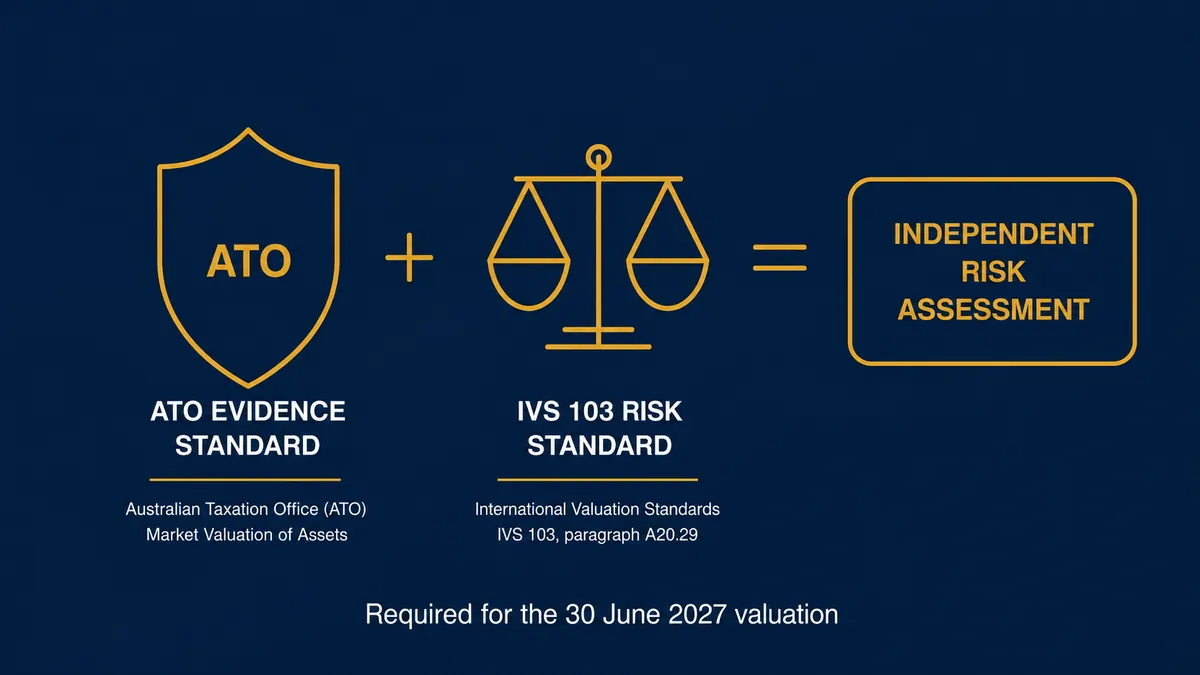
Independent Risk Assessment Requirements
Independent Risk & Value Driver Assessment

Establish the evidence pathway now. Acting early creates the advantage.

Establish an independent, dated non-financial risk and value driver baseline now, strengthen the business before 30 June 2027, and update the assessment near the valuation date.

Why act now?

  • IBV | CGT Business Valuation Create contemporaneous evidence.
  • IBV | CGT Business Valuation Document non-financial risks and value drivers.
  • IBV | CGT Business Valuation Identify opportunities to strengthen business value.
  • IBV | CGT Business Valuation Create a measurable improvement pathway.
  • IBV | CGT Business Valuation Secure valuation capacity before demand peaks.

$1,450 + GST per ABN.

BOOK THE ASSESSMENT NOW

The Preparation Timeline

1

Now

Complete the Risk & Value Driver Assessment. Establish an independent baseline of the business's non-financial risks and value drivers.

2

Before 30 June 2027

Strengthen the business. Act on identified priorities, improve key value drivers and preserve relevant records.

3

Close to 30 June 2027

Update the assessment. Capture the business’s risks and value drivers as close as practicable to the valuation date.

4

After year-end

Add reliable final financial information, reconcile it with the contemporaneous evidence and complete the independent valuation as at 30 June 2027.

What to begin gathering

  • Financial statements and tax returns
  • Management accounts and budgets
  • Owner remuneration and benefits
  • Customer and revenue information
  • Contracts, leases and agreements
  • Employees and management structure
  • Working capital and debt schedules
  • Intellectual property documentation
  • Industry information and market data
  • Details of unusual or non-recurring events

Download the Guide incl. Preparation Checklist

Small business CGT concessions remain

  • IBV | CGT Business Valuation

    15-year exemption

    May disregard all or part of a qualifying capital gain, subject to eligibility.

  • IBV | CGT Business Valuation

    Active asset reduction

    Reduce eligible gains by 50%.

  • IBV | CGT Business Valuation

    Retirement exemption

    Up to $500,000 lifetime limit.

  • IBV | CGT Business Valuation

    Active-asset rollover

    May defer an eligible capital gain, subject to replacement-asset and other statutory conditions.

Eligibility conditions apply. Depending on your circumstances, concessions may apply individually or in combination. Obtain advice from your tax adviser.
Sources: Australian Treasury — Small business CGT reform explainer
Australian Taxation Office - Small business CGT Concessions

What you receive from IBV

  • Clearly defined valuation subject
  • Transition-date valuation
  • Financial normalisation analysis
  • Owner replacement-cost analysis
  • Working capital consideration
  • Analysis of key value drivers
  • Valuation methods and cross-checks
  • Relevant market evidence
  • Documented assumptions and limitations
  • Written conclusion of value
  • Report suitable for permanent tax records

Different professions. Different responsibilities

Your tax adviser

  • Interprets the tax law
  • Assesses eligibility for concessions
  • Recommends transition approach
  • Calculates the capital gain and tax liability.
  • Provides taxation advice.

IBV

  • Establishes the market value
  • Analyses financial and commercial evidence
  • Assesses risk and value drivers
  • Applies valuation methods
  • Provides independent valuation evidence

Your tax adviser determines the tax treatment. IBV provides the independent valuation evidence.

Take action now

A timely independent valuation can help protect the value you've built
and support better outcomes for you and your business.

CGT Protection Valuation - FAQ

Is every business required to obtain a valuation?
    • No mandatory rule: A 1 July 2027 market valuation is an available evidentiary choice, not a universal filing requirement.
    • Alternative option: Alternatively, a taxpayer may choose an apportioning method determined under section 112-185, where available and applicable.
    • Commercial stakes: A formal valuation may be particularly useful where growth has been uneven or the business has significant goodwill.
Does this apply if I am not planning to sell?
    • Long-term impact: Potentially, because the 1 July 2027 date creates a permanent dividing line for tax calculations.
    • Future events: The actual capital gains tax is only triggered when you eventually sell or transfer the asset.
    • Evidence preservation: Establishing contemporaneous evidence may help substantiate the value attributable to the period before 1 July 2027, subject to eligibility and the applicable tax rules.
Can the valuation be prepared later?
    • Retrospective option: Yes, you can legally commission a historical valuation in the year you sell the asset.
    • Evidence degradation: Records, customer lists, and industry data become more difficult and uncertain to accurately reconstruct years later.
    • Hindsight rule: Retrospective reports must strictly use data knowable in 2027 without using future hindsight.
    •  
  • In short, it may still be possible, but it can cost more and carry greater uncertainty where records, commercial context and market evidence have deteriorated.
Does it need to be completed on 30 June 2027?
    • Flexible timing: The analysis does not have to be written on the exact transition night.
    • Data capture: At minimum, preserve comprehensive financial, operational and market evidence available around the transition date. A formal report may be prepared later, provided it uses only information that was available or reasonably knowable at the valuation date.
    • Report finalisation: The formal valuation report can be completed in the months following the end of the financial year.
Why does IBV recommend commissioning a proactive CGT Protection Valuation?
    • Preserves evidence: Records the financial, operational and market information available around the transition date.

      Supports the valuation: May provide stronger evidence of the value attributable to the pre-1 July 2027 period.

      Reduces uncertainty: May make a later calculation or ATO review easier to support.

Can my accountant prepare the valuation?
    • Not all accountants are independent and certified valuers.
    • Professional boundaries: Your accountant calculates tax liability and determines eligibility for small business CGT concessions.
    • Valuation specialist: IBV provides the independent, certified market value evidence to back up your accountant’s tax positions.
    • Scrutiny risk: Separating the tax-advice and valuation roles may provide a clearer and more independent evidentiary record.
Is a broker appraisal sufficient?
    • A broker appraisal is usually prepared to estimate a likely sale price and may not satisfy the evidentiary requirements of a tax valuation.
    •  
    • An appraisal based primarily on a rule of thumb or unsupported multiple may provide insufficient evidence for tax purposes.
    •  
    • ATO standards: The ATO explicitly requires tax valuations to be highly objective, supportable, and evidence-backed.
    • Audit vulnerability: Unsupported rules of thumb or generic industry multiples may face ATO challenges.
Does IBV calculate the tax liability?
  • Independence rule: No, IBV strictly provides objective, independent evidence of the business’s market value.
  • Tax advice exclusion: We do not calculate final tax bills or give legal advice on small business concessions.
  • Adviser collaboration: We provide independent valuation evidence for consideration by your registered tax practitioner when determining the applicable tax treatment. 
What is the Risk and Value river Assessment (RAVDA)?

The Risk and Value Driver Assessment (RAVDA) is IBV’s evidence-building methodology. It is not mandated by the ATO or IVS and does not replace the independent valuation report and relevant tax advice.

What if the business is owned by a company?

Different assets: The company and its shareholders are separate taxpayers. The relevant CGT asset may be the shares—not the underlying business itself.

Different treatment: Companies generally do not receive the 50% CGT discount, although an eligible shareholder’s future sale or transfer of shares may be affected.

Correct scope: Your tax adviser should identify the affected taxpayer and CGT asset. IBV can then value the appropriate interest, allowing for debt, surplus cash, non-operating assets and the rights attached to the shares.

CGT Business Valuation Guide

CGT Business Valuation Guide, page 1 of 13

Page 1 of 13

Call 1300 270 940 Fixed Professional Fee Quote