

The short answer
A Chartered Business Valuator is a professional holding the CBV designation issued by Canada’s CBV Institute. It is a specific credential—not simply another spelling of “certified business valuer” and not an Australian Chartered Accountant designation.
For an Australian business owner, the practical question is whether the professional has relevant valuation qualifications, experience and an agreed scope suitable for the decision. IBV™ provides Australian business valuations through Dr Patrick Hillenbrand, an AVI Certified Business Valuer. IBV does not represent him as a Canadian Chartered Business Valuator.
What does a Chartered Business Valuator do?
A business valuation assesses a defined business, ownership interest or asset at a specified date. It connects financial information, commercial risks and ownership rights to a reasoned conclusion of value. A professional may examine maintainable earnings, future cash flows, comparable transactions and relevant assets, choosing methods appropriate to the purpose and available evidence.
The CBV designation identifies a particular professional qualification. The CBV Institute’s published admission pathway includes its valuation study programme, the Membership Qualification Examination and practical experience requirements. This is a substantive credential, but the designation alone does not tell a client which procedures a particular engagement will include or who may rely on the resulting report.
“Valuator” is the wording used in the Canadian designation. “Valuer” is the usual wording on this Australian site. Those spelling conventions do not establish whether two qualifications are equivalent, or whether a report is suitable for a specific Australian purpose.
CBV, AVI certification and Chartered Accountant: different credentials
Chartered Business Valuator — CBV Institute. This is the Canadian designation discussed here. If a professional describes themselves using it, ask which body issued the credential and verify their membership directly with that body.
Certified Business Valuer — Australian Valuers Institute. AVI offers a Certified Business Valuer membership class with business-valuation academic entry criteria. This is the designation held by Dr Patrick Hillenbrand. The issuer matters: initials alone can be ambiguous, and the Canadian and AVI designations should not be treated as interchangeable.
Chartered Accountant. This is an accounting qualification, not another name for the Canadian Chartered Business Valuator designation. A Chartered Accountant may also have significant business-valuation expertise or hold a separate valuation credential. Ask about that person’s relevant experience and actual valuation qualifications rather than assuming either their presence or absence from an accounting body settles the question.
There is no single government licensing system for business valuers generally across Australia. Particular statutory purposes can nevertheless impose eligibility or other requirements. No universal claim that one credential is sufficient for every tax, lending, transaction or legal purpose follows from that general position.
For the Australian credential IBV actually holds, see our Certified Business Valuer service.

Signed
A clear valuation conclusion starts with an agreed purpose, relevant evidence and disclosed assumptions. The report identifies the interest valued and explains the reasoning behind its conclusion.
Do you need a Canadian designation for an Australian valuation?
Not simply because you are valuing an Australian business. Start with the transaction or decision and any requirements imposed by the intended recipient. A Canadian connection may matter if the work concerns Canadian interests, a Canadian reporting requirement or a recipient who specifically requires a CBV. Confirm those instructions before appointing anyone.
For an Australian tax question, your tax adviser should identify the relevant subject, basis and valuation date. The ATO’s market-valuation guidance emphasises a supportable valuation process and appropriate evidence. A credential does not guarantee the ATO will accept a particular conclusion, nor does the valuation determine tax eligibility.
For a bank, investor or counterparty, ask what report they need and whether they will be an authorised user. A report commissioned for your own planning is not automatically appropriate for their reliance. Resolve this before the work begins, not after a report has been issued.
Five checks before you appoint a business valuer
The important distinction is between a credential you can verify and a report you can use. Both matter. Neither should be assumed from the other.
Verify the full credential and issuer. Ask for the designation in full, the awarding body and a way to check current standing. Do not rely on a badge or unexplained initials.
Match experience to the subject. Ask about valuing the relevant type of business, ownership interest or intangible asset. General financial experience is not a substitute for understanding the valuation question.
Define the work and permitted use. Identify the subject, valuation date, purpose, intended users, scope and limitations in writing. Agree whether the engagement can support the reliance you need.
Ask how the evidence will be assessed. Understand which financial records, contracts and assumptions will be examined, how method selection will be explained and what happens if the information is incomplete.
Assess independence for this engagement. Ask about relationships, conflicts, contingent fees and any stake in the transaction. A fixed fee alone establishes neither independence nor quality.
What APES 225 tells you—and what it does not
APES 225 Valuation Services is issued by the Accounting Professional & Ethical Standards Board. It sets requirements for members of the professional bodies that adopt it, within the standard’s scope. It is not a government licence and does not confer the Canadian CBV designation.
IBV voluntarily applies the relevant principles of APES 225, as documented in its engagement terms. This is distinct from a membership-based mandatory obligation. The practical benefit for a client is a framework for agreeing the purpose and scope, identifying the interest and valuation date, explaining the work and evidence, and disclosing assumptions, limitations and permitted use.
Engagement types differ in the scope and extent of work performed. Permitted use and reliance are defined in the engagement terms. Under IBV’s engagement terms, its Calculated Value offering is for the client’s own planning, not third-party reliance. The engagement must be appropriate to the purpose; you should not select it simply because it costs less or produces a signed document. Our plain-English APES 225 guide explains these distinctions.
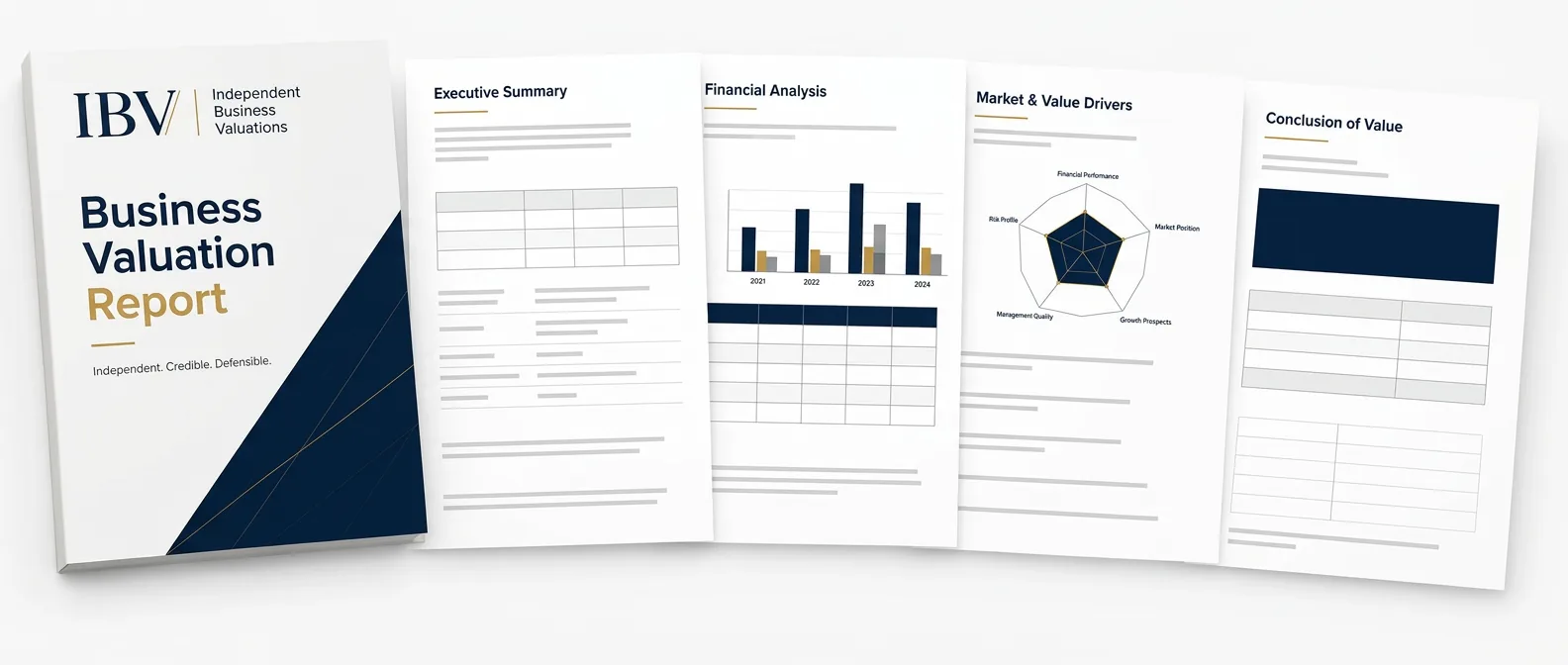
A clear, independent view of value — with the evidence behind it.
- Understand the conclusion — and what drives value.
- Gain an independent perspective. Move forward with confidence.
- Benchmark your business against industry performance.
- Identify strengths, risks and opportunities through SWOT analysis.
WHAT YOU GET IN A LIMITED SCOPE VALUATION REPORT
Inside your IBV™ report
Executive Summary
Conclusion of value · Method selected · Valuer qualifications
Detailed Report
Maintainable earnings · Cap rate / multiple · Premise of value
The Evidence Pack
SWOT analysis · Top Performers Report · RAVDA score
APES 225 voluntarily aligned. Report depth and supporting analysis follow your agreed package and engagement scope.
Free Valuation CallWhat to send with your first enquiry
Explain the decision you need to make, what is being valued and the date at which value is required. Identify anyone else who needs to use the report, and attach their instructions if you have permission to share them. Mention any transaction agreement, shareholder provision or adviser’s requirement that affects the valuation question.
Give a short outline of the business and the records available: financial statements, recent management accounts, ownership details and material contracts are useful starting points. You do not need to choose a method or package yourself. The valuer should discuss the evidence and suitable scope with you.
For IBV, scope, permitted reliance, the Fixed Professional Fee and timing are agreed in writing before work begins. The IBV™ Independence Guarantee sits alongside engagement-specific conflict assessment; it does not replace it. IBV does not accept expert-witness or court-appointed valuation work. Private negotiations and other permitted uses must still be defined in the engagement.
Frequently asked questions
Is Chartered Business Valuator a real qualification?
Yes. It is the designation issued by Canada’s CBV Institute. Its published admission pathway includes professional studies, an examination and practical valuation experience. Verify the individual’s current standing with the issuing body.
Is “chartered business valuer” the same title?
The Canadian designation is Chartered Business Valuator. Someone using a similar phrase should identify their precise qualification and issuer. Do not infer a credential from a spelling variation.
Does IBV employ a Canadian Chartered Business Valuator?
IBV presents Dr Patrick Hillenbrand as an AVI Certified Business Valuer, not as a holder of Canada’s Chartered Business Valuator designation. If your instructions specifically require a Canadian CBV, confirm that requirement before commissioning work.
Are all people using the initials CBV qualified by the same body?
No. The full designation and issuer must be checked. Chartered Business Valuator from CBV Institute and Certified Business Valuer from AVI are distinct qualifications; matching initials do not establish equivalence.
Must an Australian business valuer be a Chartered Accountant?
Chartered Accountant status is not a universal requirement for business valuations generally. Relevant valuation qualifications, experience and purpose-specific requirements matter. An accountant may also be an experienced valuer, but the accounting title alone does not establish that experience.
Will a Canadian CBV report automatically satisfy the ATO?
No credential guarantees acceptance. The report needs an appropriate valuation process, evidence, subject and date for the Australian tax question. Your tax adviser should confirm the required instructions and tax treatment.
Can I give a report prepared for my planning to a bank?
Do not assume the bank can rely on it. Ask what the bank requires and agree intended users and reliance before commissioning. IBV’s Calculated Value offering is for your own planning, not third-party reliance.
Is APES 225 the same as a valuation qualification?
No. APES 225 is a professional standard for valuation services, not a designation or licence. Ask both which qualifications the valuer holds and which framework the engagement follows.
Can a qualified valuer guarantee my business will sell for the valuation amount?
No. A valuation is a conclusion on a defined basis at a stated date, not a guaranteed transaction outcome. Negotiation, due diligence, financing and deal terms can affect the eventual price.
What if my adviser specifically requests a Chartered Business Valuator?
Ask whether they mean a Canadian CBV specifically or an appropriately qualified business valuer generally. Obtain the recipient’s requirements in writing and resolve suitability before work begins; do not substitute another credential without their agreement.
Sources and further reading
This article distinguishes professional designations; it does not claim equivalence between them or endorse an individual Canadian practitioner. Check current membership and recipient requirements directly before engaging a professional.