

Key takeaways
A credential is only as strong as its issuer
Certified Business Valuer is a professional designation, not a government licence. Ask which body issued it, check that body’s register directly and ask what the assessment covered before you rely on the title.
Australia has no universal licence for business valuers
Anyone can use the title, so verification sits with you. The designation, the issuing body and the valuer’s experience with your purpose are the checks that matter.
Certification does not guarantee acceptance
Whether the ATO, a buyer, a lender or another party accepts a valuation depends on the agreed purpose, basis, scope and their own requirements. A credential supports confidence in the author; it is not an acceptance guarantee.
Independence is a separate test from certification
A designation says nothing about fee arrangements or interests in the outcome. IBV’s Independence Guarantee—no commissions, no hourly billing, no fee linked to the value—sits alongside engagement-specific conflict checks.
Choose the engagement by purpose, not by the valuer’s title
IBV’s Calculated Value is restricted to your own preliminary planning; tax, ownership changes and related-party transfers require at least Limited Scope. Confirm purpose, users, fixed fee and limitations before signing.
What “certified” actually means for your valuation
Australia has no universal government licence for business valuers. Unlike a registered land valuer or a tax agent, a business valuer does not need a statutory registration to practise. That means the title alone tells you very little—and the credential behind it tells you a great deal.
A Certified Business Valuer is a professional designation issued by a professional body, not a government regulator. Dr Patrick Hillenbrand holds the Certified Business Valuer designation issued by the Australian Valuers Institute. The designation signals that the holder’s training, experience and work have been assessed against that body’s requirements. It is not a government licence, and it is not a claim of CPA or Chartered Accountant status.
The practical point: a designation is only as meaningful as the body that issued it and the assessment behind it. When someone describes themselves as certified, the useful questions are who certified them, what was assessed, and whether their experience covers your kind of business and your kind of purpose.
Why the credential matters most when the number is challenged
If you are simply curious about value, almost any figure might satisfy you. The credential becomes important when someone else examines the number: the ATO reviewing a market value, a former spouse’s lawyer testing a property settlement figure, a co-owner disputing a buyout price, or a lender reading the report before advancing funds.
In those situations, the report’s author is part of the evidence. A documented designation from an identifiable professional body gives the reader a starting point: they can see who stands behind the analysis and check the credential themselves. An anonymous or unverifiable “specialist” invites the opposite reaction.
A credential does not guarantee that any recipient will accept a valuation. Acceptance depends on the agreed purpose, basis, scope and the recipient’s own requirements. What the credential does is show that the valuer has submitted their competence to independent assessment—and remains accountable to a body that can withdraw the designation.
How to verify any business valuer before you engage them
Five checks, each taking minutes:
Our guide to who can value a business in Australia walks through these checks in more detail, and the business valuation specialist article explains when specialist involvement is worth commissioning.
Name the issuer. Ask which organisation issued the designation, then check that organisation’s register or membership directory directly. A genuine credential has an identifiable issuer you can contact.
Ask what was assessed. Training only, or experience and work samples as well? The answer tells you whether the designation measures study or practice.
Match experience to your purpose. A valuer experienced in sale preparation may rarely handle tax-valuation evidence. Ask about their experience with your type of engagement, without expecting confidential client details.
Test independence. Ask how the fee is set and whether the valuer has any interest in the outcome, the transaction or the parties. A fee linked to the value concluded is a warning sign.
Ask what the report will contain. A genuine valuation report identifies the interest valued, the date, the basis, the methods, the assumptions and the limitations—and names who may rely on it.

Signed
A clear valuation conclusion starts with an agreed purpose, relevant evidence and disclosed assumptions. The report identifies the interest valued and explains the reasoning behind its conclusion.
What a Certified Business Valuer does that a calculator cannot
Online calculators and rules of thumb multiply a profit figure by a number. A certified valuer’s work starts earlier and finishes later:
Defining the question. What exactly is being valued—the operating business, company shares, a partnership interest? At what date, on what basis, for whose use? A precise answer to the wrong question is still wrong.
Testing the earnings. Reported profit is a starting point. Owner remuneration, related-party rent, one-off items and the cost of replacing the owner’s work all need evidence and commercial explanation before earnings can be called maintainable.
Choosing and explaining the method. There is no universal multiple. The method must fit the business, the purpose and the available evidence, and the report must explain why.
Documenting the reasoning. The signed report shows its work: evidence, assumptions, limitations and the path from information to conclusion. That is what allows an adviser, a buyer or a reviewer to follow—and test—the number.
Certified Business Valuer, accountant or broker: who does what?
These roles complement each other, and confusing them is expensive. Your accountant prepares records and advises on tax within their qualifications. A business broker helps bring a business to market and may offer a price opinion for listing purposes—which is not a valuation. A Certified Business Valuer provides a defined, evidence-based conclusion of value for a stated purpose.
Patrick is presented as an AVI Certified Business Valuer, not as a CPA or Chartered Accountant. Your accountant remains your tax and financial adviser while IBV™ undertakes the separately agreed valuation. Our business valuation accountant page explains how the two roles work together, and the valuer or accountant comparison covers the distinction in depth.
Scope, fees and timing for your valuation
IBV™ offers three signed engagements, each with a Fixed Professional Fee confirmed in writing before work begins. All fees are + GST, and payment is due on signing:
Calculated Value and Limited Scope engagements are generally delivered within 5–7 business days after required information, clarifications, signed engagement documents and payment are received; Full Conclusion timing is agreed individually. The fee comparison sets the three side by side.
Every engagement carries the IBV™ Independence Guarantee: no commissions, no hourly billing and no fee linked to the value concluded. IBV™ voluntarily aligns its process and reporting with relevant APES 225 Valuation Services principles, without claiming membership-based obligations. IBV™ does not prepare estimates or appraisals, and does not accept expert-witness or court-appointed engagements.
Calculated Value: $2,450 + GST—the minimum engagement fee. One agreed method applied to your records, restricted to your own preliminary planning.
Limited Scope Conclusion of Value: $4,950 + GST. The most common engagement, with the scope and any material restrictions agreed in writing.
Full Conclusion of Value: quoted on instructions, with an indicated range of $6,950–$14,950 + GST. IBV™’s most comprehensive engagement for complex or high-value matters.
Sources and further reading
Frequently asked questions
What is a Certified Business Valuer?
A Certified Business Valuer is a professional designation issued by a professional body, signalling that the holder’s training, experience and work have been assessed against that body’s requirements. Dr Patrick Hillenbrand’s designation is issued by the Australian Valuers Institute. It is not a government licence or a claim of CPA or Chartered Accountant status.
Is a Certified Business Valuer licensed by the government in Australia?
No. Australia has no universal government licence for business valuers, unlike registered land valuers or registered tax agents. Business-valuation designations are issued by professional bodies, so the useful check is which body issued the credential and what it assessed. Confirm any purpose-specific requirements with your advisers before engaging anyone.
How do I verify a business valuer’s certification?
Ask which organisation issued the designation and check that body’s register or membership directory directly. Ask what was assessed—training only, or experience and work samples—and whether the valuer’s experience covers your purpose and industry. A genuine credential has an identifiable issuer you can contact.
Does a certified valuer guarantee the ATO, a buyer or a court will accept the valuation?
No. Acceptance depends on the agreed purpose, basis, scope and the recipient’s own requirements, which should be identified before engagement. A credential shows the valuer’s competence has been independently assessed; it does not guarantee any recipient’s acceptance. IBV does not accept expert-witness or court-appointed engagements.
Is a Certified Business Valuer the same as a CPA or Chartered Accountant?
No. They are different credentials from different bodies. Patrick is presented as an AVI Certified Business Valuer, not as a CPA or Chartered Accountant. Your accountant can remain your tax and financial adviser while IBV undertakes the separately agreed valuation.
How does IBV’s voluntary APES 225 alignment relate to certification?
APES 225 is a valuation-services standard issued by the Accounting Professional & Ethical Standards Board that applies to relevant members of the accounting bodies that have adopted it. IBV voluntarily aligns its process and reporting with relevant APES 225 principles; that voluntary alignment is distinct from membership-based mandatory obligations and from the AVI certification itself.
Source: APESB — APES 225 Valuation Services, the standard IBV voluntarily aligns with
When should I insist on a Certified Business Valuer?
Whenever the number will be examined by someone else: an ATO market-value review, family law negotiations, a shareholder or partnership buyout, a related-party transfer or a lender’s assessment. In those situations the report’s author is part of the evidence, and a verifiable designation gives the reader a starting point for trusting the analysis.
How much does a Certified Business Valuer cost at IBV?
Calculated Value has a Fixed Professional Fee of $2,450 + GST, the minimum engagement fee, and is for your own preliminary planning only. Limited Scope Conclusion of Value is $4,950 + GST. Full Conclusion is quoted on instructions, with an indicated range of $6,950–$14,950 + GST. Purpose and permitted reliance determine suitability, not turnover; payment is due on signing.
Can a Certified Business Valuer act as an expert witness or accept a court appointment?
IBV does not accept expert-witness or court-appointed engagements. IBV provides ATO valuations, valuation review support and valuations for private shareholder negotiations, and family law work is limited to non-litigious negotiations, voluntary mediation and settlement planning, subject to agreed users and restrictions.
How do I engage IBV, and how long does the valuation take?
Start with a confidential call about the business, the purpose, the valuation date, intended users and available records. IBV agrees the scope and Fixed Professional Fee in writing before work begins. Calculated Value and Limited Scope generally take 5–7 business days after required information, clarifications, signed documents and payment are received; Full Conclusion timing is agreed individually.
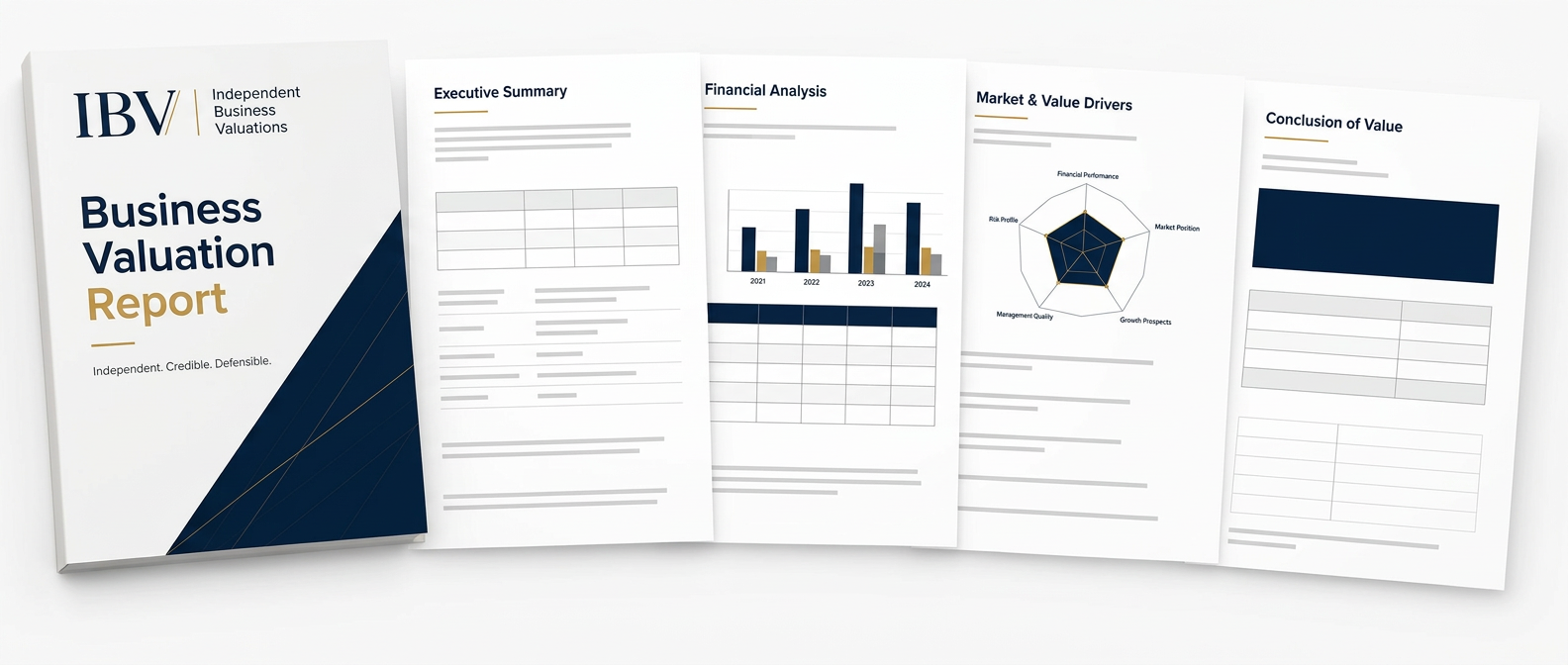
A clear, independent view of value — with the evidence behind it.
- Understand the conclusion — and what drives value.
- Gain an independent perspective. Move forward with confidence.
- Benchmark your business against industry performance.
- Identify strengths, risks and opportunities through SWOT analysis.
WHAT YOU GET IN A LIMITED SCOPE VALUATION REPORT
Inside your IBV™ report
Executive Summary
Conclusion of value · Method selected · Valuer qualifications
Detailed Report
Maintainable earnings · Cap rate / multiple · Premise of value
The Evidence Pack
SWOT analysis · Top Performers Report · RAVDA score
APES 225 voluntarily aligned. Report depth and supporting analysis follow your agreed package and engagement scope.
Free Valuation Call