
Start with the decision, not the professional title
There is no universal government licence for business valuers in Australia. Particular statutory purposes may impose specific qualification or eligibility requirements. This makes it particularly important to verify a valuer’s credentials, relevant experience, independence and the scope of the report before engaging them.
Before comparing business valuers, write down what needs to be valued, why, and at what date. A whole-business sale, a minority-share transfer, a partner buyout and a retrospective tax matter can require different evidence and instructions. The same business may need different work for each purpose. Ask your accountant or lawyer what the intended recipient needs, rather than assuming any document labelled a valuation will be suitable.
Identify the interest being assessed: business assets, shares, units or another ownership interest. Clarify whether property is included and whether another specialist is needed. Give prospective valuers the same outline so their proposed engagements can be compared fairly. A cheaper quote for a narrower task is not necessarily a like-for-like alternative.
Check credentials and the person doing the work
Ask who will undertake the analysis, who will sign the report and who will explain the conclusion. A firm's profile is useful background, but you also need to understand the competence of the person responsible for your engagement. Request details of valuation training, professional credentials and relevant experience. Verify claimed credentials with the issuing professional body where verification is available; do not rely solely on a badge in a proposal.
A qualification is evidence to investigate, not an automatic guarantee of suitability for every matter. Ask how the valuer keeps their knowledge current and how they handle questions beyond their expertise. Business valuation, real-property valuation and specialist asset work should not be treated as interchangeable just because they all produce monetary values. If you are deciding whether your accountant or an independent specialist should value the business, read Business valuation accountant or independent valuer?.
At IBV™, Dr Patrick Hillenbrand is an AVI Certified Business Valuer, a designation issued by the Australian Valuers Institute, with more than 25 years of commercial experience. He scopes the engagement, assesses the evidence and signs the report. See About IBV™ for the practice's approach and credentials, and confirm the proposed scope against your particular purpose before proceeding.
Look for experience relevant to your business
Relevant experience means understanding the economics of the business model and the decision being supported. Ask how the valuer would investigate recurring earnings, owner involvement, customer concentration, working capital and the transferability of contracts or goodwill. The useful answer describes an evidence-gathering approach, rather than promising an attractive multiple before reviewing the records.
For example, an owner-led professional practice may require careful consideration of replacement labour and client retention. A multi-site retailer may require outlet-level analysis rather than reliance on consolidated profit. These are illustrations of the questions to explore, not claims that every business in a sector should be valued the same way.
Ask for an explanation of a comparable type of engagement without requesting confidential client reports or financial figures. Our industry guidance explains business-model considerations, while valuation services help distinguish the purpose of the work.

Signed
A clear valuation conclusion starts with an agreed purpose, relevant evidence and disclosed assumptions. The report identifies the interest valued and explains the reasoning behind its conclusion.
Examine independence and potential conflicts
Ask about existing advisory relationships, ownership interests, referral arrangements and any financial interest in a sale or concluded value. Disclose your own relationships and the parties involved so potential conflicts can be considered before instructions are accepted. Familiarity with the business and independence are separate questions: someone who knows the accounts well may still need to explain how their role fits the required engagement.
A business broker may help with a transaction, and an accountant may help prepare or interpret records. Those roles do not, by themselves, establish that a proposed report meets the independence and scope requirements of your matter. Ask your adviser whether an independent valuation opinion is needed and what relationships should be documented.
The IBV™ Independence Guarantee means we do not buy, sell or broker businesses, earn commissions or link our fee to the concluded value. That explains our commercial position; it does not replace a matter-specific conflict assessment or guarantee acceptance by a recipient.
Understand what APES 225 alignment means
Ask the provider which professional framework they apply and how it affects the engagement and report. APES 225 Valuation Services is a relevant reference when discussing voluntary alignment in valuation engagements. Read the applicable standard and discuss its relevance with your adviser rather than treating a standards reference as a promise of a particular outcome.
IBV™ voluntarily aligns its valuation processes and reporting with relevant principles of APES 225 Valuation Services. APES 225 imposes mandatory obligations on members of the professional accounting bodies that have adopted the standard; IBV’s alignment does not represent a claim of membership-based obligations or universal compliance with every requirement. These bodies include CPA Australia, Chartered Accountants Australia and New Zealand, and the Institute of Public Accountants. Professional credentials, the framework followed and the actual scope of work are distinct matters worth checking.
Compare the written scope and fee
The engagement should identify the subject, purpose, valuation date, intended users, work to be performed and limits on reliance. Ask which records are needed, how missing information will be addressed, which assumptions may be necessary and whether separate specialists are included. Confirm what happens if the instructions change or additional work becomes necessary.
Compare the proposed analysis and report, not just the headline price. Does the scope include financial reconciliation, explanation of the selected methodology and consideration of relevant risks? Is follow-up clarification included, and what would require a separate agreement? Ask for exclusions in writing so a lower initial fee does not conceal a materially narrower task.
IBV™ agrees a Fixed Professional Fee before work begins. Review the fee and engagement guidance and request a written scope for your situation. The fee is not linked to the value concluded. A fixed fee alone does not establish independence or valuation quality; assess conflicts, competence and the actual work proposed.
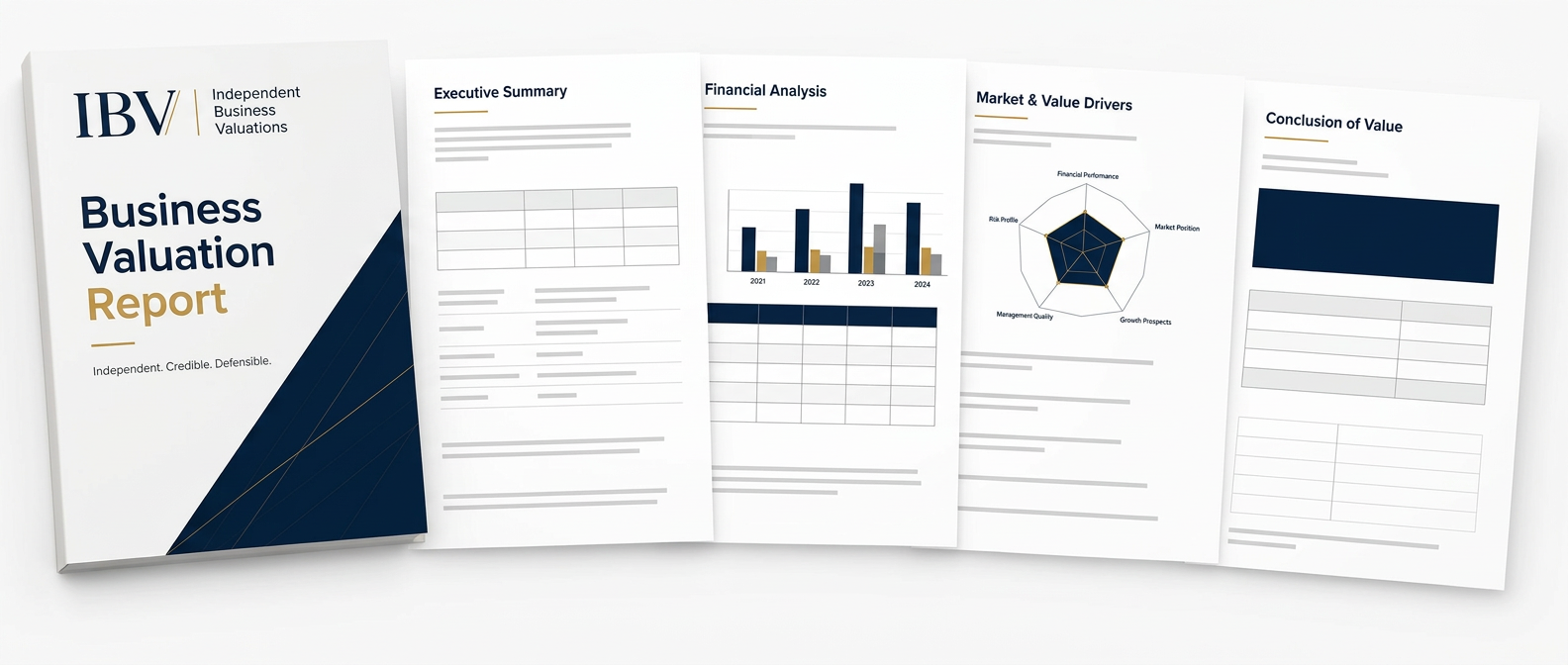
A clear, independent view of value — with the evidence behind it.
- Understand the conclusion — and what drives value.
- Gain an independent perspective. Move forward with confidence.
- Benchmark your business against industry performance.
- Identify strengths, risks and opportunities through SWOT analysis.
WHAT YOU GET IN A LIMITED SCOPE VALUATION REPORT
Inside your IBV™ report
Executive Summary
Conclusion of value · Method selected · Valuer qualifications
Detailed Report
Maintainable earnings · Cap rate / multiple · Premise of value
The Evidence Pack
SWOT analysis · Top Performers Report · RAVDA score
APES 225 voluntarily aligned. Report depth and supporting analysis follow your agreed package and engagement scope.
Free Valuation CallAsk what the report will explain
A useful report should allow its intended reader to follow the reasoning from the records to the conclusion. Ask how the valuer will describe the business interest, reconcile financial information, explain methodology and disclose assumptions and limitations. A number without that reasoning can be difficult for an adviser or another intended user to assess.
Clarify who can rely on the report and for which purpose. A report prepared for one decision should not automatically be reused for a different date, ownership interest or recipient. No business valuer can guarantee an ATO response, court acceptance, sale price or transaction outcome simply by issuing a report.
The illustrated report is representative of the applicable engagement inclusions, not a promise that every engagement includes every supporting report. RAVDA (Risk and Value Driver Assessment) is included with all three IBV engagement types. Your Industry Top Performers Report and SWOT Analysis Report are included with Limited Scope and Full Conclusion engagements, not Calculated Value. Confirm the agreed scope in writing.
Questions to ask before engaging a business valuer
Use these questions in your initial conversation and check the answers against the written proposal:
Who will analyse the evidence, sign the report and answer follow-up questions?
Which credentials can I verify, and what experience is relevant to this business and purpose?
What relationships or potential conflicts need to be disclosed?
Which business interest and valuation date will the report address?
What records, financial adjustments and operating evidence will be considered?
Which methodology decisions and limitations will the report explain?
Who may rely on the report, and for what purpose?
What is included in the fee, what is excluded, and how are changes agreed?
When does the delivery period start, and what could delay it?
Take the next step with clear instructions
Prepare a short outline of the business, ownership interest, purpose and required date, together with any deadline. For legal, tax or regulatory use, ask your adviser to review the proposed scope before you commit. A brief preparation discussion can identify whether more information or another specialist is needed.
Discuss your engagement with IBV™ or request a Free Valuation Call. Calculated Value and Limited Scope delivery is generally 5–7 business days after complete information, required clarifications, signed engagement documents and payment are received. Complex engagements may take longer. Full Conclusion timing is agreed at engagement; timing is confirmed before work begins.
References
Frequently asked questions
Do business valuers need to be licensed in Australia?
Australia does not have a single government licensing or registration system for business valuers generally. However, particular statutory purposes may impose specific qualification or eligibility requirements. Check the valuer's professional credentials, relevant experience and methodology, and confirm any special requirements with your legal or taxation adviser.
What qualifications should I look for in a business valuer?
Look for relevant valuation qualifications, recognised professional credentials and demonstrated experience with businesses similar to yours. Ask who will personally undertake the analysis and sign the report. The Australian Valuers Institute offers the Certified Business Valuer (CBV) designation, which can be verified with the issuing organisation.
Does a business valuer need to be a CPA or Chartered Accountant?
Not necessarily. Accounting qualifications can be valuable, but a CPA or Chartered Accountant designation is not a universal requirement for valuing Australian businesses. The important considerations are valuation competence, commercial experience, independence, appropriate methodology and the requirements of the particular engagement.
What is the difference between a business valuation and a business broker's appraisal?
A broker's appraisal commonly helps an owner assess a potential selling price and marketing strategy. A business valuation is prepared for a defined subject, purpose, valuation date and scope, with supporting analysis and documented assumptions. The distinction depends on the actual work and report, not simply whether the provider is called a broker, accountant or valuer.
Can my existing accountant value my business?
Potentially, if the accountant has appropriate valuation competence and the engagement permits that relationship. However, independence or conflict considerations may make a separate valuer preferable or necessary. Ask whether your accountant's existing advisory role affects the intended purpose or recipient requirements.
How can I tell whether a business valuer is independent?
Ask whether the valuer has any ownership interest in the business, existing relationships with the parties, involvement in a proposed sale or fees contingent on the valuation outcome. Potential conflicts should be disclosed and assessed before engagement. IBV's Independence Guarantee includes no business brokerage activity, sale commissions or fees linked to the concluded value.
What is APES 225, and should my valuer follow it?
APES 225 Valuation Services is an Australian professional standard addressing valuation engagements, calculation engagements, documentation and reporting. It is mandatory for relevant members of professional accounting bodies that have adopted it. Other valuers may voluntarily align with its relevant principles. Ask how the valuer applies the framework and what the agreed report will contain.
Which type of business valuation report do I need?
The appropriate engagement depends on your purpose and intended users, not turnover. IBV’s Calculated Value is for your own preliminary planning, not third-party reliance or ATO, family law or shareholder matters. A Limited Scope or Full Conclusion of Value may be appropriate where a documented valuation conclusion is required. Agreed restrictions on procedures or evidence can affect suitability and the result; a more extensive engagement may produce a different result, and disclosure cannot cure unsupported analysis. For tax, legal or financing purposes, confirm the recipient’s requirements before choosing the scope.
What should a professional business valuation report include?
A useful report identifies the business or ownership interest, valuation date, basis of value, evidence, methodology, adjustments, material assumptions, limitations and conclusion. It should explain how the valuer reached the result and identify who may rely on it. The level of detail depends on the engagement and its agreed scope.
Will the ATO, a bank or my solicitor accept the valuation?
Acceptance is not automatic. The ATO assesses tax valuations in light of relevant legislation, evidence and valuation methodology, while lenders and other recipients may impose their own requirements. Tell the valuer who will use the report and why before commissioning it. IBV does not undertake expert-witness or court-appointed valuation engagements.
How much does a business valuation cost, and how long does it take?
Fees depend on purpose, permitted reliance, complexity and reporting scope—not turnover alone. IBV agrees a Fixed Professional Fee in writing: Calculated Value $2,450 + GST (minimum engagement), Limited Scope Conclusion of Value $4,950 + GST, and Full Conclusion quoted on instructions. Payment is due on signing. Calculated Value and Limited Scope delivery is generally 5–7 business days after complete information, required clarifications, signed engagement documents and payment are received. Complex engagements may take longer; Full Conclusion timing is agreed at engagement. Timing is confirmed before work begins.
What information should I prepare before contacting a business valuer?
Start with the business name and structure, the ownership interest being valued, the purpose, relevant valuation date and intended report users. Financial statements, current management accounts, major contracts, debt and asset details, and information about the owner's responsibilities will help establish the scope. Sensitive material can be provided through the agreed engagement process.