
Key takeaways
Map who owns and uses each farm component
The family farm may combine separately owned land, water rights, livestock, machinery and trading activities, so one label can conceal several different interests. Prepare an ownership and use schedule, and agree which qualified specialists value each component rather than assuming the operating business assessment also establishes land or water values.
Match business earnings to the assumed asset access
A successor who leases land or machinery faces different operating costs from one who owns those assets, so the earnings assessment must match the proposed arrangement. Ask for a component reconciliation showing rent and access assumptions, avoiding an earnings value that retains free occupation while separately adding the property value.
Explain seasonal profits alongside production and replacement needs
A strong season or simple profit average may hide changes in production, prices, costs or scale, while delayed machinery replacement can temporarily flatter cash. Review production records, inventory movements and reinvestment needs together, asking why the chosen earnings period represents ongoing capacity rather than automatically applying a general climate adjustment.
Make family work and accommodation costs clearly visible
Unpaid family work and housing benefits can make reported costs lower than the resources an independently staffed farm would need. Record roles, workloads and benefits, then compare supported replacement arrangements and any continuing family assistance without assuming relatives must provide support or that informal promises are legally enforceable obligations.
Separate farm asset wealth from succession payment capacity
Valuable land and other assets do not necessarily generate enough operating cash for family payments, debt and reinvestment, so value and affordability answer different questions. Compare component valuations with separately labelled cash flow scenarios, leaving allocation, finance, tax and legal decisions to the family and advisers rather than adjusting value to fit payments.
Define the family’s valuation subjects
Farm succession can involve operating assets, land, water interests, livestock, equipment and ownership interests held in different entities. Begin with a clear asset and ownership map. The business valuation scope should identify which components it addresses and which need appropriately qualified specialists, rather than implying that every agricultural asset is covered by a single enterprise assessment.
Understand the operating record
Provide accounts, production and sales information, lease arrangements, funding schedules and details of family labour. Seasonal variation and unusual conditions may make a single trading period unrepresentative. Explain how assets are used across entities and which costs are borne outside the operating business, so recorded earnings can be interpreted in the context of the actual farming arrangement.
Separate enterprise returns from asset ownership
The assessment may need to consider commercial rent, replacement labour and working capital where family arrangements differ from independent terms. Specialist asset values should not be duplicated within an earnings-based business conclusion. Assumptions about continued access to land, water or equipment must be explicit, particularly where the proposed succession changes who owns or controls those inputs.

Signed
A clear valuation conclusion starts with an agreed purpose, relevant evidence and disclosed assumptions. The report identifies the interest valued and explains the reasoning behind its conclusion.
Provide an intelligible component schedule
The report should explain the operating business assessment and how separately supplied asset evidence has been used. A component schedule can help advisers distinguish enterprise value from land or other property, subject to each report’s reliance terms. Planning scenarios should be clearly labelled and should not imply that a valuation determines how family members ought to share assets or responsibilities.
Coordinate succession advice
Legal ownership, tax consequences, finance and family agreements need separate advice. The valuation does not establish rollover relief, resolve beneficiary entitlements or replace specialist agricultural property work. Broader estate and succession valuation or business and property coordination may be relevant, with scope determined by the assets and decision rather than the family’s preferred distribution outcome.
Map the operating perimeter before comparing family options
Prepare a schedule showing who owns and who uses each material input: land, irrigation rights, livestock, machinery, infrastructure and trading stock. Include leasing and finance arrangements and identify assets shared with another enterprise. A family description such as the farm can conceal several entities and legally separate interests that should not be treated as one transferable asset.
Distinguish the operating business assessment from specialist land, water, livestock or plant work. Confirm which qualified specialist addresses each component and how their evidence may be relied upon. The business valuer should explain the integration of those inputs, not imply that an operating earnings assessment establishes agricultural land value or replaces specialist inspection and analysis of assets outside the agreed expertise.
Rebuild operating returns on a consistent access basis
Decide whether the successor is assumed to own the land, lease it or operate under another documented arrangement. Then assess business earnings consistently with that assumption. An operating business that pays commercial rent has a different cost structure from consolidated farm accounts that include land ownership but no rental expense. Mixing the two can overstate the return available from the trading activity.
The same principle applies to machinery and water access. If specialist assets are valued separately, explain which costs remain within the business forecast and which returns relate to those assets. Check for double counting where land value is added to an earnings conclusion that still includes the benefit of rent free occupation. Advisers need a component reconciliation, not simply several valuations added together without testing their assumptions.
Analyse production cycles rather than smoothing everything away
Use production volumes, realised prices, input costs and seasonal working capital to explain earnings variation. Separate weather effects from changes in stocking rates, crop mix, enterprise scale or management. A simple average can hide a structural change, while selecting a favourable recent season can overstate sustainable returns. Support the selected period with an explanation of what it represents.
Review maintenance and replacement needs alongside profit. Deferring machinery replacement may temporarily improve cash without increasing long term earning capacity. Likewise, livestock and grain movements need reconciliation so changing inventory is not mistaken for freely available cash. Agriculture Victoria's Farm Business Resilience Program identifies farm finances, risk management, workforce planning and climate adaptation as practical business planning areas. Those themes support investigation of resilience, not a mechanical climate discount. 1
Make family labour and accommodation visible
Record unpaid or underpaid family work by role, workload and season. Assess credible replacement arrangements rather than applying one generic wage adjustment. Housing, utilities and other benefits may also form part of the labour arrangement. Explain their treatment consistently so a cost is not both removed as private expenditure and omitted from a necessary employee package.
Where the retiring generation will continue providing labour or receiving accommodation, identify the planning assumption separately. A transition dependent on ongoing unpaid support is economically different from an independently staffed business. The valuation can show that difference without deciding whether a family member should provide the support or whether an informal promise is legally enforceable. Those questions require family discussion and appropriate legal advice.
Compare asset wealth with the capacity to support succession
A valuable property portfolio does not necessarily produce enough operating cash to fund family payments, debt service and reinvestment. Present the assessed components alongside a separately labelled cash flow scenario prepared on explicit assumptions. Do not reduce an asset's value merely to make a proposed sibling payment affordable, or treat borrowing capacity as a valuation method.
Business Queensland's succession guidance stresses a documented transfer plan and successor preparation. 2 Use the component values to inform that discussion while leaving distribution decisions, finance approval, tax relief and legal arrangements to the family and advisers. A coherent succession comparison explains ownership, operating access, risk and funding separately rather than promising that one headline farm value resolves all four.
Scope, fees and timing
See our fixed-fee valuation packages and confirm the scope and fee before commissioning work. Confirm the purpose, intended users, information requirements and inclusions in a written engagement before work begins. Calculated Value and Limited Scope delivery is 5–7 business days from complete financial information and a signed engagement. Full Conclusion timing is confirmed individually in the engagement letter. Specialist requirements or changes to the instruction may affect suitability and timing; confirm these before relying on an external deadline.
Sources and further reading
Frequently asked questions
Does a farm succession valuation include the land as well as the business?
The scope must say what is included. The operating enterprise, land, water rights, livestock and machinery may need different evidence or specialists. Identify legal owners and retained assets before commissioning work, so an operating business conclusion is not mistaken for a complete valuation of every asset used on the farm.
How do you separate farm trading income from land ownership returns?
We need to understand who owns the land, what the operating entity pays and the arrangements expected after succession. Sustainable trading earnings can differ from accounts prepared around family ownership. Any rent or other adjustment needs evidence, while separate land value should not be added in a way that duplicates economic benefits.
Can one drought year determine the farm business value?
A single difficult season may not represent sustainable performance, but it cannot simply be ignored. Provide several years of results, production records and evidence of current conditions. The analysis should consider weather exposure, prices and operating capacity at the instructed date rather than assuming either immediate recovery or permanent decline without support.
Source: Agriculture Victoria — Farm Business Resilience Program
What farm records are useful beyond the tax accounts?
Production history, stock and crop records, debt schedules, leases, water arrangements and capital expenditure plans can help explain the business. Identify unpaid family labour and assets held in separate entities. These records help distinguish accounting profit from the earnings and resources needed to continue the enterprise after the proposed handover.
Source: Agriculture Victoria — Farm Business Resilience Program
Which date should we choose for a staged family farm transfer?
Map the proposed stages with your legal and tax advisers first. Different transfers may need different dates, especially where ownership, debt or assets change between stages. A current planning value can inform discussions, but it should not automatically be reused as evidence for a later legally significant transfer.
Can the valuation decide what is fair for farming and non-farming children?
No. It can establish evidence about specified assets or interests, but fairness, family commitments and estate distribution involve decisions beyond valuation. A documented succession process can help families discuss competing needs. Legal advice and, where useful, facilitation should address entitlements and expectations rather than treating a valuation as the family’s settlement.
Source: Business Queensland — Passing a business to a successor
How is unpaid family labour treated when parents retire?
Explain who works in the enterprise, the hours and duties involved, and what remuneration is recorded. A successor may need paid replacements or different staffing arrangements. The valuation should consider supportable ongoing labour costs under the agreed operating assumptions, not assume that historical unpaid work will remain available indefinitely.
Does keeping the farm in the family guarantee tax or duty relief?
No. Family continuity is not a substitute for the specific requirements of any tax concession or state duty provision. Ask your accountant and solicitor to assess the actual steps and jurisdiction. The valuation can provide evidence about the instructed interests, but it does not determine eligibility or make a transfer automatically tax-free.
Can we compare keeping the farm together with transferring separate enterprises?
Separate scenarios can be scoped if the operating and ownership assumptions are clear. Shared machinery, labour, access and financing may affect each option differently. Use the comparison as planning evidence, not a guarantee of sale proceeds or viability, and coordinate it with legal, tax and broader farm business planning advice.
How do we begin when property and specialist assets are involved?
Prepare an ownership map and list of enterprises, land, water rights, livestock and equipment requiring assessment. Agree specialist coordination and a Fixed Professional Fee upfront. Standard business valuation delivery is 5–7 business days after complete records and a signed engagement; separate specialist work may affect the overall timetable. This 5–7 business-day timetable applies to Calculated Value and Limited Scope only; Full Conclusion delivery is confirmed individually in the engagement letter.
A clear, independent view of value — with the evidence behind it.
- Understand the conclusion — and what drives value.
- Gain an independent perspective. Move forward with confidence.
- Benchmark your business against industry performance.
- Identify strengths, risks and opportunities through SWOT analysis.
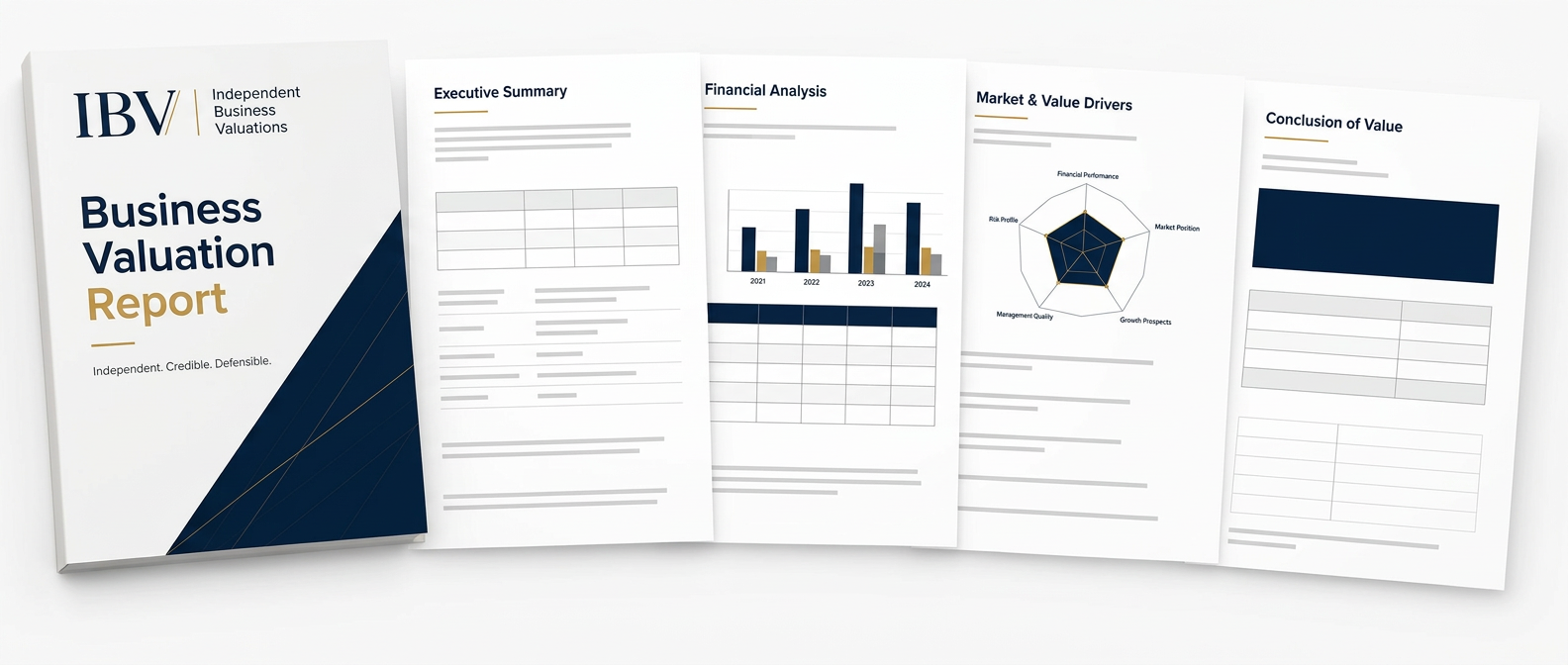
WHAT YOU GET IN A LIMITED SCOPE VALUATION REPORT
Inside your IBV™ report
Executive Summary
Conclusion of value · Method selected · Valuer qualifications
Detailed Report
Maintainable earnings · Cap rate / multiple · Premise of value
The Evidence Pack
SWOT analysis · Top Performers Report · RAVDA score
APES 225 voluntarily aligned. Report depth and supporting analysis follow your agreed package and engagement scope.
Free Valuation Call