
Key takeaways
Compare selling the property with becoming the landlord
Keeping the property while selling the business creates an ongoing investment, not simply a different way to receive the same sale proceeds. Compare separate business and property cash flows, including rent, repairs and landlord responsibilities, before deciding whether retention or a combined sale suits your position.
Use consistent rent across business and property assessments
Rent is a cost to the trading business and income to the property owner, so changing it shifts value between the two. Ask both specialists to use compatible rental and lease assumptions, rather than combining the most favourable rent assumption from each separate assessment.
Identify which valuation includes each fixture and asset
Fit-outs, fixtures and equipment can sit between the business and property assessments, creating a risk that the same item is counted twice. Map the assets with both valuers and record ownership and removal obligations, recognising that physical presence does not establish legal ownership.
Keep redevelopment value separate from incompatible trading assumptions
A property assessment based on redevelopment may assume the existing business leaves, while the business valuation assumes it keeps trading there. Present those alternatives separately and investigate any relocation, disruption or customer loss rather than adding values that cannot realistically be realised together.
Check transaction allocations with local tax and legal advisers
A commercial split between business and property values does not automatically determine transfer duty or other tax outcomes. Reconcile the proposed allocation with the actual transaction and seek relevant local advice, because guidance for one jurisdiction should not be treated as a national rule.
Identify the assets and specialists
An operating business and its premises are different valuation subjects, even when held by the same owner. Establish whether the instruction concerns the business, freehold property, leasehold rights or a combination. Property valuation requirements and the involvement of an appropriately qualified property valuer must be confirmed rather than assuming that a business valuation engagement automatically includes real estate advice.
Collect both sides of the record
Business accounts, lease documents, ownership records and property reports help establish how the operation uses the premises. Identify related-party rent, maintenance obligations and any assets included in both records. Proposed sale documents should describe what transfers, because a combined asking price may conceal materially different assumptions about land, buildings, equipment and the operating business.
Reconcile rent and operating earnings
When property is held outside the trading entity, the business assessment needs an explicit rental assumption. A market-based occupancy cost may differ from the amount recorded between related parties. The analysis should also identify whether plant, improvements or other assets are included in the property evidence, so their value is not inadvertently duplicated in the business conclusion.

Signed
A clear valuation conclusion starts with an agreed purpose, relevant evidence and disclosed assumptions. The report identifies the interest valued and explains the reasoning behind its conclusion.
Coordinate dates and assumptions
The business report can explain how external property evidence has been used and which specialist assumptions remain outside its scope. Where dates differ, the implications should be considered rather than concealed. A reconciliation should distinguish the business component from real estate and make clear whether any combined figure is simply a sum or reflects a different transaction premise.
Confirm reliance and responsibilities
Acceptance of a property report depends on its purpose, author and reliance terms. Lending, tax and transaction instructions can have different requirements. The business valuation should not imply certification of property title, building condition or environmental matters. For a financing instruction, discuss lending and security valuation and the proposed lender’s requirements before commissioning either component.
Compare ownership structures as different economic choices
An owner considering a combined sale should also understand the alternative of retaining the freehold and leasing it to a purchaser. These are not simply two ways of presenting the same price. Retention creates a landlord investment, continuing property exposure and a relationship with the incoming operator. A combined disposal removes that exposure but may narrow the buyer population to parties able to acquire both assets.
Prepare separate cash-flow views for the trading business and property owner before considering their combined position. Identify who pays repairs, insurance and major replacements under each scenario. Government sale guidance asks owners to decide what is being sold; for a property-backed operation, that decision should include whether future rent and landlord responsibilities remain with the seller. 1
Use rent as the connection between two valuations
A rental assumption transfers economic benefit between the operating business and the freehold interest. Lower rent can make the business appear more profitable while weakening the property's income stream. Higher rent can do the reverse. The combined analysis should use compatible assumptions rather than selecting whichever rent produces the highest value in each report.
For a hypothetical owner-occupied workshop, model a sustainable market rent in the business cash flow and the corresponding rental income in the property assessment, with each specialist addressing the relevant evidence. Compare lease terms as well as the annual amount. A rent supported only by unusually generous incentives or deferred maintenance obligations may not be equivalent to the same headline rent under a different lease. Document the bridge so a reader can see how occupancy costs connect the components.
Identify assets that sit on the boundary
Create a physical asset map showing land, buildings, fixtures, removable equipment and tenant improvements. Ask both valuers to mark which items their conclusions include. Specialised fit-outs can be particularly difficult: an installation may support business earnings, form part of the premises and carry limited resale value outside its current use. Those observations do not justify adding three separate values for the same item.
Record ownership and make-good obligations where equipment or improvements are leased or installed by another party. Physical presence does not establish legal ownership. For tax-related purposes, the ATO's market valuation guidance emphasises relevant, reliable information at the valuation date. 2 An asset map and consistent supporting records help explain the valuation perimeter without purporting to resolve title or classify every fixture legally.
Keep alternative property uses separate from trading assumptions
A valuable redevelopment opportunity may conflict with continued operation of the existing business. Do not combine a property value premised on vacant redevelopment with business cash flows premised on uninterrupted occupation unless the combined scenario genuinely supports both. Ask the property specialist to identify the assumed use, occupation status and necessary approvals behind the property conclusion.
Consider a hypothetical roadside operation occupying land attractive for another use. A purchaser cannot necessarily realise the full alternative-use property value while preserving every dollar of existing goodwill. Relocation costs, customer loss and interruption may be relevant, but require evidence rather than a standard deduction. Present competing scenarios separately so the owner understands what must happen to realise each outcome.
Transaction allocations also need purpose-specific advice. Revenue NSW distinguishes land, certain goods and other business assets when explaining duty on business sales, including transactions involving separate agreements. 3 That guidance is jurisdiction-specific, not a national allocation rule. A commercial division between business and property values should therefore be reconciled with the actual transaction and reviewed by the relevant tax and legal advisers, rather than treated as automatically determining duty or other tax consequences.
Scope, fees and timing
See our fixed-fee valuation packages and confirm the scope and fee before commissioning work. Confirm the purpose, intended users, information requirements and inclusions in a written engagement before work begins. Calculated Value and Limited Scope delivery is 5–7 business days from complete financial information and a signed engagement. Full Conclusion timing is confirmed individually in the engagement letter. Specialist requirements or changes to the instruction may affect suitability and timing; confirm these before relying on an external deadline.
Sources and further reading
Frequently asked questions
Does one business valuation automatically include the freehold premises?
No. The operating business and the real estate are separate valuation subjects, even if they have the same owner. Confirm whether you need business value, property value or coordinated reporting for both. Any property valuation and the involvement of an appropriately qualified property valuer must be expressly scoped rather than assumed to be included.
How is rent treated when the business owns or uses family premises?
The operating assessment needs a clear occupancy assumption. Where actual rent is absent or differs from a commercial amount, sustainable earnings may need adjustment. Provide leases and related-party arrangements, supported by suitable property evidence where required. Otherwise a rent-free business could appear more profitable than a purchaser operating under normal occupancy costs.
What records do you need when the property is in a different entity?
Provide an ownership chart, business accounts, lease documents and details of inter-entity balances. Include existing property reports and explain who owns plant, improvements and other assets. The valuation scope should distinguish the operating entity from the property owner so cash flows and asset values are allocated consistently rather than combined simply because the owners are related.
How do you avoid counting equipment or improvements twice?
Reconcile the assets included in each valuation and identify the treatment of fixtures, fit-out, plant and leasehold improvements. A property report and business asset register may overlap. The combined analysis should explain exclusions and adjustments, rather than adding two headline figures without checking whether the same assets already contribute to both conclusions.
Must the business and property valuations use the same date?
Using a common date helps make the conclusions comparable, especially for a proposed combined transaction. If only an older property report is available, its suitability and any material market changes need consideration. The business report should disclose the source and date of external evidence, not present a mismatched figure as a current property valuation.
Can I simply add the business value to the property value?
Only after checking that the bases, dates, rental assumptions and asset inclusions are compatible. A sum may be useful, but it does not automatically establish the price of a combined sale. Transaction structure, costs and purchaser requirements can affect the result. The report should distinguish the separate components from any expressly scoped combined assessment.
What if the property's redevelopment potential conflicts with ongoing trading?
The property and operating business may rest on different use assumptions, so the figures cannot necessarily be combined without adjustment. Obtain specialist property advice about the relevant use and constraints. The business assessment should make its occupancy and continuity assumptions clear, particularly where redevelopment would require relocation, disruption or closure of the existing operation.
Can an existing property report be used in the business assessment?
Potentially, after checking its date, purpose, asset coverage and permitted reliance. A report prepared for another party or purpose may not be suitable without further instructions. Agree how external property evidence will be used and disclosed. Its inclusion does not mean IBV has independently certified the real estate conclusion or the underlying property assumptions.
Does coordinated valuation include building, title or environmental checks?
No, not unless separately arranged with appropriate specialists. Business and property values do not themselves establish sound building condition, clean title or absence of contamination. Those matters can materially affect a transaction and need suitable due diligence. Any reliance on supplied information or specialist reports should be identified in the agreed valuation scope.
How are fees and timing arranged when a property specialist is needed?
Start by identifying each asset, report user and required date so responsibilities and specialist costs can be agreed. IBV's Fixed Professional Fee is agreed upfront. Standard business valuation delivery is 5–7 business days after complete records and signed engagement; coordinated specialist work may need additional time. This 5–7 business-day timetable applies to Calculated Value and Limited Scope only; Full Conclusion delivery is confirmed individually in the engagement letter.

A clear, independent view of value — with the evidence behind it.
- Understand the conclusion — and what drives value.
- Gain an independent perspective. Move forward with confidence.
- Benchmark your business against industry performance.
- Identify strengths, risks and opportunities through SWOT analysis.
WHAT YOU GET IN A LIMITED SCOPE VALUATION REPORT
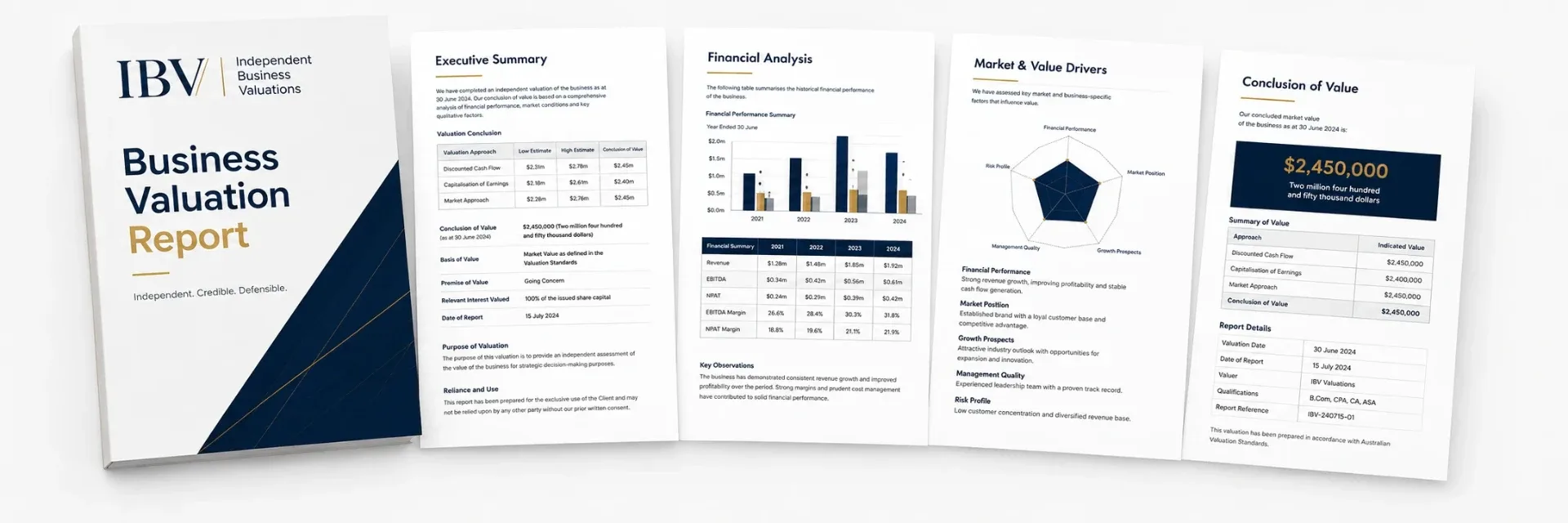
Inside your IBV™ report
Executive Summary
Conclusion of value · Method selected · Valuer qualifications
Detailed Report
Maintainable earnings · Cap rate / multiple · Premise of value
The Evidence Pack
SWOT analysis · Top Performers Report · RAVDA score
APES 225 voluntarily aligned. Report depth and supporting analysis follow your agreed package and engagement scope.
Free Valuation Call