

Key takeaways
Value agency fees, not rent collected.
Separate agency income from landlord money; reconcile AAMI definitions excluding GST and support multiples with comparable completed transactions.
Map service intensity.
Assess travel, inspections, maintenance and backlogs rather than property count alone.
Explain portfolio movement.
Track losses, additions and landlord concentration; distinguish market value from deferred or retention-adjusted sale consideration.
Separate trust money from liquidity.
Use business receivables, payroll and suppliers to assess operating working capital.
Cost handover realistically.
Check jurisdiction-specific appointment transfer, consent, termination and purchaser licensing alongside migration and staffing costs.
Identify exactly what is being transferred
A property management portfolio and a full real estate agency are different valuation subjects. The portfolio may exclude the brand, staff or sales business, while an equity interest can carry broader assets and obligations. Establish whether the subject is selected management agreements, an operating business or shares before choosing a method or interpreting market evidence.
Evidence questions for the engagement
Prepare a de-identified property schedule, management agreements, fee receipts, landlord concentration, losses and new instructions. Distinguish recurring management fees from letting fees, reimbursements and exceptional receipts. What proportion of properties is in arrears or subject to fee concessions? Can management agreements transfer, and what notices, consents or termination rights apply? Legal review may be necessary.
Test the economics, not just the accounting total
The cost of servicing the portfolio matters alongside fee income. Review property manager workloads, supervision, software, compliance and owner responsibilities. Where the agency also earns sales commission, separate that activity and its support costs. Otherwise the same staff and overhead can be omitted, allocated inconsistently or counted twice across the two activities.

Signed
A clear valuation conclusion starts with an agreed purpose, relevant evidence and disclosed assumptions. The report identifies the interest valued and explains the reasoning behind its conclusion.
A useful reporting deliverable
The practical output is a management fee retention and service cost reconciliation, with sales activity presented separately where material. It should identify client concentration, attrition evidence and transfer assumptions, then explain how they affect the conclusion. A market comparison is only meaningful when the underlying income definition, included assets and contractual rights are genuinely comparable.
Build income from contractual fee entitlements
Rent passing through an agency is not agency revenue. Reconstruct management income from fees it is entitled to earn, treating GST consistently. A management percentage needs its calculation base: rent charged, collected and other receipts may produce different results under particular agreements.
Separate management, leasing, renewals, inspections and other charges. Identify waivers, introductory discounts and disputed invoices. Annualising one month can mislead where vacancies, concessions or unusual leasing occur. In sales, distinguish listings, signed contracts, unconditional transactions and settlements. These stages support different expectations of future commission. Forecast entitlement, cancellation exposure and collection timing rather than assume an entire pipeline is earned revenue. Reconcile statements and fee transfers to the ledger so the agency's income is distinguishable from funds belonging to landlords or vendors.
Average Annual Management Income (AAMI)
Australian rent-roll transactions are commonly compared using Average Annual Management Income (AAMI), generally based on recurring management fees excluding GST. Confirm the precise income definition and whether ancillary fees are included before comparing portfolios or annualising receipts. A per-property average must be reconciled to total annual management income; it is not interchangeable with total portfolio revenue.
A multiple of annual management income is a legitimate market-comparison technique when supported by relevant completed transactions and consistent definitions. Assess differences in fee quality, landlord concentration, geography, servicing costs, retention history and contractual rights. AAMI is a useful comparison metric, not a substitute for assessing the actual portfolio. Asking prices and unexplained industry rules do not establish the appropriate multiple.
Examine service geography and workload
A compact portfolio may allow several inspections per trip, while scattered properties consume travel time. Separate apartment clusters, detached housing, regional assets and specialised accommodation where service demands differ. Property count alone says little about efficiency.
Measure inspections, maintenance requests, arrears follow-up, tribunal preparation and reporting. Low fees can accompany intensive administration; high advertised fees do not guarantee better margins where extra work is promised. Identify repeated disputes, incomplete records and access problems. Backlogs may not appear in profit accounts. Estimate remediation separately from continuing staff costs. Review staffing coverage during leave and turnover, not just average properties per manager. A supported service model should explain the practical workload assumed and the supervision needed to maintain it rather than rely on a generic portfolio-size target.
Analyse losses without hiding causes
Track opening properties, additions, transfers out, sales, withdrawals and closing properties with consistent identifiers. Distinguish landlord sales from dissatisfaction or fee competition. All affect income but imply different forecasting assumptions.
Analyse landlord as well as property concentration. One investor with several assets differs from unrelated owners. Document developer, broker, sales-agent or franchise introductions and supporting arrangements. Recent additions cannot prove old clients will remain; discounts and onboarding may make them initially costly. Cohort analysis can test fee maturation and departures after promotions. Disclose retention assumptions: historical stability is evidence, not a promise. Review whether new instructions depend on a departed salesperson or a development pipeline that may not recur. Link the revenue forecast to these documented sources instead of using a constant net-addition rate without explanation.
Keep trust money outside operating liquidity
Landlord rents and client funds are not cash available to fund the agency. Consumer Affairs Victoria's guidance explains identifying entitlement to trust money, maintaining the true position and monthly reconciliation. It also addresses payments from trust accounts. These are Victorian examples; advisers must confirm requirements for each jurisdiction.
Review operating accounts separately and reconcile fee transfers to revenue. Investigate unexplained differences. Business working capital includes commission receivables, recoverable advertising, payroll, suppliers and ordinary operating balances, not unrestricted access to client funds. Reconcile vendor marketing receipts, committed advertising and actual spending. Identify any evidence gaps requiring professional review. A trust balance should neither be added to equity value as surplus cash nor used to disguise an operating funding shortfall. Contractual and regulatory responsibility remains separate from the valuer's assessment of supported commercial implications.
Price the handover before assuming savings
Migration can require parallel software, data cleansing, training and supervision. Missing inspections or maintenance histories may increase handover effort. Identify these costs rather than hide them in an unexplained earnings adjustment. Check who controls landlord relationships and decisions; a senior manager's departure can affect both service capacity and communications.
Review employment terms, entitlements and supported replacements without presuming acceptance of new arrangements. Contract continuity needs jurisdiction-specific legal review. NSW's Property and Stock Agents Act provides one statutory framework, not a universal national rule. Actual agreements and transaction structure matter. Separate purchaser-specific savings from operating capability available to market participants generally. A proposed integration plan may be commercially useful but should not automatically replace the subject's supported cost base. Data access, software rights and transfer arrangements need evidence and realistic timing.
Transferability of management agreements
The value of a rent roll depends partly on whether its management appointments can lawfully continue following a sale. Requirements vary by jurisdiction and transaction structure. In Queensland, an appointment may be transferred where the original appointment permits it or the landlord consents in writing. Continuing appointments are also subject to termination rights; Queensland guidance allows either party to cancel with at least 30 days’ written notice, or a shorter period by mutual agreement. Do not apply this example as a national rule.
Distinguish a share sale, where the contracting entity may remain unchanged, from an asset sale involving transfer of individual management appointments. Confirm the purchaser's licensing position and identify agreements requiring consent or replacement before assuming uninterrupted management-fee income. A portfolio of 300 properties does not necessarily represent 300 transferable management appointments. The valuation explains supported continuity assumptions; jurisdiction-specific legal advice establishes the contractual requirements.
Retention-based purchase price adjustments
Rent-roll sale agreements may retain part of the purchase price or adjust it according to the number or value of management appointments remaining after completion. These arrangements allocate some landlord-departure risk between vendor and purchaser. Review the retention period, how lost managements are defined, calculation terms and the evidence needed to release or adjust the retained amount.
Distinguish the market value of the rent roll from consideration payable under a particular transaction, including deferred payments, retention amounts and adjustment mechanisms. Compare transactions on a consistent basis rather than assuming headline contract prices represent unconditional consideration. A conditional retention amount is neither a guaranteed receipt nor an automatic reduction in market value: assess the actual terms and supported retention expectations.
The GST treatment of a rent-roll sale depends on its structure and circumstances. A qualifying sale of a going concern may be GST-free under section 38-325 of the GST Act, subject to statutory requirements and appropriate tax advice.
Hypothetical example: similar fees, different economics
This illustration is not a client matter or valuation recommendation. Two portfolios earn similar recurring management fees. One requires more travel, maintenance coordination and supervision, leaving less contribution before shared overhead. The other is geographically compact but has a major landlord concentration.
Test the concentration through a specific sensitivity rather than assume the landlord stays or leaves. Examine inspection backlogs and remediation separately from normal service costs. Neither fee income nor property count resolves relative value. Consistent comparison considers servicing, concentration, records, rights and transfer assumptions. Shared sales-agency overhead must be allocated without disappearing or being counted twice. The report should explain how fee durability and delivery costs inform the chosen method rather than apply an unsupported universal rent-roll multiple. Rent roll valuation evidence explores those comparisons in greater detail.
Sources and further reading
Queensland Government — Appointment to act as a property agent: transfer and termination
NSW Government — Real estate trust accounts and audit requirements
ATO — GSTR 2002/5: statutory requirements for GST-free supplies of going concerns
PMVA — Rent-roll market commentary (commercial industry source, not a valuation standard)
Frequently asked questions
Can I value a rent roll using a single multiple?
A quoted multiple alone is not a valuation. Average Annual Management Income (AAMI), generally based on recurring management fees excluding GST, is a useful market-comparison metric. Confirm whether ancillary fees are included and reconcile per-property averages to total annual management income. A multiple can support a valuation when backed by relevant completed transactions, consistent fee definitions and comparable transaction terms. Assess fee quality, retention, servicing costs, contractual rights and landlord concentration rather than apply an unexplained industry rule.
Is the sales agency included with the rent roll?
Only if the agreed scope includes it. Sales commissions and property-management income have different characteristics, so the report should identify the operations and interests being valued and avoid overlapping components.
What portfolio information is useful?
Provide anonymised property and fee schedules, management agreements, retention and churn trends, financial statements and staffing costs. Identify unusual fees, related-party arrangements and any consent requirements affecting a transfer.
What is the difference between a rent roll and an agency business?
A rent roll describes management relationships and their associated fee income. A wider agency may include staff, systems, branding and sales operations. Define the subject precisely: a portfolio, an operating business and shares in the agency are not interchangeable valuation interests.
Are real estate trust account balances part of the agency’s value?
Do not treat client trust money as ordinary agency cash or earnings. Identify trust accounts separately and obtain jurisdiction-specific advice. NSW guidance, for example, requires client funds to be held for the client and disbursed as directed; the applicable rules depend on the agency’s jurisdiction.
How should recurring and occasional rent roll fees be separated?
Reconcile management fees, letting fees, reimbursements and other receipts to agreements and accounts. Explain their frequency and the cost of earning them. Consistent definitions are essential: a quoted comparison based on recurring fees may not be comparable to a schedule including unusual or reimbursed amounts.
How does dependence on a property manager affect agency value?
Identify who maintains landlord relationships, supervises operations and performs the work, and assess replacement costs and transition risks. Staff continuity is relevant to sustainable service delivery. Regulatory supervision requirements vary by jurisdiction and should be confirmed rather than inferred from the business valuation.
Can a valuation confirm that management agreements are transferable?
No. Requirements vary by jurisdiction and transaction structure. In Queensland, an appointment may be transferred where the original appointment permits it or the landlord consents in writing. Continuing appointments also have termination rights. Distinguish a share sale, where the contracting entity may remain unchanged, from an asset sale transferring individual appointments. Confirm purchaser licensing and agreements requiring consent or replacement through legal review; 300 properties do not necessarily represent 300 transferable appointments. The valuation explains continuity assumptions but does not determine legal rights or guarantee landlord retention.
Should rent roll schedules include landlord and tenant personal details?
Start with de-identified portfolio schedules. Share personal details only where necessary through an agreed, appropriately authorised process. OAIC guidance distinguishes a sale where information remains within the business from an asset transfer or disclosure outside it. Privacy coverage depends on circumstances and some small businesses are covered; obtain advice about the obligations applying to the agency and the proposed disclosure.
Source: OAIC: selling a business
Does an agency valuation include its office property?
Not automatically. Clarify whether the subject is the portfolio, operating agency, shares or premises. Provide the lease where relevant and identify any property-owning entity. If freehold value is also required, agree whether separate specialist evidence is needed rather than adding an unsupported property estimate.
How do retention clauses affect a rent-roll sale price?
A contract may retain or adjust part of the purchase price according to the number or value of management appointments remaining after completion. Review the retention period, loss definitions and release or adjustment terms. Distinguish market value from transaction consideration, including deferred payments and retention amounts, and compare completed transactions on a consistent basis. A headline contract price is not necessarily unconditional consideration; a retention amount is neither a guaranteed receipt nor an automatic reduction in market value.
Is a rent-roll sale automatically GST-free?
No. GST treatment depends on the transaction structure and circumstances. A qualifying sale of a going concern may be GST-free under section 38-325 of the GST Act, subject to statutory requirements. Confirm the supplier's and purchaser's obligations with a tax adviser rather than assume that every rent-roll transfer qualifies.
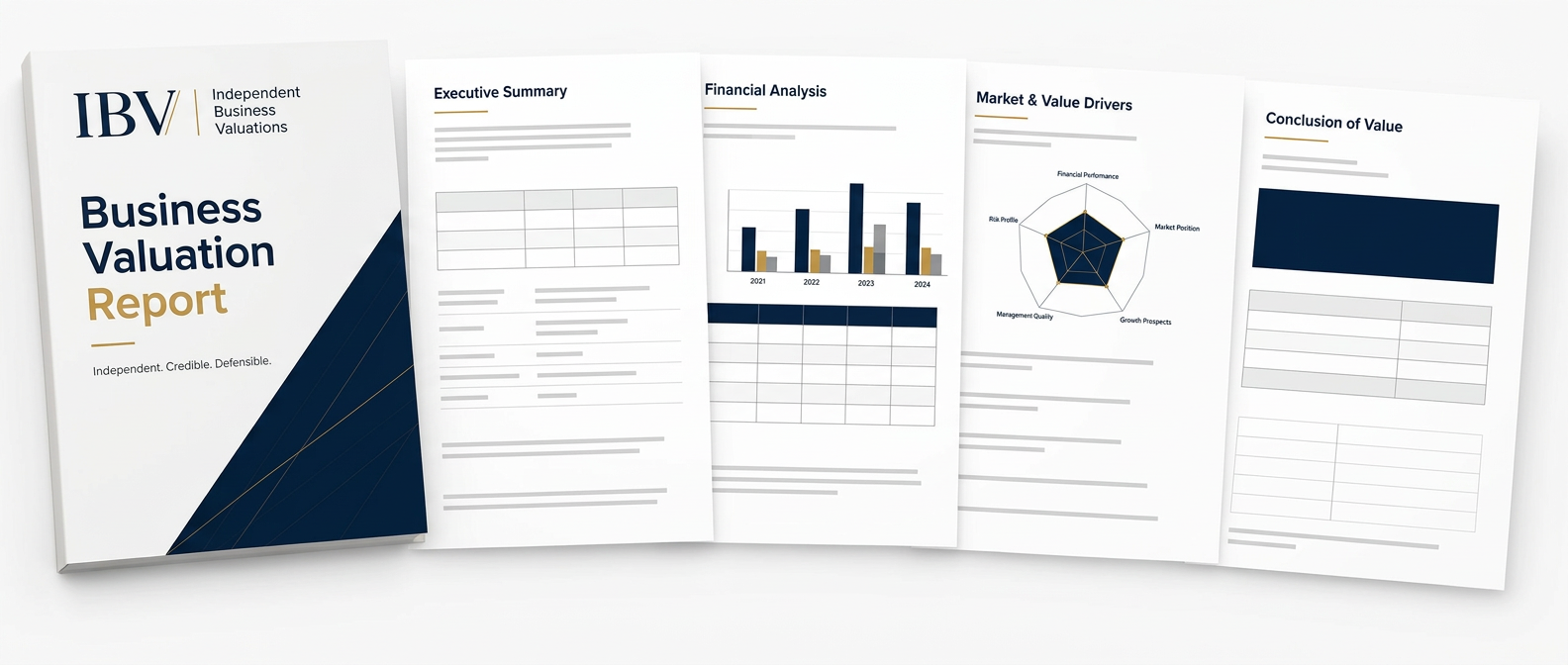
A clear, independent view of value — with the evidence behind it.
- Understand the conclusion — and what drives value.
- Gain an independent perspective. Move forward with confidence.
- Benchmark your business against industry performance.
- Identify strengths, risks and opportunities through SWOT analysis.
WHAT YOU GET IN A LIMITED SCOPE VALUATION REPORT
Inside your IBV™ report
Executive Summary
Conclusion of value · Method selected · Valuer qualifications
Detailed Report
Maintainable earnings · Cap rate / multiple · Premise of value
The Evidence Pack
SWOT analysis · Top Performers Report · RAVDA score
APES 225 voluntarily aligned. Report depth and supporting analysis follow your agreed package and engagement scope.
Free Valuation Call