

Key takeaways
Define what the purchase must achieve before bidding
A business purchase should fit the income, investment return and management role you need, rather than simply look attractive at the asking price. Set those requirements before negotiating so you can judge whether the opportunity deserves your time and capital.
Calculate the full cash commitment beyond the price
The amount paid to the seller may exclude cash needed for daily operations, transaction costs, repairs and equipment replacement. Add these amounts when comparing investment returns, and show borrowing separately so funded expenditure does not disappear from your assessment of the total commitment.
Allow a fair wage for your own work
A purchase can look more profitable than it really is if the buyer’s work is treated as free. Separate reasonable payment for the role you will perform from the return on money invested, then use that distinction consistently when comparing opportunities.
Keep a share of the benefits you create
Savings or extra sales from combining businesses may depend on your own resources, spending and integration work. Assess what those benefits require and test delays or partial success before increasing your offer, rather than paying the seller for all the value you hope to create.
Set a bidding limit against realistic investment alternatives
A price that looks reasonable beside other asking prices may still offer a poor return compared with expanding your existing business or retaining your money. Compare realistic alternatives consistently and set a limit that changes with evidence, not competitive pressure or emotional commitment.
Compare like with like
An asking price is an invitation to negotiate, not evidence that an acquisition will meet your investment requirements. Before bidding, identify the income you need, the work you will perform and the total capital you must commit. Then define the assets or ownership interest on offer and the earnings, obligations and operating rights that come with it. The valuation tests that specific opportunity; it does not replace legal due diligence or a lender’s credit assessment.
Request evidence of earnings
Obtain accounts, recent management results, revenue breakdowns and explanations for proposed add-backs. Where access is limited, record that limitation rather than assuming the seller’s summary is complete. Reconcile trading claims with the available records and consider whether costs will change under new ownership, including replacement management, rent, staffing and any necessary ongoing investment.
Test the operating assumptions
Customer concentration, recurring revenue, supplier dependence and lease continuity can influence the assessment. Forecasts should be examined against capacity, market conditions and trading history. A purchaser’s expected synergies should remain distinguishable from the standalone business, particularly where the asking price appears to rely on benefits that only a particular buyer could generate after completion.

Signed
A clear valuation conclusion starts with an agreed purpose, relevant evidence and disclosed assumptions. The report identifies the interest valued and explains the reasoning behind its conclusion.
Provide a decision-focused assessment
The report explains the value basis, financial adjustments and assumptions supporting the conclusion. It should highlight unresolved information that could materially change the assessment. This helps the buyer identify which commercial questions need answers before proceeding, while preserving a clear distinction between a valuation opinion and a recommendation that the transaction must be completed.
Retain separate transaction checks
A valuation is not a substitute for legal, tax, financial or operational due diligence. It does not confirm title, liabilities or contractual enforceability. Where the brief calls for closer examination of seller-supplied valuation inputs, discuss buyer due diligence valuation, and agree which verification procedures are included rather than assuming a general audit of the target business.
Set an acquisition hurdle before discussing price
A valuation can help answer whether a particular opportunity deserves your capital, but first define what you need the acquisition to achieve. A purchaser seeking an income and a purchaser expanding an established group are solving different problems. Write down the management role you will perform, the capital you can commit and the return you require for accepting business risk.
Separate remuneration for your work from the return on your investment. Otherwise, a purchase can appear attractive because the buyer is effectively supplying unpaid labour. Government buying guidance asks prospective owners to consider their skills, available time and capital before proceeding; those practical constraints should shape your acquisition criteria rather than being considered only after a price has been agreed. 1
Build an all-in capital view of the opportunity
The amount paid to the seller is only one part of the capital committed. Prepare a schedule covering consideration, transaction costs, opening liquidity, initial repairs and expenditure needed to operate at the assumed level. Keep funding sources in a separate schedule so borrowed money does not disappear from the economic assessment simply because it is not equity.
For a hypothetical acquisition, a $900,000 purchase could require another $150,000 of working capital and $100,000 of equipment replacement. Compare the expected return with the full $1.15 million commitment, while recognising that individual amounts may receive different accounting or tax treatment. This is an investment comparison, not an allocation of the contract price. A cheaper business requiring substantial immediate reinvestment can be less attractive than a higher-priced business with sound operating capacity.
Decide who should receive the benefit of your synergies
An existing operator may reduce duplicate administration, use spare warehouse space or cross-sell to its customers. These advantages can justify paying more than a standalone purchaser, but they do not establish that the seller created all the additional value. Map each expected synergy to the action, expenditure and integration effort needed to achieve it.
Then construct a bidding ceiling that preserves an appropriate share of the benefit for you. A hypothetical $80,000 annual saving is not equivalent to $80,000 of immediate, risk-free profit if it requires system migration, redundancies or customer changes. Test partial realisation and delayed benefits. Keep the standalone value visible so you can identify how much of the offer is being supported by your own execution capability rather than the target's existing performance.
Use alternatives to make a disciplined go-or-no-go decision
Compare the purchase with realistic alternatives: expanding your existing operation, building a smaller business, buying another target or retaining capital. Use consistent assumptions about owner remuneration, reinvestment and risk across the options. A multiple that appears reasonable beside advertised asking prices may still produce an unattractive return compared with a practical alternative available to you.
Government valuation guidance describes different methods, including methods based on earnings, assets and market comparisons. Treat these as perspectives requiring judgement, not competing calculators from which to select the highest result. 2 Ask why an asset-heavy target and a service business should or should not be compared on the same measure.
Finally, identify the assumptions that would move your ceiling and the circumstances in which you would walk away. This page's acquisition decision is distinct from buyer due diligence: the question here is what the opportunity is worth to you under clearly stated assumptions, not whether each seller representation has been verified. Keep that distinction visible when moving from evaluation to investigation. A disciplined ceiling can change with new evidence, but should not rise merely because negotiations have become competitive or emotionally difficult.
Scope, fees and timing
See our fixed-fee valuation packages and confirm the scope and fee before commissioning work. Confirm the purpose, intended users, information requirements and inclusions in a written engagement before work begins. Calculated Value and Limited Scope delivery is 5–7 business days from complete financial information and a signed engagement. Full Conclusion timing is confirmed individually in the engagement letter. Specialist requirements or changes to the instruction may affect suitability and timing; confirm these before relying on an external deadline.
Sources and further reading
Frequently asked questions
Can you compare the asking price with an independent business value?
Yes, within an agreed valuation scope and the records available. Supply the sale particulars and identify stock, debt, working capital and excluded assets. Comparing like with like matters: an asking price for operating assets is not directly comparable with a value for all company shares, especially where liabilities remain within the company.
What can you assess if the seller only provides a profit summary?
A summary may support an initial discussion, but it rarely explains the full earnings position or liabilities. Request underlying accounts, recent trading results and details of proposed adjustments. Any assessment must identify information gaps. Limited access may restrict the conclusion or mean that more evidence is needed before a useful valuation can be completed.
Should I pay for the growth I expect to create after buying?
Your own expansion plans or cost savings should be distinguished from the target's existing business performance. A standalone valuation should not silently include benefits only you can achieve. If useful, separately scoped scenarios can examine your assumptions, but implementation costs, timing and execution risks still need to be considered before you decide what to offer.
How is an owner-operated business assessed if I need a manager?
The assessment should consider the market cost of replacing the seller's work, not assume their drawings represent a suitable wage. Describe your intended involvement and obtain details of the seller's duties and hours. Management costs, staffing gaps and transition support can materially change the earnings available to a buyer who will not work in the business.
Does an affordable purchase price mean I have enough funding?
No. You may also need funds for working capital, stock, professional fees and immediate investment after completion. The valuation examines the instructed business interest, not your personal borrowing capacity. Ask your accountant and lender to assess cash requirements and funding terms separately before treating an apparently affordable price as a workable acquisition budget.
Which date should a valuation use during purchase negotiations?
Agree a date that matches the decision and available financial evidence, rather than simply using the report issue date. Ask for significant trading or contractual changes since that date to be identified. If negotiations continue for months, updated results may be needed before relying on an earlier assessment to support a revised offer.
Can the report confirm that all licences and contracts will transfer?
No. The valuation can reflect the commercial importance of licences, leases and customer agreements, but it does not certify their transferability. Your lawyer should review consent requirements and the transaction documents. If continued operation depends on an unresolved approval, that uncertainty needs to remain visible in the valuation assumptions and your purchase decision.
How are earn-outs and seller finance treated when comparing offers?
Deferred and contingent payments should be separated from a simple cash price comparison. Their value depends on timing, conditions and risk, so the maximum advertised amount may not equal immediate cash consideration. Provide the proposed terms for review and obtain legal and financial advice on enforceability, funding and the practical allocation of transaction risk.
Is this the same as a complete acquisition due diligence exercise?
No. A purchase valuation provides an opinion on the defined business or interest using agreed information and procedures. It does not automatically investigate every liability, tax exposure or operational issue. If specific seller claims need tracing to records, discuss a buyer due diligence scope and coordinate separate legal, accounting and technical checks.
What should I send before asking for a purchase valuation quote?
Start with the business description, proposed acquisition structure, asking price, available records and your offer deadline. Avoid assuming that a seller's timetable guarantees completion. IBV agrees a Fixed Professional Fee upfront; standard delivery is 5–7 business days after complete records and signed engagement. This 5–7 business-day timetable applies to Calculated Value and Limited Scope only; Full Conclusion delivery is confirmed individually in the engagement letter.
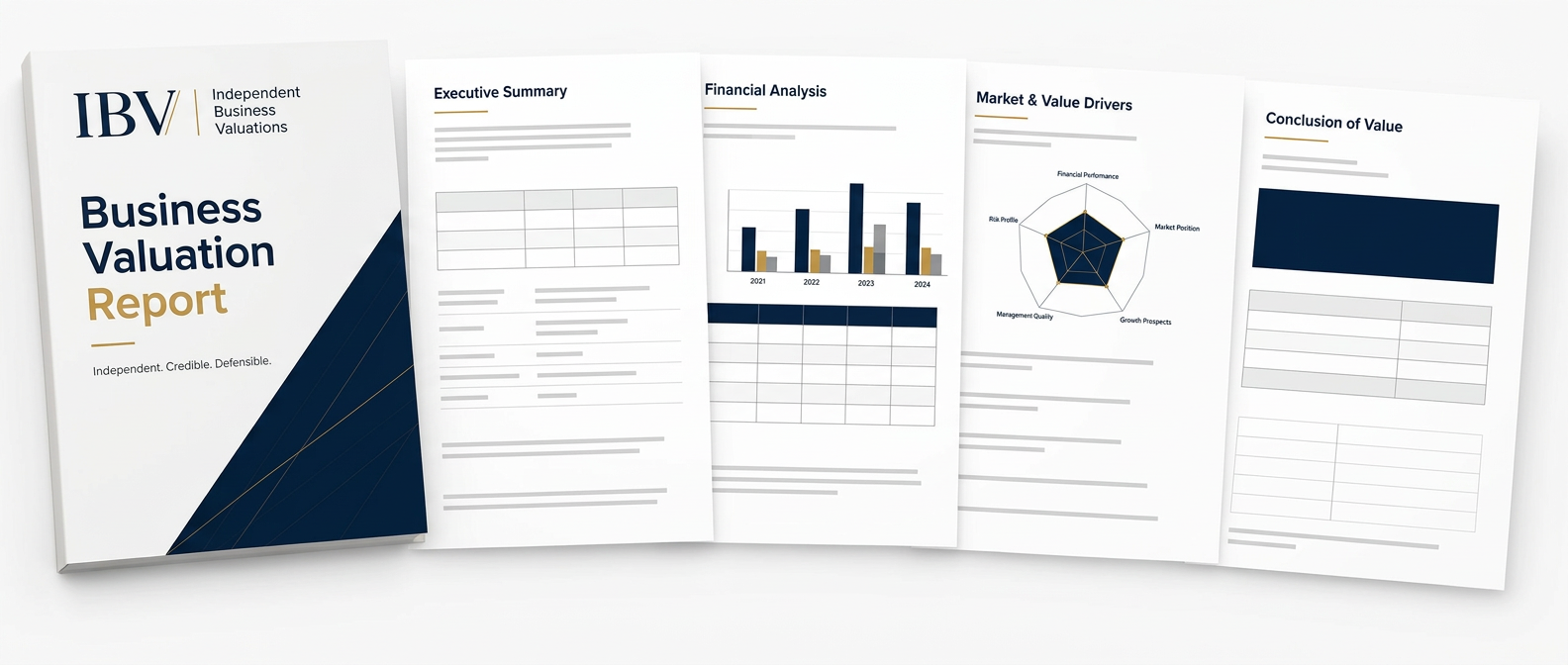
A clear, independent view of value — with the evidence behind it.
- Understand the conclusion — and what drives value.
- Gain an independent perspective. Move forward with confidence.
- Benchmark your business against industry performance.
- Identify strengths, risks and opportunities through SWOT analysis.
WHAT YOU GET IN A LIMITED SCOPE VALUATION REPORT
Inside your IBV™ report
Executive Summary
Conclusion of value · Method selected · Valuer qualifications
Detailed Report
Maintainable earnings · Cap rate / multiple · Premise of value
The Evidence Pack
SWOT analysis · Top Performers Report · RAVDA score
APES 225 voluntarily aligned. Report depth and supporting analysis follow your agreed package and engagement scope.
Free Valuation Call