
Key takeaways
Turn disputed transactions into clear questions about value
An allegation about missing profits is easier to assess when it identifies payments, dates, records and the possible financial effect. Prepare a neutral transaction list with your advisers, leaving legal wrongdoing for lawyers and the court rather than asking the valuer to decide who is at fault.
Identify missing records without assuming unlimited access rights
Owners may have different financial information, and missing records can limit how confidently a business can be valued. Ask your lawyer what information can properly be obtained, then have the valuer explain unresolved gaps and conflicting documents rather than filling them with assumptions that favour either side.
Separate routine profit adjustments from disputed alternative histories
Replacing an owner salary with a commercial wage differs from estimating what profits might have been without alleged diverted sales, sometimes called a counterfactual. Ask for separate calculations that include the costs of earning those sales, with legal instructions addressing any separate claim to avoid counting recovery twice.
Compare the reasons behind different reports before totals
Two valuations can differ because they assess different dates, interests, records or assumptions, while similar totals can conceal offsetting mistakes. Ask for a comparison of the underlying calculations and judgements, and keep any negotiated compromise clearly separate from an independent conclusion about the value of the business interest.
Keep legal outcomes separate from the financial assessment
A shareholder dispute does not automatically establish a legal wrong or determine how an owner should be bought out. Ask your lawyer to confirm the valuation instructions and who will decide disputed facts, so the valuer can explain alternative financial outcomes without assuming a particular court remedy applies.
Set the basis before debating value
Disputes often involve disagreement about more than earnings or multiples. The relevant agreement, court instruction or negotiated process may define a particular valuation basis and date. Your lawyer should clarify those requirements, including any assumptions about control, continued operation or excluded conduct, before the valuer begins an assessment of the interest in dispute.
Establish a balanced evidence record
Provide governing documents, ownership registers, financial statements and details of contested transactions or adjustments. Identify restrictions on access to company information and the source of each material claim. Where competing accounts remain unresolved, the report should distinguish verified records from instructions rather than presenting one party’s allegations as established financial or legal facts.
Separate business performance from disputed conduct
Analysis may need to consider remuneration, related-party transactions, diverted income allegations or unusual expenditure. The valuer assesses the valuation implications of instructed facts, not whether misconduct legally occurred. Alternative assumptions may be appropriate where authorised, but each scenario needs a clear basis and should not disguise unresolved factual issues within a single unexplained conclusion.

Signed
A clear valuation conclusion starts with an agreed purpose, relevant evidence and disclosed assumptions. The report identifies the interest valued and explains the reasoning behind its conclusion.
Make the reasoning reviewable
A report should identify the interest, basis, date, evidence and significant adjustments. Any treatment of minority rights or transfer restrictions needs explicit reasoning consistent with the instruction. Transparent schedules help the parties and advisers understand why conclusions differ, and whether the difference arises from facts, valuation judgement or a different interpretation of the required basis.
Confirm the dispute process
An advisory report is not automatically suitable as expert evidence or a binding determination. Joint appointment, mediation and litigation can carry different requirements. If proceedings are involved, note that IBV™ does not act as a court-appointed or expert witness valuer, so confirm with the instructing lawyer whether a separate expert will be required, and ask the instructing lawyer to confirm applicable rules, communication arrangements and reliance before work begins. No particular settlement or legal outcome is promised.
Turn competing allegations into an issue matrix
Organise disputed items by transaction, accounting treatment, factual position and potential valuation effect. For each item, list the source document, the party raising it and the evidence still needed. A broad claim that profits were suppressed is difficult to test; a dated schedule of supplier payments, recipient entities and ledger entries creates a question that can be investigated.
Keep the matrix neutral. An expense can be commercially questionable without automatically being an earnings adjustment, and a payment to an owner may represent remuneration, a loan repayment or a distribution. Lawyers identify the legal issues and instructed factual assumptions. The valuer assesses the economic consequences without deciding whether oppression, breach of duty or another wrong occurred.
Reconcile information asymmetry without filling gaps with advocacy
Compare the financial records available to each owner and identify missing periods, bank accounts or operating divisions. Request transaction level exports with account descriptions and reconciliation reports, not only selected screenshots. Preserve the original files and record who supplied each extract. Where documents contradict one another, explain the conflict rather than quietly selecting the version that produces a preferred result.
ASIC's shareholder dispute guidance describes information rights and possible avenues for addressing disputes. It does not mean every shareholder has unrestricted access to all internal records. The lawyer should determine what can be requested or obtained through the appropriate process. The valuation report should explain the practical effect of any remaining information limitation. 1
Separate restoration assumptions from ordinary normalisation
An ordinary normalisation might replace an owner's salary with a commercial employment cost. A restoration assumption might instead model revenue said to have been diverted away from the company. These are different analytical steps and should occupy separate schedules. Otherwise, an apparently routine earnings adjustment can conceal a disputed counterfactual about how the business would have performed.
For each counterfactual, identify the required customers, resources, costs and working capital. Adding alleged lost sales without the costs of earning them overstates the financial effect. Also distinguish a recurring earnings impact from a separate receivable or damages claim. Whether any claim belongs in the valued interest, and on what basis, requires legal instruction so that recovery is not counted twice.
Explain disagreement through a common calculation bridge
Where two reports differ, first align their dates, subjects and valuation bases. Then reconcile revenue, wages, related party charges, debt, surplus assets and parcel treatment. Show which differences arise from records, which from assumptions and which from professional judgement. A difference in final value alone does not establish that either report is unreliable.
A bridge can also reveal accidental agreement: two offsetting errors may produce similar totals. Review the underlying mechanics rather than treating numerical proximity as validation. If settlement discussions use alternative scenarios, retain labels that identify their factual assumptions. A negotiated midpoint is a commercial compromise, not necessarily an independent valuation conclusion or evidence that the competing methods are equally persuasive.
Keep the remedy question distinct from the valuation task
The Corporations Act contains provisions concerning oppressive conduct and court orders in sections 232 and 233. Their relevance and any resulting valuation directions are matters for the lawyers and court, not a presumption the valuer should build into every shareholder exit. 2
Before a scenario is finalised, ask who decides the disputed facts and whether the instruction permits alternative outcomes. Identify any issue that could materially change the conclusion if determined differently. This produces evidence useful for negotiation or further expert work while preserving the distinction between financial analysis, legal remedies and the parties' ultimate settlement choices.
Retain a version history of authorised scenarios so later readers can distinguish new evidence from a change in the legal instruction.
Scope, fees and timing
See our fixed-fee valuation packages and confirm the scope and fee before commissioning work. Confirm the purpose, intended users, information requirements and inclusions in a written engagement before work begins. Calculated Value and Limited Scope delivery is 5–7 business days from complete financial information and a signed engagement. Full Conclusion timing is confirmed individually in the engagement letter. Specialist requirements or changes to the instruction may affect suitability and timing; confirm these before relying on an external deadline.
Sources and further reading
Frequently asked questions
Can both shareholders jointly appoint you when we disagree about the price?
A joint instruction can be discussed, provided the parties agree the valuation question, information access and communication arrangements. Your lawyers should confirm the appointment terms and whether any result is intended to be binding. A jointly commissioned valuation is not automatically an expert determination or court appointment, and independence remains essential.
Source: Federal Court — Expert Evidence Practice Note (GPN-EXPT)
Our shareholders agreement sets an exit formula. Will you use it?
Provide the complete agreement and any amendments before we scope the work. Your lawyer should confirm how the valuation clause operates, including the date, basis and treatment of disputed provisions. A contractual formula can ask a different question from market value, so we should not substitute a standard approach without clear instructions.
Can you adjust for the other shareholder paying themselves too much?
We can examine the valuation effect of remuneration using records and a supported comparison with the work performed. That is different from deciding whether a payment was unlawful. Where facts are disputed, the instructing lawyers may need to define assumptions or scenarios so allegations are not silently treated as established facts.
Source: Federal Court — Expert Evidence Practice Note (GPN-EXPT)
What if I cannot access the company’s full financial records?
Tell us which records you hold and which are missing before commissioning the valuation. We can identify the evidence needed and likely limitations, but cannot promise a reliable conclusion from inadequate information. Your lawyer should handle information-access rights and any legal process required to obtain company records from the other owners.
Source: Federal Court — Expert Evidence Practice Note (GPN-EXPT)
Will the majority shareholder’s offer determine the minority value?
An offer is relevant context, not necessarily a conclusive valuation. We examine its terms, the interest involved and the required basis under the agreement or legal instructions. Minority and transferability issues need specific reasoning; there is no automatic discount that applies to every shareholder dispute or every small holding.
Can you assess value before the disputed transactions took place?
A historical valuation may be possible if your lawyer specifies the date and any assumptions about the disputed transactions. We need records showing the business position and expectations then. The report must distinguish a genuine historical assessment from a hypothetical scenario that excludes conduct, as these may answer different questions.
The other side already has a valuation. Can you explain why it differs?
An issue-focused review can examine the interest, valuation date, earnings adjustments, debt treatment and methods in that report. Provide its supporting material where available. We may agree with parts of it or identify evidence gaps; an independent review is not a promise to produce a lower or higher competing number.
Source: Federal Court — Expert Evidence Practice Note (GPN-EXPT)
Can the valuation help us settle at mediation?
A clearly reasoned report can give the parties a common reference and identify which assumptions drive the disagreement. Expert opinion may be used in alternative dispute resolution, subject to the agreed instruction. It cannot guarantee settlement, and your lawyer should confirm permitted reliance and whether mediation attendance needs a separate scope.
Source: Federal Court — Expert Evidence Practice Note (GPN-EXPT)
Will you decide whether the other owner acted oppressively?
No. Legal findings about oppression, duties or remedies belong to the legal process. A valuer can assess business value and, where properly instructed, the financial effect of specified assumptions. We need your lawyer to separate the valuation questions from contested legal allegations before deciding what evidence and analysis the engagement requires.
Source: Federal Court — Expert Evidence Practice Note (GPN-EXPT)
Can we use a negotiation valuation in court if discussions fail?
Do not assume so. Court evidence may require different instructions, disclosures, expert declarations and compliance with the relevant rules. Speak with your lawyer before commissioning work that may be used in proceedings. Converting an advisory report is subject to suitability and a separately agreed scope, not an automatic inclusion.
Source: Federal Court — Expert Evidence Practice Note (GPN-EXPT)

A clear, independent view of value — with the evidence behind it.
- Understand the conclusion — and what drives value.
- Gain an independent perspective. Move forward with confidence.
- Benchmark your business against industry performance.
- Identify strengths, risks and opportunities through SWOT analysis.
WHAT YOU GET IN A LIMITED SCOPE VALUATION REPORT
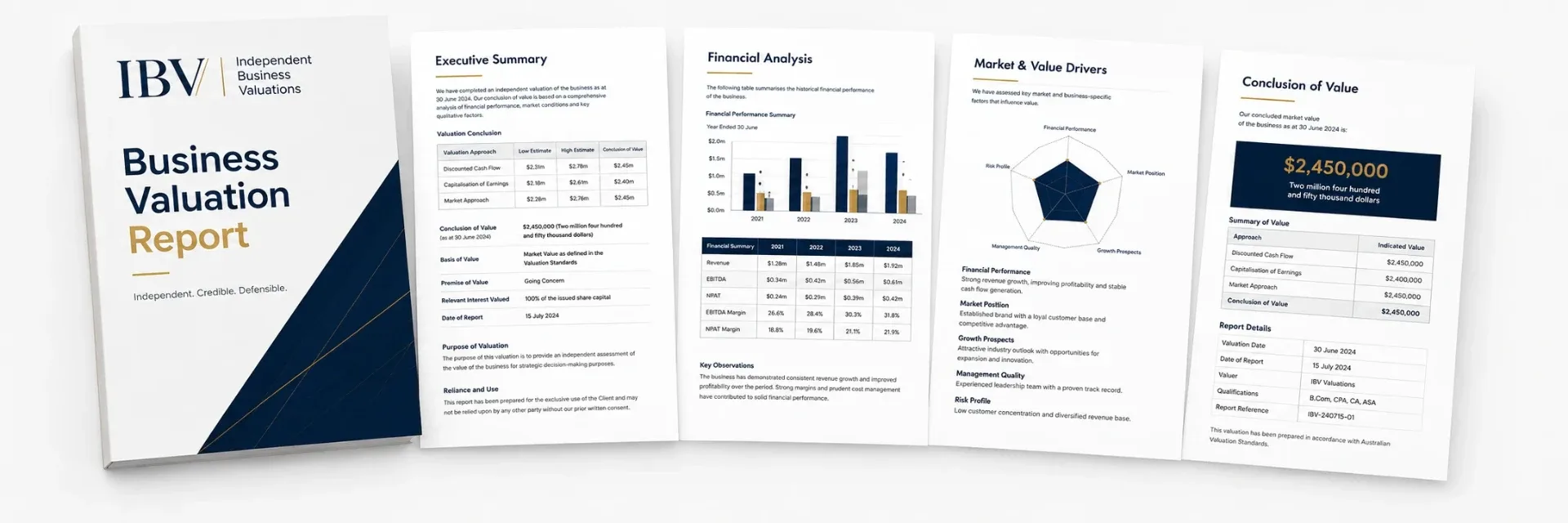
Inside your IBV™ report
Executive Summary
Conclusion of value · Method selected · Valuer qualifications
Detailed Report
Maintainable earnings · Cap rate / multiple · Premise of value
The Evidence Pack
SWOT analysis · Top Performers Report · RAVDA score
APES 225 voluntarily aligned. Report depth and supporting analysis follow your agreed package and engagement scope.
Free Valuation Call