

Key takeaways
Value the business model, not screenshots.
Maturity and evidence determine whether maintainable earnings, future cash flows, comparable transactions or identifiable assets best support value.
Recurring revenue needs retention evidence.
Test churn, contract terms and customer concentration before treating subscriptions as durable income.
Platform dependence is a risk to price.
Search rankings, app stores and marketplaces sit outside the owner’s control; diversified, owned channels support durability.
Verify the rights and the transfer pathway.
Check code ownership, open-source licences, eligible app transfers and lawful customer-data use; app transfers are not developer-account transfers.
Historical development spending is not current value.
Pre-profit ventures need evidence of product maturity, customer economics, rights, comparable transactions or supportable future cash flows—not a tally of past spending.
The owner’s replacement cost still applies online.
Founder labour, personal brands and key developers must be costed before earnings are called transferable.
An online business is still a business
An online business valuation applies established valuation principles to digital business models. Depending on the company's maturity, value may be supported by maintainable earnings, expected future cash flows, comparable market transactions or identifiable assets. For subscription businesses, the sustainability of recurring revenue, customer retention, growth and required investment can be particularly important. The analysis must also establish which technology, contractual rights, intellectual property and customer relationships are transferable.
This guide covers Australian online and digital businesses: SaaS and subscription software, apps, content and membership sites, digital services and technology companies whose value sits in intellectual property rather than physical assets. For product businesses holding inventory, the e-commerce and retail guide addresses stock and trading margins; this page focuses on businesses where cash flow and code matter more than shelves.
Identify what a buyer can actually acquire
Start by defining the subject of the valuation: the shares in a company, the assets of a business, or a particular ownership interest. In an asset sale, each component must be capable of transfer. Domain names, websites, code repositories, social media accounts, email lists and platform storefronts are held under different arrangements, and some are easier to transfer than others.
Platform and app transferability
App-store accounts, marketplace storefronts and advertising accounts operate under different contractual terms. Apple and Google provide mechanisms for transferring eligible applications between developer accounts, including continuity of ratings, reviews and users in qualifying circumstances. However, some financial histories, integrations, permissions and account-level rights may not transfer. Transferring an application is not the same as transferring the underlying developer account.
A valuation should examine the actual transfer pathway and any resulting costs, interruptions or loss of commercial benefits. A share sale may preserve some arrangements because the contracting entity remains unchanged, but this depends on account ownership, platform conditions and change-of-control provisions. The distinction between company and business value therefore matters.
Customer data and privacy
Customer databases can support value, but personal information is not an unrestricted saleable asset. The Privacy Act and Australian Privacy Principles apply where the business or transaction falls within their scope, including certain transactions involving the sale or disclosure of personal information. Most small businesses with annual turnover of $3 million or less are exempt, subject to exceptions; trading in personal information can itself bring a business within the Act. Requirements can differ between share sales and asset sales. Do not assume that an exemption or a whole-business sale authorises every new use of customer records.
Where email or SMS marketing contributes to revenue, the Spam Act also imposes consent, identification and unsubscribe requirements, regardless of business size. A valuation should consider whether the purchaser can lawfully continue the relevant customer relationships and communications, supported by appropriate legal advice.
Recurring revenue is not automatically durable revenue
SaaS and subscription businesses are often described by monthly or annual recurring revenue. Recurring revenue is valuable only to the extent it recurs. Examine the retention evidence behind the headline: customer churn, cohort behaviour, contract terms, the proportion on monthly versus annual plans, discounts given for upfront payment and the concentration of revenue in a small number of customers.
For SaaS businesses, examine Annual Recurring Revenue (ARR), Monthly Recurring Revenue (MRR), gross and net revenue retention, customer acquisition cost, customer lifetime value, gross margins and the cost of serving each customer. These metrics should be reconciled to financial records and consistently defined. Subscription growth can be economically weak where acquisition and support costs exceed the value of the customers retained. Metrics inform future cash flows and comparability; they are not a mechanical valuation formula.
Advance subscription receipts require separate attention. Annual customer payments may improve cash flow without representing revenue fully earned at receipt. Under AASB 15, where applicable, consideration received before the promised service is transferred can create a contract liability. Review deferred revenue, remaining service obligations and their treatment in working capital or transaction adjustments to avoid overstating earnings or cash available to owners. Avoid counting the same obligation twice when reconciling enterprise value to equity value.
A business whose top three customers represent half of recurring revenue carries a different risk from one with hundreds of small accounts. The customer concentration article explains how dependence changes the analysis. Growth also needs context: rapid growth produced by heavy discounting or unsustainable advertising spend may not continue under new ownership.
For early-stage and pre-profit digital businesses, historical development expenditure may inform the analysis but does not establish current market value. Depending on the circumstances, evidence may include product maturity, intellectual property rights, user adoption, customer economics, comparable investments or transactions, the cost of developing a comparable asset and supportable future cash-flow scenarios. The methodology and uncertainty should be clearly explained. AASB 138 distinguishes research expenditure from development expenditure meeting recognition criteria; accounting recognition is not equivalent to market value.

Signed
A clear valuation conclusion starts with an agreed purpose, relevant evidence and disclosed assumptions. The report identifies the interest valued and explains the reasoning behind its conclusion.
Normalise the earnings behind the dashboard
Online businesses are frequently run by founders who underpay themselves, work from home and expense selectively. The same normalisation discipline applies as for any owner-operated business: replace the owner's labour at a market cost, separate personal from business expenditure, and test claimed one-off items. The normalised earnings article sets out which add-backs survive scrutiny.
Costs that are easy to overlook online include hosting and software subscriptions, payment processing and platform fees, contractor and support costs, content production, and the advertising spend required to replace customers who leave. Revenue that depends on the founder's personal profile—a channel, a personal brand, a newsletter written in the founder's voice—raises the same transferable-goodwill question as any personal-services business: what remains when the founder leaves? The goodwill valuation guide explains the distinction.
Price the platform and traffic risk
Many online businesses depend on channels they do not control: search rankings, paid advertising auctions, app store placement, marketplace algorithms or a social platform's feed. That dependence is a valuation risk to assess, not a footnote. A business earning well from a single organic keyword cluster can lose that income after one algorithm update; a business buying most of its customers through paid ads is exposed to rising acquisition costs.
Evidence matters more than assertions. Analytics access, channel-level revenue history, cohort data and advertising account records show how customers actually arrive and what they cost. Diversified, owned channels—an email list built with proper consent, direct traffic, a recognisable brand—generally support a more durable earnings assessment than a single rented channel.
Verify the technology and intellectual property
Ask who owns the code. Software written by founders, employees or contractors involves different ownership positions, and contractor arrangements do not automatically assign intellectual property to the business. Open-source components carry licence obligations. IP Australia explains the main categories of intellectual property; the valuation needs to establish what the business owns, what it licenses and what it merely uses.
Technology also carries ongoing cost. Code needs maintenance, security updates and hosting; products need development to stay competitive. An earnings figure that ignores realistic maintenance and development spending overstates what a buyer can extract. Key-person dependency applies with force: if one developer holds the system together, continuity risk belongs in the analysis. Assess technical debt, cybersecurity vulnerabilities, system documentation, cloud infrastructure dependencies and the commercial cost of replacing critical developers. Required remediation and maintenance expenditure can materially affect sustainable cash flow.
Match the method to the evidence
There is no universal preferred formula for an online business. Capitalisation of maintainable earnings can suit mature businesses with sustainable trading, while an income approach using supportable future cash flows may better reflect a SaaS business investing heavily in growth. Negative current EBITDA does not, by itself, mean a recurring-revenue business has no value.
A market approach may use completed comparable transactions and appropriately defined recurring revenue, including ARR, where the evidence is reliable. Compare growth, gross and net retention, margins, profitability, investment requirements, business risk and market conditions at the valuation date before adopting a multiple. ARR is not interchangeable with total revenue, and advertised asking prices are not equivalent to completed transaction evidence.
For pre-revenue or early-stage ventures, evidence may support identifiable-asset analysis, a cost approach or supportable cash-flow scenarios. Cost analysis should address a comparable asset's utility and obsolescence, not simply total historical spending. Rates must match the cash flows, including enterprise versus equity, tax treatment and the risks already reflected in projections. Secondary methods can test a primary indication where appropriate; investigate differences rather than mechanically averaging results. The guide to valuing a business in Australia explains the main approaches, and the EBITDA multiples article explains why marketplace asking prices and rules of thumb are not valuation evidence.
Prepare the evidence before you commission a valuation
Useful records include financial statements and monthly management results, platform and payment-processor reports, analytics access, subscription and churn data, customer concentration schedules, advertising account history, hosting and software cost schedules, contractor and intellectual property agreements, and details of domain, platform and app store account ownership. For .au domains, confirm that the incoming registrant meets auDA eligibility requirements and that the proposed transfer follows the applicable licensing rules. Do not assume that purchasing a website automatically transfers its domain licence. Tell IBV the purpose of the valuation and who will rely on the report so the scope and engagement type can be agreed.
Every engagement is quoted as a Fixed Professional Fee before work begins, with fees from $2,450 + GST depending on the engagement type, purpose and reliance required. The fixed fee comparison explains the engagement options, and the small business valuation service describes the typical pathway for owner-operated businesses.
Sources and further reading
These sources explain applicable frameworks, not the value or compliance of a particular online business. Check the law, platform terms and agreement dates relevant to the valuation date. Obtain specialist legal, tax and privacy advice where required.
Frequently asked questions
How is an online business valued in Australia?
Define the subject—shares, business assets or a particular ownership interest—and the valuation date first. Depending on maturity and evidence, analyse maintainable earnings, supportable future cash flows, comparable market transactions or identifiable assets. Assess customer retention, required investment, platform dependence and technology rights. Select methods supported by that evidence rather than applying a universal revenue or profit multiple.
Is a SaaS business valued using a revenue or ARR multiple?
It can be. Annual Recurring Revenue (ARR) multiples are used in SaaS market comparisons where reliable, genuinely comparable transaction evidence exists. The appropriate multiple depends on factors such as growth, customer retention, gross margins, profitability, market conditions and business risk. A revenue multiple is not automatically appropriate, and advertised asking prices are not equivalent to completed transaction evidence. IBV selects the method supported by the business’s circumstances and available information.
How do you value a SaaS business in Australia?
Start with the valuation purpose, date and ownership interest, then reconcile ARR, MRR, gross and net revenue retention, acquisition costs, customer lifetime value and gross margins to consistently defined financial records. Review IP ownership, customer contracts, deferred revenue, remaining service obligations and required technology investment. Supportable future cash flows, comparable ARR-based transactions or maintainable earnings may be relevant depending on maturity and evidence; negative current EBITDA does not automatically imply no value.
Can a startup or pre-profit online business be valued?
Yes, but the method must match the evidence. Historical development expenditure may inform analysis but does not establish current market value, and accounting recognition is not equivalent to market value. Evidence may include product maturity, IP rights, user adoption, customer economics, comparable investments or transactions, the cost of developing a comparable asset and supportable future cash-flow scenarios. Explain the methodology and uncertainty rather than presenting a speculative forecast as fact.
Does website traffic or a social media following add value?
Only to the extent it produces supportable, transferable earnings. Traffic that does not convert, or an audience attached to the founder personally, may add little. Examine channel-level revenue, conversion and acquisition costs rather than raw visitor or follower counts.
How does dependence on Google, an app store or a marketplace affect value?
Single-channel dependence increases the risk attached to future earnings and can reduce the value a given level of profit supports. Algorithm changes, policy decisions and rising advertising costs sit outside the owner’s control. Diversified and owned channels, such as a consented email list and direct traffic, generally support a more durable assessment.
Are domain names, app store accounts and customer lists transferable?
It depends on the rights and transaction. Apple and Google allow eligible app transfers between developer accounts with continuity of specified customer-facing history; this is not a developer-account transfer, and some reports, integrations and account-level rights do not transfer. Incoming .au registrants must meet eligibility and licensing rules. Privacy Act coverage and transaction structure affect customer-data handling; small-business exceptions require checking. Commercial email and SMS marketing also require consent, identification and unsubscribe compliance regardless of business size. Obtain legal advice on the specific arrangements.
Source: OAIC — Selling a business
Who owns the software code in a sale?
Ownership depends on who wrote the code and the agreements in place. Founders, employees and contractors are treated differently, and contractor work does not automatically assign intellectual property to the business. Open-source components carry licence obligations. Verify ownership before treating the software as a saleable asset.
Source: IP Australia — Understanding IP
What is churn and why does it matter to value?
Churn is the rate at which subscribers or customers leave. Recurring revenue is valuable only while it recurs, so retention evidence—cohort behaviour, contract terms and the mix of monthly and annual plans—directly affects how much future earnings can be relied upon.
What documents should I prepare for an online business valuation?
Prepare financial statements and monthly results, platform and payment-processor reports, analytics and channel data, subscription and churn metrics, customer concentration schedules, advertising history, hosting and software cost schedules, contractor and intellectual property agreements, and account ownership details for domains, app stores and marketplaces.
How much does an online business valuation cost?
Every IBV engagement is quoted as a Fixed Professional Fee before work begins, from $2,450 + GST. The fee depends on the engagement type, the purpose of the valuation and who will rely on it—not on the size of the business or the value concluded.
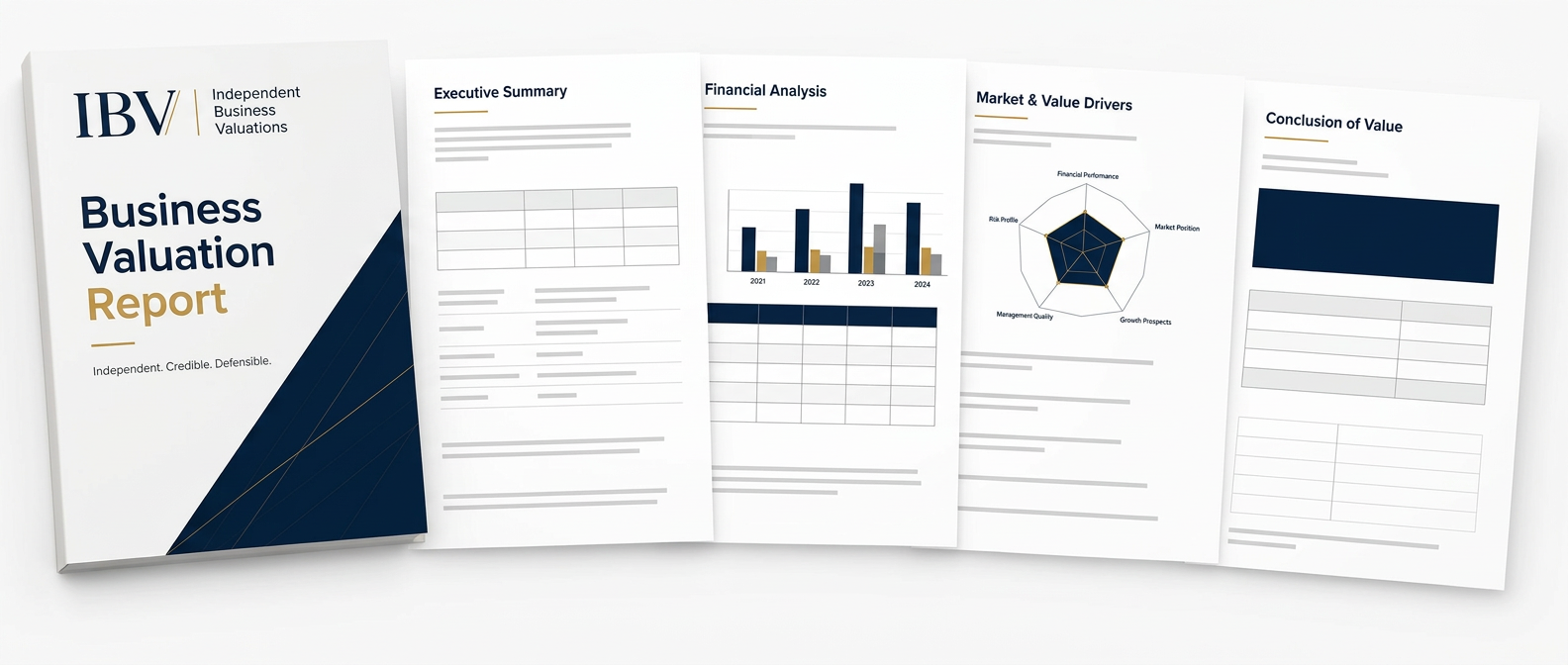
A clear, independent view of value — with the evidence behind it.
- Understand the conclusion — and what drives value.
- Gain an independent perspective. Move forward with confidence.
- Benchmark your business against industry performance.
- Identify strengths, risks and opportunities through SWOT analysis.
WHAT YOU GET IN A LIMITED SCOPE VALUATION REPORT
Inside your IBV™ report
Executive Summary
Conclusion of value · Method selected · Valuer qualifications
Detailed Report
Maintainable earnings · Cap rate / multiple · Premise of value
The Evidence Pack
SWOT analysis · Top Performers Report · RAVDA score
APES 225 voluntarily aligned. Report depth and supporting analysis follow your agreed package and engagement scope.
Free Valuation Call