

Key takeaways
An appraisal is an indication; a valuation is an engagement.
An appraisal offers an informal opinion without testing the records. A valuation defines the subject, purpose and date, examines the evidence and explains its reasoning in a signed report.
The right document depends on who relies on the number.
If an adviser, lender, the ATO or another party will act on the figure, it needs a defined scope and traceable evidence behind it. Curiosity and early planning can start with less.
A challenged appraisal has nothing to show.
Without documented instructions, examined records and disclosed reasoning, an informal figure cannot answer the first question a reviewer asks: what supports this?
The cheapest document can become the most expensive outcome.
An appraisal rejected by the other side or queried by a regulator must be replaced by the valuation that should have come first—after time and negotiating position are lost.
Match the scope to the decision, not the turnover.
Not every decision needs the most comprehensive engagement. The first conversation should be about what the number must support, then the scope and fixed fee follow.
Business appraisal vs business valuation: start with what each document is
The words are often used interchangeably in conversation, but they describe different work. An appraisal is typically an informal indication of what a business might be worth—a broker's opinion of a likely selling range, a rule-of-thumb calculation, or a figure produced quickly for discussion. A business valuation is a defined engagement: a qualified valuer examines the financial evidence, applies recognised methods, explains the reasoning and signs a report that states what was valued, for whom, at what date and on what basis.
The distinction is not about which word sounds more professional. It is about what the document can support. An appraisal can be a useful starting point for curiosity or early planning. A valuation is what you need when someone—an adviser, a lender, the ATO, a former partner or a family member—will rely on the number to make a decision.
The Australian Government's guidance on valuing a business describes several accepted approaches and the records the analysis draws on. What it does not describe is a shortcut that removes the need to examine those records. That is the practical line between the two documents.
What an appraisal usually involves
An appraisal is usually fast and inexpensive because it does not test the underlying evidence. A business broker's appraisal, for example, draws on the broker's experience of asking prices and recent listings. It answers a narrow question: what might the market ask for a business like this one? It generally does not reconcile your accounts, normalise owner remuneration, examine contracts or test whether the earnings can transfer to a new owner.
That limits what an appraisal can do. It cannot tell you whether the figure would survive scrutiny, because scrutiny was never applied. If the broker also stands to earn a commission from selling the business, the number carries a further question about incentives—an issue we return to in why independence matters in a business valuation.
Online calculators sit at the far end of the same spectrum. They apply a multiple to a figure you type in, without knowing whether that figure is accurate, sustainable or even the right measure of earnings. Treat the output as a conversation starter, never as a basis for a decision.
What a business valuation requires
A valuation begins with instructions: the subject being valued, the purpose, the valuation date, the basis of value and who may rely on the report. Those instructions shape everything that follows, which is why defining what your number is meant to represent comes before any calculation.
The valuer then gathers and tests evidence—financial statements, tax returns, contracts, asset records and the arrangements behind related-party dealings. Earnings are normalised so they reflect what a hypothetical purchaser could expect, including the commercial cost of replacing the owner's own work. Methods are selected because the evidence supports them, not because they produce a preferred figure, and the report explains the reasoning so a reader can trace the conclusion back to the evidence.
Professional standards sit behind that discipline. IBV™ voluntarily aligns with APES 225 Valuation Services, the standard issued by the Accounting Professional and Ethical Standards Board, which sets requirements for valuation engagements performed by its members, including defined engagement types and reporting obligations. IBV™ is not bound by it as a mandatory member standard but adheres to it voluntarily, because the discipline it describes is what makes a conclusion defensible.

Signed
A clear valuation conclusion starts with an agreed purpose, relevant evidence and disclosed assumptions. The report identifies the interest valued and explains the reasoning behind its conclusion.
Why the difference matters when someone relies on the number
Consider what happens when the figure is challenged. If a shareholder exit, a tax position or a family law property pool rests on an appraisal, the first question asked will be: what evidence supports this? An appraisal has no answer beyond experience and opinion. A valuation report answers with the documents examined, the adjustments made, the methods chosen and the assumptions disclosed.
The ATO's market valuation guidance makes the same point in the tax context: a market value should be supported by a documented process and relevant evidence, and the person providing it should be appropriately qualified. A figure that cannot show its workings invites exactly the scrutiny it cannot withstand.
This is also why the cheapest document is often the most expensive outcome. A low-cost appraisal that is rejected by the other side, or queried by a regulator, must be replaced by the valuation that should have been commissioned first—after positions have hardened and time has been lost.
Where estimates and rules of thumb legitimately fit
Informal figures are not useless; they are simply limited. A broker's appraisal can help you decide whether selling is worth exploring. A rule of thumb can tell you whether an expectation is in a plausible range before you spend money on advice. An estimate can frame an early conversation with your accountant about how a business is valued in Australia.
The test is reliance. If no decision will rest on the number, an informal indication may be all you need. The moment a decision—selling, buying out a partner, transferring between related parties, lodging a tax position, dividing assets—rests on the figure, the document behind it must be able to carry that weight.
How to decide which one you need
Ask three questions. Who will rely on the number? What decision does it support? What happens if it is challenged? If the answers name an adviser, a court, the ATO, a lender or another party to a transaction, you need a valuation with a defined scope, not an appraisal.
Scope then becomes the next decision. A valuation of a straightforward business with reliable records, prepared for your own planning, needs less work than one prepared for a tax matter or a family law proceeding. Our Fixed Professional Fees page explains the three engagement levels and what each includes, so the scope matches the decision rather than a turnover band.
One commitment is worth stating plainly: IBV™ does not provide appraisals or estimates, because an informal number presented as a valuation helps no one. Every engagement—starting with the Calculated Value at $2,450 plus GST—is a genuine valuation: defined scope, examined evidence, explained reasoning and a signed report.
What a signed valuation report contains that an appraisal does not
The clearest way to see the difference is to compare the documents side by side. A signed valuation report states the valuer's instructions, qualifications and independence. It identifies the subject interest, the purpose, the valuation date and the basis of value. It sets out the information examined, the adjustments made to reported earnings, the methods adopted and—equally important—the methods considered and set aside, with reasons. It discloses assumptions, limiting conditions and any information that was unavailable, and it finishes with a conclusion the valuer signs and stands behind.
An appraisal typically contains none of this architecture. There is no defined subject, no stated basis of value, no reconciliation of the accounts and no disclosed reasoning to examine. That is not a criticism of the person who prepared it; the document was never built to carry that weight. The problem arises only when it is asked to.
This architecture is also what makes two valuations comparable. When each report states its scope, evidence and reasoning, an adviser can see why two figures differ and which conclusion better fits the decision at hand. Two appraisals offer no such basis for comparison—only two opinions.
Common situations where the wrong document gets chosen
The most frequent mistake is using a broker's appraisal to set expectations for a negotiation the broker will not control. The appraisal reflects what the broker hopes to list the business at; the buyer's adviser will value what the business can actually deliver. The gap between those numbers is where deals stall.
The second mistake is relying on an estimate for a related-party transfer or restructure because "it is only moving between family entities". The ATO examines these transactions precisely because the parties are connected, and the value needs documented support regardless of who is on the other side. Our article on how methodology affects related-party transfers explains what that support looks like.
The third is commissioning a full valuation when a defined, narrower scope would do. Not every decision needs the most comprehensive engagement. The skill is matching the scope to the reliance—which is why the first conversation with a valuer should be about the decision, not the price.
Frequently asked questions
Is a business appraisal the same as a business valuation?
No. An appraisal is an informal indication of value—often a broker's opinion of a likely selling range—prepared without testing the underlying records. A valuation is a defined engagement that examines the financial evidence, applies recognised methods and concludes in a signed report stating what was valued, for whom, at what date and on what basis.
Is a business broker's appraisal a valuation?
Generally no. A broker's appraisal draws on experience of asking prices and recent listings to suggest a marketable range. It usually does not reconcile your accounts, normalise owner remuneration or test whether earnings transfer to a new owner, and it is not prepared under a valuation standard.
Can I use an online business value calculator instead of a valuation?
A calculator applies a multiple to a figure you enter, without knowing whether that figure is accurate or sustainable. Treat the result as a conversation starter. It cannot support a sale negotiation, a tax position or a buy-out, because no evidence stands behind it.
When is an appraisal enough?
When no decision will rest on the number. An appraisal or estimate can help you explore whether selling is worth considering, or whether an expectation is in a plausible range, before you spend money on advice. The moment a decision relies on the figure, you need a valuation.
When do I need a formal business valuation?
Whenever someone will rely on the number: a sale or purchase, a shareholder or partner exit, a related-party transfer, a tax or CGT position, a family law property division, or a lender's assessment. If the figure could be challenged, it needs documented evidence and reasoning behind it.
Why does a valuation cost more than an appraisal?
Because the work is different. A valuation defines the instructions, gathers and reconciles financial records, normalises earnings, selects supportable methods, documents assumptions and limitations, and finishes with a conclusion the valuer signs and stands behind. An appraisal skips that work, which is why it cannot carry the same weight.
What is the APES 225 valuation standard, and does IBV™ voluntarily follow it?
IBV™ voluntarily aligns with APES 225 Valuation Services, the professional standard issued by the Accounting Professional and Ethical Standards Board for valuation engagements performed by its members. It defines engagement types and reporting obligations. IBV™ is not bound by APES 225 but voluntarily adheres to it, because the discipline it describes is what makes a conclusion defensible.
Source: APESB Valuation Services
Does IBV™ provide appraisals or estimates?
No. An informal number presented as a valuation helps no one. Every IBV™ engagement—starting with the Calculated Value at $2,450 plus GST—is a genuine valuation: defined scope, examined evidence, explained reasoning and a signed report.
Can an appraisal be used in a family law or tax matter?
It is unlikely to be accepted. These matters are built for challenge, and the first question asked will be what evidence supports the figure. An appraisal has no documented process to show. A valuation report answers with the records examined, the methods chosen and the assumptions disclosed.
How do I choose the right level of valuation?
Start with the decision, not the price. Ask who will rely on the number, what it must support and what happens if it is challenged. The scope then follows: a straightforward business valued for your own planning needs less work than one prepared for a tax matter or family law proceeding. The Fixed Professional Fees page explains the three engagement levels.
A clear, independent view of value — with the evidence behind it.
- Understand the conclusion — and what drives value.
- Gain an independent perspective. Move forward with confidence.
- Benchmark your business against industry performance.
- Identify strengths, risks and opportunities through SWOT analysis.
WHAT YOU GET IN A LIMITED SCOPE VALUATION REPORT
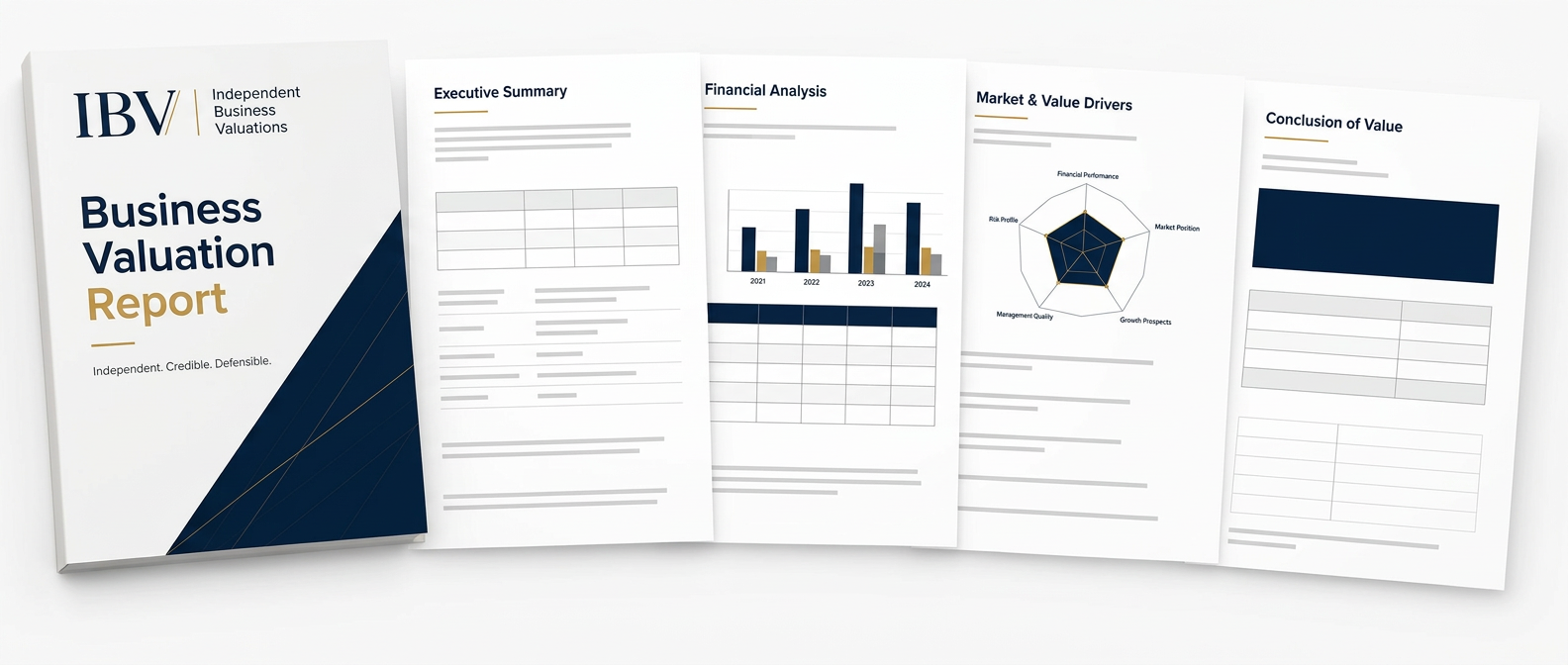
Inside your IBV™ report
Executive Summary
Conclusion of value · Method selected · Valuer qualifications
Detailed Report
Maintainable earnings · Cap rate / multiple · Premise of value
The Evidence Pack
SWOT analysis · Top Performers Report · RAVDA score
APES 225 voluntarily aligned. Report depth and supporting analysis follow your agreed package and engagement scope.
Free Valuation Call