
Key takeaways
Scope before arithmetic
“What is the business worth?” is incomplete until the asset or interest, valuation date, purpose, basis of value and relevant rights are defined.
Maintainable earnings are not reported profit
Business Valuers normalise owner-specific, non-recurring, and non-commercial items to estimate the business’s sustainable economics.
The multiple is a compressed judgment
Risk, growth, transferability, evidence quality and comparability sit behind the apparently simple number.
Valuation methods must be reconciled
Income, market and cost or asset-based approaches answer different questions. Explain differences rather than mechanically averaging them.
Enterprise value is not equity value
Debt, surplus assets, working capital and the rights attached to a specific ownership interest can materially change the value attributable to shareholders.
Quick Answer
A Business Valuation is a reasoned, evidence-based assessment of the value of a business, ownership interest or specified asset at a particular date.
A professional valuation considers the purpose and basis of value, maintainable earnings, business risk, transferability, market evidence and the valuation approaches appropriate to the circumstances.
The result is not simply a multiple applied to profit.
It is a supported conclusion of value based on evidence, analysis and professional judgement.
Executive Briefing
- Business Valuation is not simply a matter of selecting an industry multiple and applying it to reported profit. Before value can be determined, the valuer must first establish exactly what is being valued, for what purpose, at what date and on what basis.
- The analysis then moves through the underlying economics of the business: historical financial performance, normalised maintainable earnings, business-specific risks, growth prospects, customer and owner dependency, transferability, market evidence and the quality of the information available. Appropriate valuation approaches are then considered and the evidence reconciled into a conclusion of value.
- For private businesses, apparently small judgements can have material consequences. A change to maintainable earnings, the treatment of owner remuneration, customer concentration or the ability of the business to operate independently of its owner can materially change the valuation.
- This guide explains that process — and the questions business owners, accountants and professional advisers should ask when assessing whether a Business Valuation is commercially reasonable and defensible.
Before Determining Value, Define the Valuation
Before a Business Valuer calculates anything, the valuation question needs to be defined. Change the interest being valued, the valuation date, purpose, basis of value or attached rights and the answer can legitimately change.
Once the scope is clear, the conclusion can be built through a disciplined chain of evidence and professional judgement.
Five things that must be explicit
- Subject interest: Is the valuation of the operating business, shares, units, goodwill or another asset?
- Valuation date: What was known or reasonably knowable at that date?
- Purpose: Is the valuation for sale, tax, succession, restructure, ownership change or another decision?
- Basis of value: Is Market Value required, or another defined basis?
- Rights: Do control, liquidity, transfer restrictions or particular share-class rights affect what is being valued
Quality of Earnings
Reported profit is evidence. Maintainable earnings require valuation judgement.
A valuer is rarely paid to copy the P&L. The task is to estimate sustainable earnings consistent with the applicable basis of value, after considering owner-specific, abnormal, non-recurring and non-commercial items.
Reported EBITDA
Starting evidence
± Normalisations
Owner / related-party / one-off
± Structural changes
Costs or benefits that persist
= Maintainable earnings
Valuation input
Good adjustments
- Owner salary above or below market, with evidence
- Genuinely non-recurring legal or relocation costs
- Related-party rent adjusted to market terms
- One-off revenue that will not recur
- Known permanent cost savings already implemented
Dangerous adjustments
- Adding back “one-offs” that happen every year
- Ignoring required replacement management cost
- Annualising a strong month without capacity evidence
- Removing legitimate maintenance expenditure
- Treating ambitious forecasts as established earnings
Accountant’s Lens
Think of normalisation as a quality-of-earnings bridge. The question is not “can I justify this add-back?” but whether the adjustment recreates sustainable economics appropriate to the valuation basis. For market-value work, a useful test is whether a rational buyer would expect the amount to recur after completion.
Key Takeout
The best normalisation schedule is not the one that produces the highest earnings. It is the one that survives challenge.
Capitalisation and Multiples
A multiple and a capitalisation rate are two ways of expressing the same relationship
In a simple capitalisation model, value is maintainable earnings divided by a capitalisation rate. The reciprocal of that capitalisation rate is the earnings multiple.
This is why apparently small changes in the rate can move value materially.
Capitalisation of maintainable earnings is one application of the income approach.
Illustrative example
$600,000 maintainable earnings
÷ 25% capitalisation rate
= $2.40 million indicative value
| Capitalisation rate | Reciprocal multiple | Value on $600k |
|---|---|---|
| 20.0% | 5.00× | $3.00m |
| 22.5% | 4.44× | $2.67m |
| 25.0% | 4.00× | $2.40m |
| 27.5% | 3.64× | $2.18m |
| 30.0% | 3.33× | $2.00m |
Illustrative mathematics only. The appropriate earnings metric and capitalisation rate depend on the valuation basis, method and business.
What the rate is absorbing
- Business-specific operating risk
- Customer, supplier and key-person concentration
- Growth expectations embedded in the earnings base
- Scale, liquidity and marketability
- Transferability of goodwill and management capability
- Quality and reliability of the underlying evidence
Key Takeout
If the selected earnings figure already assumes future growth, do not quietly “pay for” the same growth again through an aggressive multiple.
Risk Compressed into a Multiple
Why “industry multiple × EBITDA” is usually too crude
A market multiple looks simple because it compresses many assumptions into one number.
The professional task is to unpack those assumptions and ask whether the observed evidence is truly comparable to the subject business.
One of those assumptions is transferability: a buyer prices what is likely to survive beyond the current owner.
Factors that can shift pricing
Operating risk
Transferability
Earnings quality
Dependency / concentration
Market evidence
Comparable to what?
Industry label alone is weak.
Compare size, margins, growth, recurring revenue, geography, customer mix, management, capital intensity and transaction structure.
Comparable on which metric?
EBITDA, EBIT, revenue and seller’s discretionary earnings are not interchangeable.
The multiple must match the earnings definition.
Comparable on which deal basis?
Headline transaction prices may include working capital, earn-outs, property, strategic premiums or unusual terms.
Normalise the evidence before relying on it.
Accountant’s Lens
Multiples can hide accounting differences. Two companies with equal EBITDA can have very different capital expenditure requirements, lease structures, working-capital intensity and cash conversion.
A multiple comparison is only as good as the metric being compared.
Challenge Question
If you cannot explain why this business deserves this multiple, you do not yet have a valuation conclusion—you have a lookup.
Same Profit. Different Value.
The P&L says “equal”. The buyer does not.
Both businesses produce maintainable EBITDA of $500,000.
The difference is the probability that a buyer can actually inherit those earnings.
| Business A | Business B | |
|---|---|---|
| Profile | Transferable & resilient | Concentrated & owner-led |
| Largest customer | 8% | 41% |
| Recurring / contracted revenue | 70% | 15% |
| Owner dependence | Low | High |
| Second-tier management | Strong | Limited |
| Documented systems | Mature | Weak |
| Illustrative multiple | 4.5× | 2.8× |
| Enterprise value | $2.25m | $1.40m |
$850,000 Value Gap
In this illustration, the earnings are identical.
The value gap is driven by risk, transferability and buyer confidence. Good Business Valuations often spend more time understanding the business than manipulating a spreadsheet.
What would narrow the gap?
- Reduce customer concentration
- Build management depth
- Document operating systems
- Move owner relationships into the business
- Increase recurring revenue quality
Illustrative only. Multiples are hypothetical and are not market evidence for any real business or industry.
Three Approaches & Reconciliation
The three approaches ask different questions
Valuation methods are tools, not answers.
01 · Income Approach
Question: What are the future economic benefits worth today?
Strong when: earnings or cash flows can be estimated with reasonable reliability.
Watch: forecast bias, terminal assumptions, and mismatch between the earnings metric and discount or capitalisation rate.
02 · Market Approach
Question: What does market evidence imply for a comparable business or interest?
Strong when: transactions or public-company evidence are sufficiently comparable.
Watch: deal terms, scale, timing, metric definitions and strategic premiums.
03 · Cost / Asset-Based Approach
Question: What does the value of the underlying assets less liabilities imply for the business or interest?
Strong when: the business is asset-, investment- or holding-company driven, or reliable earnings / cash-flow evidence is limited.
Watch: it is not usually primary for a profitable going concern; consider unrecorded intangibles, contingent liabilities and whether going-concern value exceeds net assets.
IVS terminology: an asset-based / summation method can be an application of the cost approach.
Key Takeout · Reconciliation
If one method indicates $3.0 million and another $2.2 million, averaging them is not automatically sophisticated.
The valuer should ask why the methods differ and weight each method according to the quality and relevance of its evidence.
| Question | Stronger evidence | Weaker evidence |
|---|---|---|
| Historical profitability | Stable, reconciled, explainable | Volatile, incomplete, heavily adjusted |
| Market comparables | Recent, similar, transparent terms | Small sample, stale, opaque deal terms |
| Forecasts | Board-approved, capacity-backed, prepared contemporaneously | Created for valuation, unsupported, hockey-stick growth |
Enterprise Value to Equity Value
A $4 million business is not necessarily $4 million to the shareholders
A headline earnings multiple often produces enterprise value: the value of the operating business.
To reach equity value, the valuer may need to adjust for debt, debt-like items, surplus assets and the agreed working-capital position.
Enterprise value: $4.00m
Less net debt: $0.70m
Plus surplus cash / assets: $0.20m
Indicative equity value: $3.50m
Debt-like is broader than bank debt
Depending on the transaction and basis of value, items such as shareholder loans, unpaid tax, deferred consideration, abnormal provisions or unfunded obligations may need analysis.
Working capital can move proceeds
A business may be valued on the assumption that a normal level of working capital is delivered.
A shortfall at completion can reduce proceeds even if the enterprise value is unchanged.
Accountant’s Lens
This is where valuation and completion mechanics meet.
Do not mix operating performance with financing structure. First understand what the multiple is valuing; then bridge to the specific equity interest.
Key Takeout
Never debate “the value” until everyone is talking about the same layer of value.
Goodwill & Transferability
What survives when the owner leaves?
Goodwill is not simply the difference between price and net assets.
In a private business, the critical commercial question is whether customer relationships, reputation, know-how, systems and earnings capacity are attached to the enterprise or to a particular individual.
Enterprise-attached
- Brand recognised independently of owner
- Contracts sit with the entity
- Team owns customer relationships
- Systems and IP are documented
- Management can operate independently
Transferability Test
If the owner disappeared for 90 days, what revenue, capability and customer confidence would remain?
Person-attached
- Owner is primary rainmaker
- Key clients follow the individual
- Know-how is undocumented
- Licences or reputation are personal
- No credible management successor
Why buyers care
Transferability affects both earnings and risk.
If replacing the owner requires a $180,000 general manager, maintainable earnings may fall.
If customers may leave anyway, the multiple may also fall.
One issue can therefore affect both sides of the valuation equation.
Accountant’s Lens
Owner dependency should not be dealt with only through an add-back schedule.
It can require a replacement-cost adjustment, a risk adjustment, or both—provided double counting is avoided.
Key Takeout · Double-Counting Trap
If you reduce earnings for a replacement manager and also apply a lower multiple because “management depth is weak”, make sure you are not penalising the same risk twice without justification.
The Accountant’s Lens
Six valuation distinctions worth carrying into every client conversation
1. EBITDA is not cash flow
Capital expenditure, working capital, tax, financing and lease economics can create materially different cash outcomes.
2. Normalisation is not advocacy
An adjustment should recreate economics appropriate to the valuation basis, not maximise the client’s earnings base.
3. A multiple must match the metric
Do not apply a transaction multiple derived from one earnings definition to another.
4. Enterprise value is not equity value
Debt, surplus assets and working-capital assumptions can materially change shareholder value.
5. Forecasts need contemporaneous credibility
A forecast prepared later with hindsight is not equivalent to a plan that existed at the valuation date.
6. Scope changes the service
APES 225 distinguishes valuation, limited-scope valuation and calculation engagements; users should understand the difference.
APES 225 in Plain English
For members of Australian professional accounting bodies, APES 225 places obligations around valuation services, reporting and documentation.
A calculation engagement is not simply a cheaper full valuation; it is a different valuation service involving the agreed application of Valuation Approaches, Valuation Methods and Valuation Procedures.
Quick Report Audit
| Area | What good looks like | Warning sign |
|---|---|---|
| Earnings | Material normalisations are quantified, explained and tied to economics appropriate to the valuation basis | Large add-backs with little evidence or no replacement-cost logic |
| Risk | Specific risks and their treatment in earnings, rate or multiple are transparent | The same risk is penalised twice or buried inside an unexplained multiple |
| Market evidence | Comparable transactions use compatible metrics, dates, scale and deal terms | A headline multiple is copied from an incomparable deal or industry rule of thumb |
Key Takeout
A strong valuation makes judgement visible enough for another informed professional to challenge it intelligently.
Worked Valuation Case
From reported accounts to equity value
A private service business reports EBITDA of $540,000.
The valuer identifies three material adjustments and concludes maintainable EBITDA of $650,000.
The point is not the answer—it is to show where judgement enters.
Earnings Bridge
| $000 | |
|---|---|
| Reported EBITDA | 540 |
| Add: excess owner remuneration | +85 |
| Add: one-off relocation cost | +45 |
| Less: replacement systems manager | -20 |
| Maintainable EBITDA | 650 |
Risk and Transferability
- Recurring revenue: strong
- Customer concentration: moderate
- Owner dependence: reducing but present
- Management depth: satisfactory
- Historical margins: stable
- Growth outlook: credible, not fully contracted
Illustrative Multiple Range
3.75× to 4.25×
In a real valuation, the selected range would require support from relevant market evidence, an income-approach analysis and/or other appropriate valuation evidence.
The range shown here is hypothetical and not a benchmark.
| Multiple | Enterprise value |
|---|---|
| 3.75× × $650k | $2.44m |
| 4.00× × $650k | $2.60m |
| 4.25× × $650k | $2.76m |
Enterprise value: $2.60m
Less net debt: $0.35m
Illustrative equity value: $2.25m
Key Takeout · Upstream
Do not start by debating whether 4.00× “looks right”. Ask whether $650,000 is genuinely maintainable, whether the risk profile and market evidence justify the range, and whether the $350,000 net-debt adjustment is correctly defined.
Accountant’s Lens
One $50,000 normalisation moves enterprise value by $200,000 at a 4.0× multiple.
The quality of the earnings bridge can matter as much as the argument over the multiple.
What to Do Next
Use the guide to ask better valuation questions
A valuation becomes useful when it improves a decision.
Before commissioning or relying on one, work through these six questions.
1. What decision will this value support?
Sale, succession, tax, restructure, ownership change, planning or another purpose?
2. What exactly is being valued?
Operating business, shares, units, goodwill, minority interest or another asset?
3. What is the valuation date?
The evidence and assumptions need to be consistent with that point in time.
4. What earnings are genuinely maintainable?
Which normalisations are supportable under the applicable basis of value?
5. Which risks actually move value?
Concentration, owner dependency, transferability, management, growth and evidence quality.
6. What would materially change the conclusion?
Identify the assumptions and sensitivities that deserve the most scrutiny.
Key Takeout
Do not buy a valuation number. Buy a clear, supportable explanation of value and the evidence behind it.
Income Approach
Best for profitable businesses with discernible earnings or cash flows.
Market Approach
Uses comparable business sales and market evidence to indicate value.
Asset Approach
Assesses the market value of identifiable assets less relevant liabilities.
Value is not a number you calculate.
It is a conclusion you support.
- IBV Valuation Principle
Read the guide as a booklet
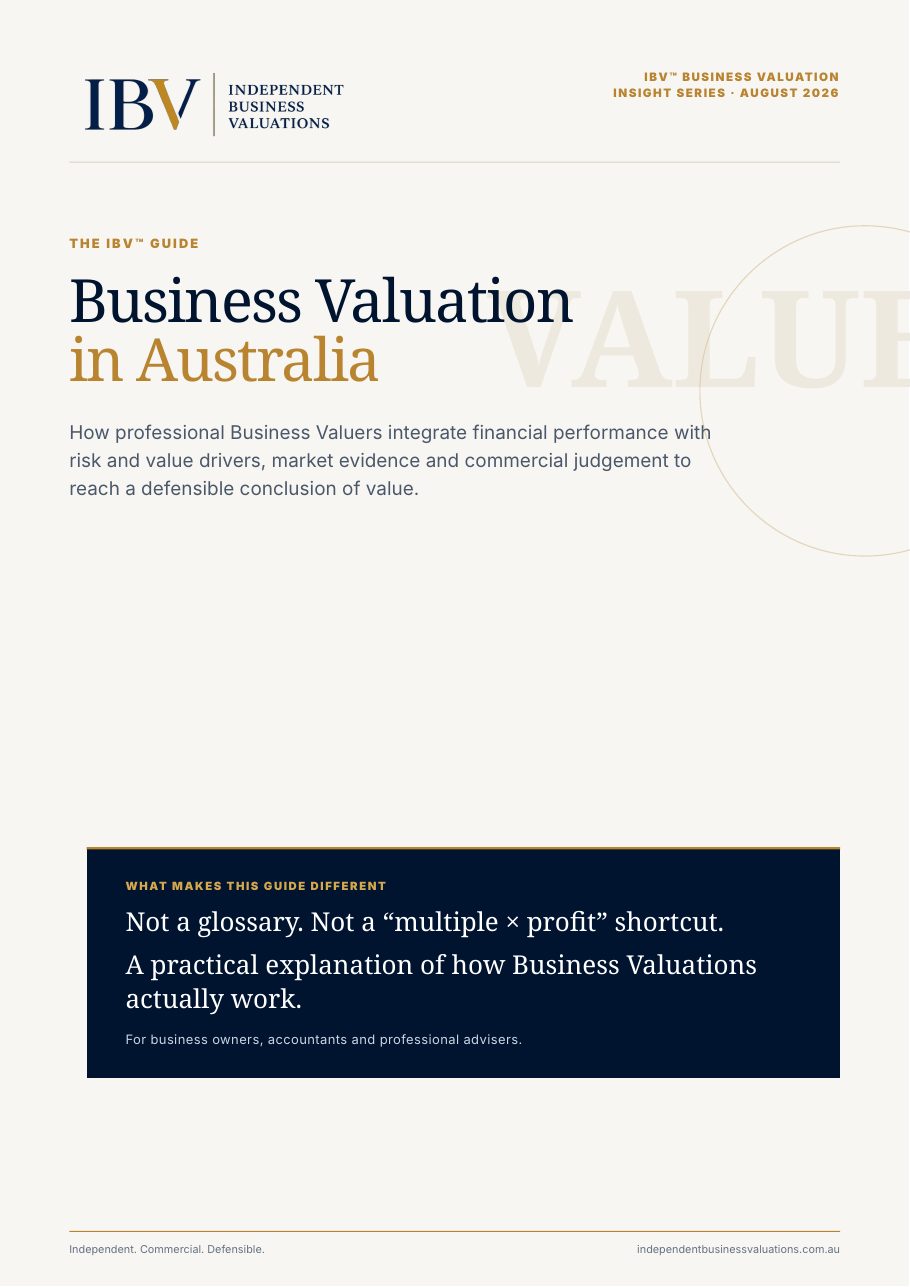
Page 1 of 15
Keep The Definitive Guide to Business Valuation in Australia for your records — the same booklet as the flipbook above.
Source notes
References
Frequently asked questions
What is a business valuation?
A business valuation is a reasoned, evidence-based assessment of the value of a business, ownership interest or specified asset at a particular date. It considers the purpose of the valuation, basis of value, financial performance, business risk, transferability, market evidence and the rights attached to the interest being valued.
How is a business valued in Australia?
A professional business valuation begins by defining exactly what is being valued, the valuation date, purpose, basis of value and relevant ownership rights. The valuer then analyses the underlying economics, normalises earnings where appropriate, assesses business-specific risks, considers suitable valuation methods and reconciles the available evidence into a supportable conclusion of value.
What are the main business valuation methods?
The three principal valuation approaches are the income approach, market approach and cost or asset-based approach. The income approach considers future economic benefits, the market approach considers comparable market evidence, and the asset-based approach considers the value of underlying assets less relevant liabilities. More than one approach may be considered and the results should be reconciled rather than mechanically averaged.
What are maintainable earnings in a business valuation?
Maintainable earnings are an estimate of the sustainable earnings a business can reasonably generate, rather than simply the profit reported in its accounts. A Business Valuer may adjust for owner-specific remuneration, related-party transactions, genuine one-off expenses, abnormal income and structural changes to determine an earnings level that better reflects the ongoing economics of the business.
How are business valuation multiples determined?
A valuation multiple should not simply be selected from an industry average. It reflects factors including operating risk, growth expectations, customer and supplier concentration, earnings quality, business scale, marketability, management capability and the transferability of goodwill. Comparable transaction evidence must also use a compatible earnings measure and reflect relevant differences in size, structure and deal terms.
Two businesses with the same profit - different values?
Yes. Two businesses with identical maintainable earnings can have materially different values because buyers also consider the risk and transferability of those earnings. Customer concentration, recurring revenue, owner dependence, management depth, documented systems and the ability of the business to operate without its current owner can all affect the value a buyer would attribute to the business.
Difference between enterprise value and equity value?
Enterprise value generally represents the value of the operating business. Equity value represents the residual value attributable to shareholders after relevant adjustments such as net debt, debt-like liabilities, surplus cash, non-operating assets and, where applicable, working-capital adjustments. A business with an enterprise value of $4 million therefore does not necessarily have $4 million of equity value.
How does goodwill affect a business valuation?
Goodwill is influenced by whether the business’s earning capacity, customer relationships, reputation, systems, know-how and management capability are attached to the enterprise or mainly to the current owner. Goodwill that can continue after an ownership change is generally more transferable. High owner dependence or customer relationships tied personally to the owner can reduce the value attributable to transferable goodwill.
When is an asset-based valuation appropriate?
An asset-based approach can be particularly relevant for asset-intensive, investment or holding businesses, or where reliable maintainable earnings or cash-flow evidence is limited. The valuer considers the market value of identifiable assets and relevant liabilities, including assets that may not be fully reflected in the accounting records. For a profitable going concern, an asset-based approach may instead provide a supporting or cross-checking indication of value.
What information does a Business Valuer need?
The information required depends on the purpose and scope of the valuation, but commonly includes historical financial statements, current trading information, details of normalisation adjustments, ownership and debt information, customer and supplier concentrations, contracts, management structure, business risks, forecasts where relevant and evidence supporting comparable transactions or assets. The evidence should be consistent with the valuation date and the specific interest being valued.
Free confidential valuation call
Let’s start with what you need.
Fifteen minutes with an AVI-Certified Business Valuer to confirm your purpose, the right engagement, the Fixed Professional Fee and timing.
- Clarify the decision and valuation date.
- Discuss scope, fee and any deadline.
- Decide whether to proceed — no obligation.
Prefer to talk now? 1300 270 940