

Independent valuation support for Tasmania business owners
When the value of your business matters, you need more than an unexplained figure. IBV™ gives you a clearly reasoned, independent assessment for your agreed purpose—and direct access to Dr Patrick Hillenbrand, AVI Certified Business Valuer.
Signed report: a defined valuation conclusion with the evidence, assumptions and reasoning behind it.
IBV™ Independence Guarantee: an independent assessment, not a value selected to suit a preferred outcome.
Fixed Professional Fee: scope, reporting requirements and fee agreed in writing before work begins.
APES 225 aligned: voluntary alignment with recognised valuation guidance, with limitations and intended use disclosed.
How we can help you
Choose the service that fits your decision. We confirm the valuation date, ownership interest and intended users before recommending the engagement.
Preparing a sale: business sale valuations to support a reasoned discussion of value.
Buying out a partner: partnership buyout valuations for the interest being transferred.
Planning succession: buy–sell agreement valuations to inform ownership transition arrangements.
Changing a structure: family trust restructure valuations with instructions coordinated through your advisers.
Tax-related transactions: CGT business valuations for an adviser-confirmed purpose, date and basis of value.
Ownership disputes: family law business valuations with reporting requirements agreed before engagement.
Independent valuations for Tasmanian enterprises
We support valuation enquiries across Hobart, Launceston and regional Tasmania through coordinated document review and scheduled discussions. For businesses serving local, visitor or interstate customers, we examine the revenue sources, supply arrangements and operating costs that actually support earnings.
Where trading is seasonal, we analyse a representative period and explain the assumptions behind maintainable earnings. Freight dependence, bookings and supplier continuity are considered when relevant to your business—not treated as automatic discounts for operating in Tasmania.

Signed
A clear valuation conclusion starts with an agreed purpose, relevant evidence and disclosed assumptions. The report identifies the interest valued and explains the reasoning behind its conclusion.
Start your Tasmania valuation
Book a Free Valuation Call to tell us what you own, why you need the valuation and when you need it. We will confirm the documents required, recommend the reporting scope and provide a Fixed Professional Fee quote.
Standard delivery is generally 5–7 business days after complete information and a signed engagement are received.
We serve Tasmania owners through document review and scheduled discussions. Any required site visit or specialist assessment is agreed separately. Tax, legal and transaction advice remains with your professional advisers; a valuation does not guarantee acceptance by an authority or a particular sale price.
Tasmania business resources
Tasmanian owners can use these resources to prepare for a sale, understand buyer enquiries and investigate economic context. State-level releases provide background, not a substitute for representative trading records or evidence of seasonal earnings.
Preparing a Tasmanian business for sale
Business Tasmania’s selling guide outlines sale preparation and financial-record readiness. Assemble records covering a representative trading period and identify what a purchaser would actually receive.
Understanding a buyer’s checks
Business Tasmania’s acquisition guidance covers due diligence, financial and legal checks and valuation. Use the buyer perspective to prepare evidence about suppliers, customers and obligations before negotiating an ownership transfer.
Finding personalised business support
Business Tasmania support offers assistance and referrals to advice services. Ask for relevant guidance when organising business information or identifying issues that need specialist attention alongside the valuation.
Reviewing the economic backdrop
Tasmanian Treasury economic data releases provides analysis based on official economic sources. Check the relevant period when researching broader activity or investment conditions, without using statewide trends as an automatic adjustment to your business’s value.
Frequently asked questions
Does operating in Tasmania automatically justify a valuation discount?
No. Examine the actual customers, supply arrangements, freight exposure and operating records rather than apply a blanket geographic adjustment. Business Tasmania’s buying guidance encourages review of contracts, suppliers and finances. Any allowance should relate to evidenced circumstances, not an assumption that every Tasmanian business faces the same constraints.
Which Tasmanian licence and council checks matter for a visitor-facing business?
Identify the actual services and obtain corresponding licence and council records. Business Tasmania recommends checking ABLIS and relevant council requirements, such as land use, food activities and signage. Disclose material approval uncertainty rather than assume an existing booking history proves every current or proposed activity is permitted.
How can a Tasmanian commercial lease affect seasonal trading assumptions?
Review permitted use, renewal options, rent changes, maintenance and restrictions relevant to the business. Commercial lease terms vary, and Business Tasmania recommends independent legal advice. Connect the actual commitments to expected earnings, particularly where the operator relies on specific premises for its peak trading period.
How are local customers and visitor demand separated in a Tasmanian valuation?
Use monthly sales, customer categories, channel records and bookings to identify the demand supporting earnings. Compare repeat local trade with visitor-related activity where records allow. Assess seasonality and concentration without assuming every business in Hobart, Launceston or a regional community depends primarily on tourism.
Are forward bookings earned revenue in a Tasmanian accommodation valuation?
Separate completed stays from future bookings, deposits and cancellable reservations. Review cancellation terms, booking history and the costs needed to deliver future stays. Forward demand may inform expectations, but it is not completed trading or necessarily unrestricted cash; associated service obligations must also be considered.
What evidence helps assess shipping dependence for a Tasmanian business?
Provide freight agreements, dispatch records, delivery terms and evidence of who bears additional transport or delay costs. Identify alternatives and whether customers could accept changed arrangements. Connect these facts to margins and continuity assumptions rather than impose a general shipping penalty on every business selling beyond Tasmania.
Source: Australian Government: emergency management planning
How is buffer stock treated when a Tasmanian business protects supply continuity?
Determine whether the inventory is an ordinary requirement of the supply model or an exceptional accumulation. Review lead times, ageing, alternative products and supplier terms. Stock that protects continuity still ties up cash, so explain both its operating role and its treatment within normal working capital.
How is a Tasmanian proprietor’s peak-season work reflected in earnings?
Document busy and quieter-period duties instead of relying on annual salary alone. Identify management, guest service, sales and operational work a successor must replace. Recognise necessary staffing through the trading cycle without treating seasonal owner effort as free or assuming peak staffing costs continue unchanged throughout the year.
What if a Tasmanian operator combines accommodation, retail and distribution?
Prepare accounts by activity and reconcile them to the consolidated result. Identify shared employees, premises, inventory and administration. Assess which activities continue within the ownership interest being valued, explaining different demand cycles and supply needs rather than obscuring them within one annual margin for the whole operation.
How is succession assessed when a Tasmanian visitor business includes owner-held property?
Separate the property interest from the operating business and identify who will manage bookings, suppliers and guests after succession. Document occupancy and continuing owner involvement. Distinguish property ownership from transferable goodwill while recognising that a successor needs suitable premises and the capability to operate the business.
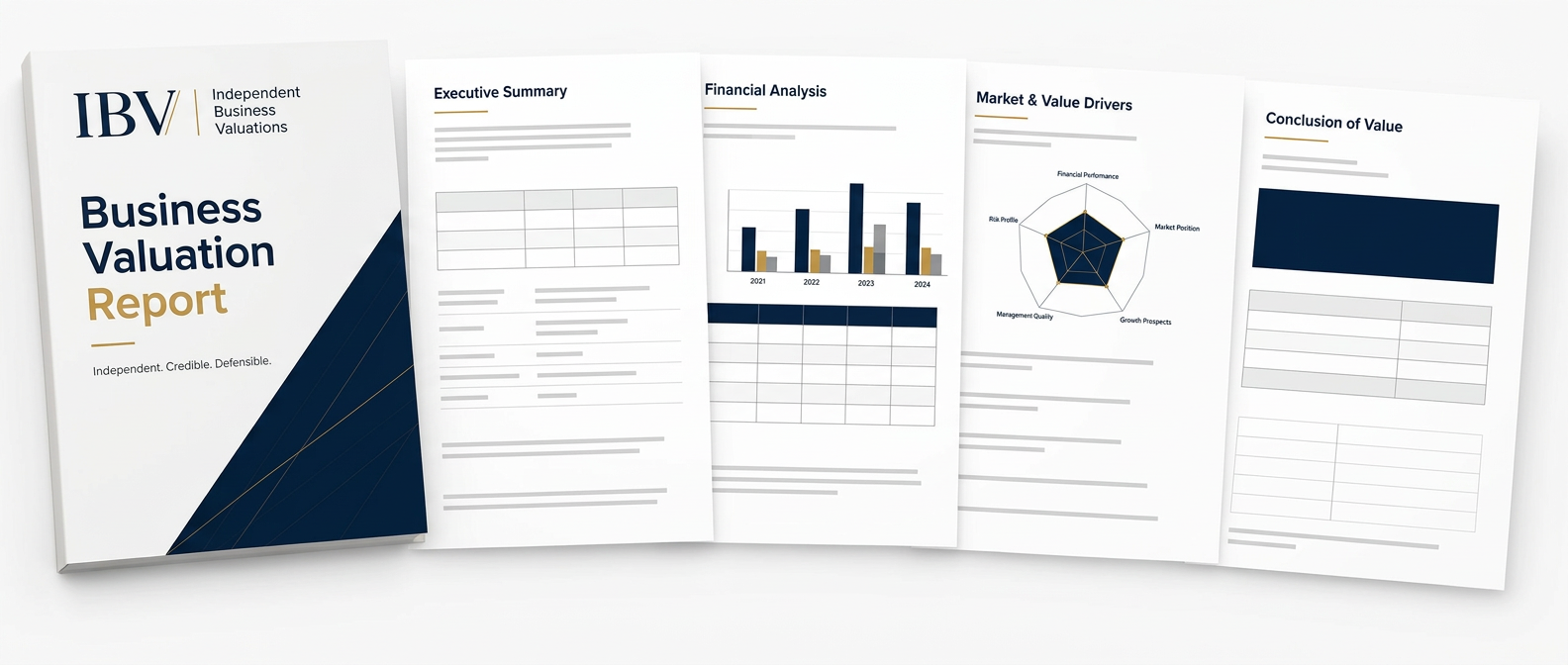
A clear, independent view of value — with the evidence behind it.
- Understand the conclusion — and what drives value.
- Gain an independent perspective. Move forward with confidence.
- Benchmark your business against industry performance.
- Identify strengths, risks and opportunities through SWOT analysis.
WHAT YOU GET IN A LIMITED SCOPE VALUATION REPORT
Inside your IBV™ report
Executive Summary
Conclusion of value · Method selected · Valuer qualifications
Detailed Report
Maintainable earnings · Cap rate / multiple · Premise of value
The Evidence Pack
SWOT analysis · Top Performers Report · RAVDA score
APES 225 voluntarily aligned. Report depth and supporting analysis follow your agreed package and engagement scope.
Free Valuation Call