

Key takeaways
A specialist's product is a reasoned opinion, not a sale or a tax return.
A business valuation specialist is engaged to reach and document an opinion of value for a defined purpose. Their fee is not tied to a sale, a loan or the number concluded, which is what keeps the opinion usable by others.
Check accreditation, independence and relevant experience.
Ask which valuation body accredits the valuer, which professional standard the work follows, how the fee is set and whether they have valued businesses of a similar size, structure and industry.
Purpose decides whether you need a specialist.
A casual conversation about value rarely does. Tax events, family law property settlements, shareholder changes, restructures and significant transactions usually call for a documented valuation that another party may review.
The scope sets the depth, and the scope is agreed first.
A specialist should confirm the subject, valuation date, basis of value, intended users and information available before quoting, then describe the resulting engagement in writing.
A good report lets a reader follow the reasoning.
The method, normalising adjustments, risk assessment, assumptions and limitations should be explained clearly enough for an adviser, the ATO or the other party to trace how the conclusion was reached.
What a business valuation specialist actually does
A business valuation specialist is engaged to answer one question: what is this business, or this interest in it, worth for a stated purpose at a stated date? The answer is an opinion supported by evidence, and the work is documented so that someone other than the owner can follow how the conclusion was reached.
That focus is what separates a specialist from the many other people who talk about value. A business broker estimates what the market might pay so that a listing can be priced. An accountant prepares financial statements and tax returns and may comment on value as part of a wider relationship. A lender assesses security. Each perspective is legitimate, but each answers a different question. A valuation specialist is engaged only to reach the opinion, and their fee does not change with the figure they conclude.
The day-to-day work is investigative. A specialist reconciles financial statements with tax returns and bank records, identifies owner wages and personal expenses that need adjusting, separates one-off items from repeatable earnings, and tests whether customers, contracts, staff and premises would transfer to a new owner. They then select a method the evidence can support, assess risk, cross-check the result and explain the reasoning in a written report.
Specialist, broker, accountant or appraiser?
The labels overlap in everyday language, so it helps to compare what each person is actually engaged to produce.
The distinction matters because the reader of the document changes the standard required. If the ATO, a former spouse's lawyer, a co-owner or a buyer's adviser will review the figure, the reasoning needs to survive their questions. Our guide to business appraisal vs business valuation explains that difference in more detail.
Business valuation specialist: an independent opinion of value for a defined purpose, documented in a report that sets out scope, method, assumptions and limitations.
Business broker: a market appraisal used to price and sell a business, usually linked to a commission when a sale completes.
Accountant: financial statements, tax compliance and general advice. Some accountants also hold valuation accreditation; many refer valuation work to a specialist.
Online calculator or informal appraisal: a quick indication based on limited inputs. It can help an owner ask better questions, but it is not a valuation and is not designed to be relied on by anyone else.
Credentials and standards worth checking
Australia does not license business valuers in the way it registers tax agents, so the owner has to check credentials directly. Useful questions include:
IBV™ is led by Dr Patrick Hillenbrand, AVI Certified Business Valuer. IBV™ is not bound by APES 225 as a mandatory member standard but voluntarily adheres to it, and the IBV™ Independence Guarantee commits to no commissions, no hourly billing and no fee linked to the value concluded.
Accreditation: is the valuer accredited by a recognised valuation body, such as the Australian Valuation Institute, and do they hold a designation specific to business valuation?
Professional standard: does the work follow, or voluntarily align with, APES 225 Valuation Services, which defines engagement types, independence expectations and reporting content?
Independence: how is the fee set? A fixed fee agreed in advance, with no commission and no link to the value concluded, removes an obvious conflict.
Experience: has the valuer worked on businesses of a similar size, ownership structure and industry, and for the same purpose you have in mind?
Reporting: can they show you the structure of a typical report, with client details removed, so you know what you will receive?

Signed
A clear valuation conclusion starts with an agreed purpose, relevant evidence and disclosed assumptions. The report identifies the interest valued and explains the reasoning behind its conclusion.
When a specialist valuation is worth commissioning
Not every conversation about value needs a specialist. If you are idly curious, a conversation with your accountant or broker may be enough. The case for a specialist grows when the figure will be relied on by someone who is not on your side of the table, or when a tax or legal outcome turns on it. Typical examples include:
In each case, the cost of a poorly supported number—an ATO review, a contested settlement or a mispriced deal—usually outweighs the professional fee.
Tax events: market value for capital gains tax, small business CGT concessions, related-party transfers or restructures, where the ATO's market valuation guidance expects a supportable, documented approach.
Family law: property settlements where business interests form part of the asset pool and both parties need a figure they can test.
Ownership changes: partner buyouts, shareholder exits, buy–sell agreements and succession planning.
Transactions: setting or testing a price before selling or buying, so negotiation starts from evidence rather than hope.
How the engagement should work
A well-run specialist engagement starts with questions, not a quote. The valuer should confirm what is being valued (the operating business, its assets or particular shares or units), the valuation date, the basis of value, who will rely on the report and what records exist. Only then can they recommend the right engagement and quote a fixed professional fee.
Under APES 225, which IBV™ voluntarily aligns with, the main engagement categories are a calculation engagement, a limited scope valuation and a full scope valuation. Each produces a different type of opinion and suits a different level of reliance. IBV™ explains how those categories map to its services, fees and timing on the Fixed Professional Fees page.
Once engaged, expect a document request, a conversation about how the business really operates, a draft for discussion and then a signed report. Throughout, the specialist should be able to explain every material adjustment and assumption in plain language.
What the finished report should let you do
The test of a specialist's work is whether it helps the people who rely on it. A good report should allow your accountant to use the figure in a tax position, a lawyer to understand how the value was reached, a buyer's adviser to test the earnings or a co-owner to see that the conclusion was not chosen to suit one party.
That means clearly stating the scope, sources of information, normalising adjustments, method, risk assessment, cross-checks, assumptions and limitations. It also means stating plainly what the report is not: it is not tax advice, legal advice or a guarantee of a sale price.
Warning signs when choosing a valuer
A few signals suggest the person offering a valuation may not be the right fit for a consequential decision:
None of these signs proves a valuation is wrong, but each is worth questioning before you rely on the result.
The fee depends on the result or on a sale. Commissions, success fees or a fee that rises with the value create a conflict, however well managed.
A figure is offered before records are reviewed. A credible specialist will not commit to a number before confirming the scope and examining the evidence.
No clear engagement type or standard. If the valuer cannot explain what kind of opinion you will receive and which standard the work follows or aligns with, the report may not meet a reader's expectations.
Reliance on a single rule of thumb. Industry multiples can be a useful cross-check, but a valuation built only on one is unlikely to survive scrutiny.
Reluctance to explain adjustments. You should be able to understand every material normalising adjustment and assumption.
Choosing the right specialist for your situation
Start with your purpose and the people who will rely on the figure. Then shortlist valuers who are accredited, independent of the outcome and experienced with similar businesses. Ask each for the engagement type they recommend, what records they will need, the fixed fee and the expected timing.
If you would like to talk through your situation, book a Free Valuation Call with IBV™. We will confirm the scope that fits your purpose before any work begins.
Sources and further reading
Frequently asked questions
What is a business valuation specialist?
A business valuation specialist is a professional engaged to reach and document an independent opinion of the value of a business, or an interest in it, for a defined purpose at a defined date. Their work focuses on evidence, method and reasoning rather than selling, lending or tax compliance.
Is a business valuation specialist the same as a business broker?
No. A broker prices and markets a business for sale and is usually paid a commission when it sells. A valuation specialist is paid a fee that does not depend on the value concluded or on any transaction completing, so the opinion can be relied on by other parties.
Are business valuers licensed in Australia?
There is no general government licence for business valuers. Owners should check accreditation with a recognised valuation body, the professional standard the valuer follows and their experience with similar businesses.
Source: Australian Valuation Institute
What standard should a business valuation specialist follow?
In Australia, APES 225 Valuation Services, which IBV™ voluntarily aligns with, is the recognised professional standard for valuation engagements. It defines calculation, limited scope and full scope engagements and sets expectations for independence and reporting. IBV™ voluntarily adheres to it.
When do I need a specialist rather than my accountant's opinion?
Consider a specialist when the figure will be relied on by the ATO, a court, the other party in a family law matter, a co-owner or a buyer, or when a tax or legal outcome depends on it. An informal estimate is unlikely to withstand that scrutiny.
Can a valuation specialist help with an ATO market value requirement?
Yes. The ATO expects market valuations to be undertaken by a suitably qualified person using a supportable, documented approach. A specialist report sets out the method, evidence and assumptions so your adviser can use it in the tax position.
Source: ATO — Market valuation of assets
What does a business valuation specialist need from me?
Typically three to five years of financial statements and tax returns, current management accounts, details of ownership, key contracts, leases, staffing and any owner or related-party arrangements. The specialist will confirm the list once the scope is agreed.
How much does a business valuation specialist cost?
Cost depends on the engagement type, purpose and complexity. IBV™ offers a Calculated Value at a fixed $2,450 + GST, a Limited Scope Conclusion of Value at a fixed $4,950 + GST, and a quoted Full Scope Conclusion of Value.
How long does a specialist valuation take?
For IBV™ Calculated Value and Limited Scope engagements, delivery is generally 5–7 business days after complete information and a signed engagement are received. Full scope timing is agreed at engagement.
Will a specialist guarantee the value is accepted?
No reputable specialist can guarantee acceptance by the ATO, a court or a buyer. What they can do is provide a well-supported, clearly explained opinion that gives your advisers the best basis for relying on it.
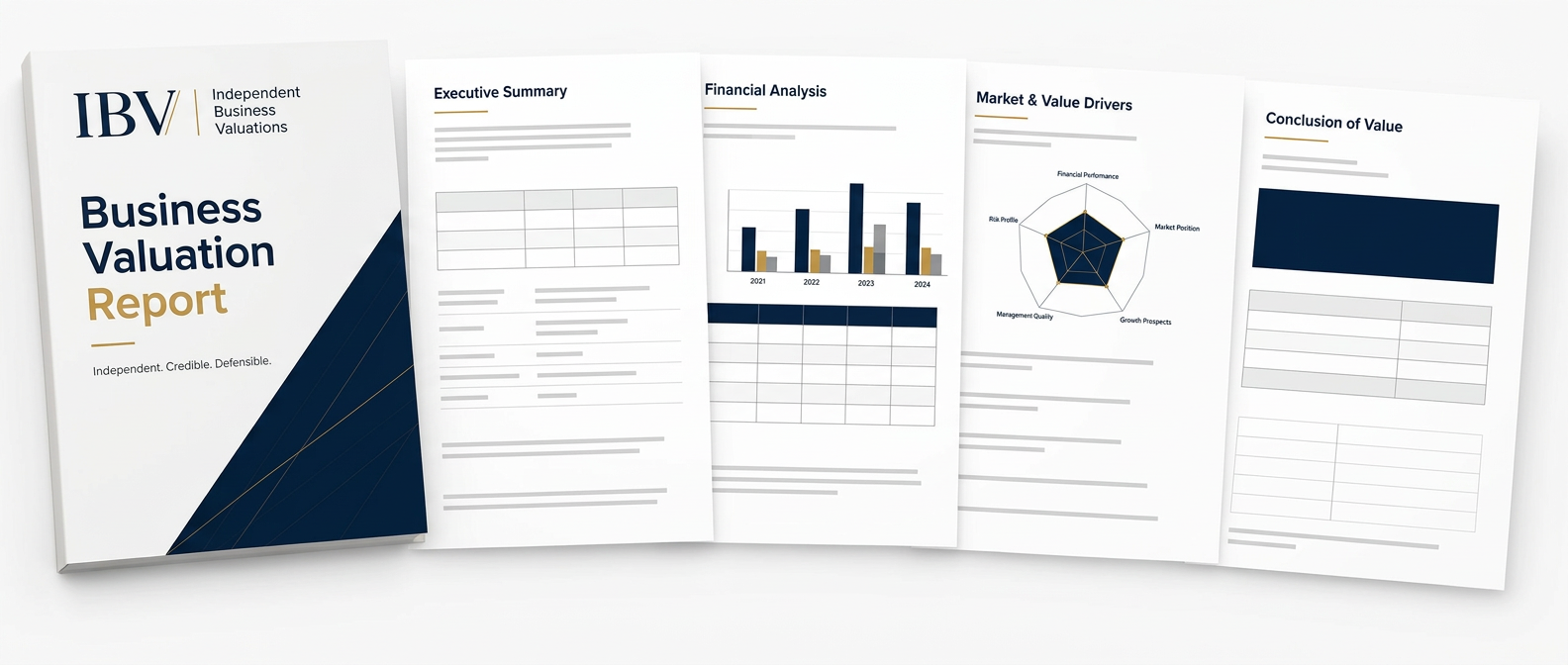
A clear, independent view of value — with the evidence behind it.
- Understand the conclusion — and what drives value.
- Gain an independent perspective. Move forward with confidence.
- Benchmark your business against industry performance.
- Identify strengths, risks and opportunities through SWOT analysis.
WHAT YOU GET IN A LIMITED SCOPE VALUATION REPORT
Inside your IBV™ report
Executive Summary
Conclusion of value · Method selected · Valuer qualifications
Detailed Report
Maintainable earnings · Cap rate / multiple · Premise of value
The Evidence Pack
SWOT analysis · Top Performers Report · RAVDA score
APES 225 voluntarily aligned. Report depth and supporting analysis follow your agreed package and engagement scope.
Free Valuation Call