
Key takeaways
Value the investment at the fund reporting date
An unlisted investment can change in value without a sale, so last year’s recorded amount or the latest available accounts may not support this year’s assessment. Obtain financial information reconciled to the fund’s exact reporting date, while leaving investment suitability and wider trustee responsibilities to appropriately qualified advisers.
Choose a method that reflects the underlying business
Accounting net assets may miss goodwill, meaning value from business advantages such as established relationships and systems, while an asset holding entity may require closer attention to recoverable assets and liabilities. Ask why the method fits the investment and how specialist values are reconciled without counting assets or income twice.
Explain changes in value with supporting business evidence
Changes in earnings, debt, distributions or ownership rights can move an investment’s value, while a revised figure may instead correct an unsupported earlier amount. Ask for a movement analysis and supporting records, checking the terms and independence of any transaction before using its price as evidence for the fund’s holding.
Prepare valuation evidence without assuming an audit outcome
An auditor needs supporting evidence about market value, and a valuation report is only one possible part of that evidence package. Agree an index of ownership records, financial information, calculations and limitations with your accountant, recognising that the auditor remains responsible for the opinion and may need further material.
Separate the assessed value from permission to transact
A supported market value does not establish whether a self managed superannuation fund may buy, retain or sell an investment, or determine its tax treatment. Ask qualified advisers to assess the applicable rules separately, and check dates and intervening changes before using an annual reporting figure for a transaction.
Identify the asset held by the fund
An SMSF may hold shares or units rather than directly own the operating business. The instruction should identify the actual holding, relevant date and intended reporting or transaction use. Trustees should coordinate with their accountant and auditor about the evidence required, rather than assume that a general business report will satisfy every question about the fund’s investment.
Provide ownership and financial evidence
Useful records include registers, deeds or constitutions, financial statements, current trading results and loan schedules. Explain related-party arrangements and any restrictions affecting distributions or transfer. Where the investment sits within a chain of entities, provide enough information to understand underlying operations and liabilities without assuming that a valuation of one entity automatically represents the fund’s entire economic exposure.
Reconcile business value to the holding
Analysis can move from operating value through debt, cash and other assets to the relevant equity interest. The rights and restrictions attached to the fund’s holding need separate consideration. Any adjustment for control or marketability should have a reasoned basis rather than being applied automatically, and uncertainty caused by limited access to investee information should be clearly identified.

Signed
A clear valuation conclusion starts with an agreed purpose, relevant evidence and disclosed assumptions. The report identifies the interest valued and explains the reasoning behind its conclusion.
Provide a dated evidence record
The report should state what was valued, at which date, using what records and methods. Supporting schedules can help trustees and advisers understand material assumptions and changes in the underlying business. The output remains subject to its agreed purpose and reliance terms; it should not be described as automatically accepted by an auditor or as a standing value for future periods.
Separate valuation from fund compliance
Investment rules, related-party restrictions and reporting obligations need advice specific to the fund. The report does not certify compliance or determine tax treatment. Division 296 valuation planning requires the accountant to confirm applicable legislation and the actual measurement question; no reset election, new cost base or date entitlement is assumed from commissioning valuation work.
Assemble evidence for the fund's exact reporting date
Obtain investee accounts and management information that support the fund's reporting date, not merely the most recently available annual report. If the dates differ, reconcile trading, distributions, new borrowings and capital changes across the gap. Unlisted investments can change materially even when no external transaction occurs. An unchanged book value is not, by itself, evidence of an unchanged market value.
The ATO's SMSF valuation guide addresses valuing fund assets at market value for accounts and other superannuation purposes. It also makes clear that the guide does not replace trustees' broader responsibilities. 1 The valuation engagement should therefore identify the particular holding and measurement purpose while leaving investment suitability and legal compliance questions with the trustees' appropriately qualified advisers.
Look through net assets where the business requires it
For an operating company, reported net assets may omit internally generated goodwill and may carry property or equipment at accounting amounts. For an asset holding entity, recoverable asset values and liabilities may be more important than a trading earnings multiple. Explain why the selected approach fits the underlying activities rather than defaulting to the method used in the previous fund accounts.
If specialist asset opinions are needed, coordinate their dates and assumptions with the holding valuation. Check that property income, commercial rent and business goodwill are treated consistently. A property value included in net assets should not also appear as an unadjusted surplus asset in a separate equity bridge. The report needs an intelligible reconciliation from the investee's economics to the fund's particular shares or units.
Investigate changes in unlisted investment value
Prepare a movement analysis covering earnings, debt, cash, distributions, asset revaluations and ownership rights. Distinguish an actual change in value from a correction to an earlier unsupported carrying amount. If a new investor subscribed at a different price, review the rights received and the circumstances of the transaction before treating that price as a benchmark for the fund's holding.
Related party transactions need particular care as evidence. A recorded transfer price may reflect an agreed accounting amount rather than independent bargaining. Likewise, a trustee's estimate does not become objective simply because it is repeated in successive financial statements. Request the underlying records and identify what corroborates the selected assumptions. The valuation conclusion should explain the evidence rather than merely reproduce a directors' resolution.
Anticipate audit questions without promising an audit result
Agree an evidence index with the trustee and accountant: ownership documents, investee financial information, specialist reports, calculations and explanations of significant movements. Keep the valuation date, report date and source dates visible. Where access to an investee is limited, describe what could not be obtained and why it matters instead of filling the gap with an unqualified assumption.
ATO guidance for SMSF auditors distinguishes the auditor's task of obtaining sufficient appropriate evidence from the task of valuing assets. 2 A valuation report can form part of the evidence provided, but the auditor retains responsibility for the audit opinion. Neither commissioning an external report nor adopting its conclusion guarantees that all audit evidence requirements have been satisfied.
Keep annual measurement separate from transaction permissions
A supported market value does not determine whether the fund may acquire, retain or dispose of the investment under the applicable superannuation rules. Nor does it determine contribution treatment, related party restrictions, in house asset treatment or tax consequences. Those matters can depend on facts beyond the financial valuation and require advice specific to the fund.
When a transaction and annual reporting occur near one another, confirm whether their dates, interests and assumptions actually match. Do not carry a reporting figure into a proposed transfer without checking intervening changes. The practical objective is a current, reviewable evidence package for the instructed purpose, not a standing certificate of value or a substitute for trustees' compliance decisions.
Scope, fees and timing
See our fixed-fee valuation packages and confirm the scope and fee before commissioning work. Confirm the purpose, intended users, information requirements and inclusions in a written engagement before work begins. Calculated Value and Limited Scope delivery is 5–7 business days from complete financial information and a signed engagement. Full Conclusion timing is confirmed individually in the engagement letter. Specialist requirements or changes to the instruction may affect suitability and timing; confirm these before relying on an external deadline.
Sources and further reading
Frequently asked questions
Do you value the whole business or the SMSF’s actual holding?
The instruction should identify the shares, units or other interest legally held by the fund. A whole-business value may need adjustment for debt, surplus assets and the rights of that holding. Provide the ownership chain so the report does not mistake an underlying company’s total value for the fund’s investment value.
Which date do we need for the SMSF annual accounts?
For annual accounts, trustees generally need market values at the financial year-end, commonly 30 June. Other events can require different dates. Ask the fund accountant to confirm the purpose and date before engagement, especially for contributions, pension events or transactions, rather than assuming the annual reporting figure answers every superannuation question.
Must we obtain an independent business valuation every year?
An independent report is not automatically required annually for every unlisted holding. Trustees still need objective and supportable market value evidence for the relevant reporting date. Discuss the investment’s complexity and changes with the accountant and auditor; an old report should not be rolled forward unchanged where important financial or ownership circumstances have shifted.
What evidence helps support unlisted shares held by our fund?
Provide company accounts, current trading information, ownership registers, governing documents and significant transactions. Underlying asset values, liabilities and transfer restrictions can matter. The ATO expects objective and supportable evidence, so a director’s unsupported estimate or a historic purchase price alone may be insufficient to support the holding’s current market value.
Can the company’s net asset figure stand in for market value?
Not automatically. Book assets may differ from market values, and an operating business may have goodwill or risks not captured in net assets. The appropriate method depends on the investment and evidence. A conclusion should explain why the selected approach measures the fund’s actual interest at the required date.
Does a valuation make a related-party acquisition by our SMSF permissible?
No. A market value report does not resolve acquisition restrictions, in-house asset rules or other superannuation compliance questions. Ask a qualified SMSF adviser to review the proposed investment before proceeding. Valuation evidence may support a required measurement, but it cannot convert a prohibited transaction into an allowable one.
How are restrictions on selling the fund’s shares considered?
Provide the constitution, shareholder agreement and any transfer approvals or pre-emption terms. Their relevance depends on the actual rights and the required valuation basis. Do not assume the holding equals its percentage of total business value, or that a standard discount applies without evidence and analysis of the investment’s circumstances.
Will the report guarantee our SMSF auditor accepts the value?
No. The auditor independently assesses whether sufficient appropriate evidence supports the financial statements. Agree the investment, date and evidence expectations with the accountant and auditor before commissioning work. The report can explain methods and assumptions, but additional enquiries may still arise and audit acceptance cannot be promised.
What if the business deteriorates after the fund’s year-end?
Tell the accountant and valuer what happened and when. Later information may reveal a condition already present at year-end or reflect a genuinely new event. The valuation should assess evidence relevant to the instructed date rather than automatically replacing the year-end figure with either today’s value or the last available estimate.
What is the next step for a hard-to-value SMSF investment?
Send the fund’s holding details, ownership chain, required date and the auditor’s specific questions for scoping. A Fixed Professional Fee is agreed upfront. Allow 5–7 business days after complete records and a signed engagement. Missing underlying entity records should be identified before annual return deadlines drive the engagement. This 5–7 business-day timetable applies to Calculated Value and Limited Scope only; Full Conclusion delivery is confirmed individually in the engagement letter.
A clear, independent view of value — with the evidence behind it.
- Understand the conclusion — and what drives value.
- Gain an independent perspective. Move forward with confidence.
- Benchmark your business against industry performance.
- Identify strengths, risks and opportunities through SWOT analysis.
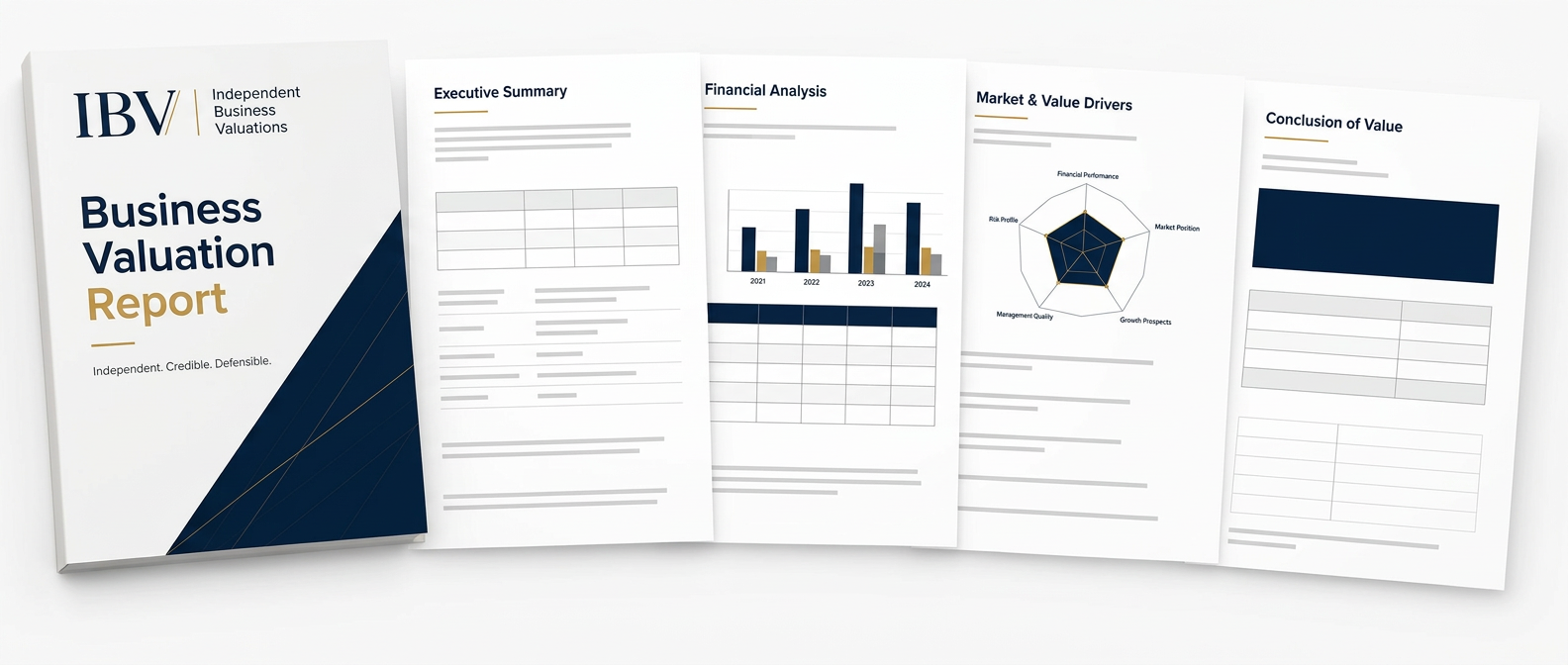
WHAT YOU GET IN A LIMITED SCOPE VALUATION REPORT
Inside your IBV™ report
Executive Summary
Conclusion of value · Method selected · Valuer qualifications
Detailed Report
Maintainable earnings · Cap rate / multiple · Premise of value
The Evidence Pack
SWOT analysis · Top Performers Report · RAVDA score
APES 225 voluntarily aligned. Report depth and supporting analysis follow your agreed package and engagement scope.
Free Valuation Call