

Key takeaways
Define what moves—not just the agreed price.
Establish whether assets, shares or units transfer, the rights involved and the relevant date. A price agreed between related parties does not by itself demonstrate market value.
Choose the approach that fits the business and evidence.
The principal approaches are market, income and cost. Capitalisation of earnings and discounted cash flow are income methods; asset-based valuations may draw on several approaches. Choose according to the business, interest and evidence—not the parties’ preferred result.
A sophisticated model cannot fix unsupported inputs.
Test forecasts, owner remuneration, related-party rent and asset records. Method selection should explain why the available information supports the analysis.
Bridge business value to the specific ownership interest.
Consider relevant debt, cash, non-operating assets and the rights being transferred. Control and transfer restrictions require evidence, not mechanical adjustments.
Explain differing indications and keep advice separate.
Reconcile methods and show why alternatives were adopted, cross-checked or rejected. Legal and tax advisers confirm transaction requirements; the report does not guarantee treatment.
Define the subject before the method
Transferring business assets is not the same as transferring shares or units. Establish what rights and obligations move, whether control changes and what date applies. Related parties may agree a price, but that agreement alone does not demonstrate market value. The valuation needs an independent reasoning trail appropriate to the instruction.
Understand what each approach answers
Three principal valuation approaches are commonly recognised: market, income and cost. The market approach draws on comparable transactions, the income approach considers future economic benefits through methods such as capitalisation of earnings or discounted cash flow, and the cost approach considers replacement costs. Asset-based valuations may also draw on market evidence when assessing individual assets. The appropriate approach and method depend on the business, the interest being valued and the available evidence.
Ask whether the information supports the approach
Are forecasts grounded in contracts, demonstrated margins and credible capacity? Are historical earnings distorted by owner remuneration or related party rent? Do asset records reflect what is actually owned and required to operate? Method selection should explain the quality of those inputs. Using a sophisticated model cannot repair assumptions that lack a defensible foundation.

Signed
A clear valuation conclusion starts with an agreed purpose, relevant evidence and disclosed assumptions. The report identifies the interest valued and explains the reasoning behind its conclusion.
Reconcile the steps to the interest
Distinguish operating business value from the value of equity after relevant debt, cash and non-operating assets are considered. Assess the rights of the specific interest rather than automatically treating every share as an equal fraction of a controlling business value. Any treatment of control or transfer restrictions needs evidence and an explanation, not a mechanical adjustment.
Show why alternative indications differ
A useful deliverable is a method selection note and reconciliation, explaining why approaches were adopted, used as cross-checks or rejected. Where indications differ, investigate differences in earnings, funding, asset inclusion and assumptions before choosing a conclusion. This is an explanation of reasoning, not an invented transaction example or a numerical demonstration without supporting evidence.
Why the agreed price is not the whole question
Related parties may have reasons for a transfer that differ from the motivations of unrelated market participants. A family succession, group restructure or shareholder rearrangement can involve terms shaped by the relationship. That does not automatically make the price wrong, but it means the agreement should not be assumed to provide independent market-value evidence without investigation.
A transaction between related parties is not automatically non-arm's-length. The actual circumstances and independence of the negotiations matter. Where the applicable tax provisions require market value, the agreed transfer price may need to be tested against independent valuation evidence.
Ask the legal or tax adviser whether market value is required for the particular transaction and under which instruction. Rules differ by asset, provision and circumstances. A valuation report should answer the agreed measurement question; it should not promise a tax outcome or imply that every related-party transfer is governed by one universal rule.
The relationship is also not a reason to choose the method producing the lowest or highest number. Method selection follows the business economics, subject interest and available evidence. The conclusion should be explainable to someone who was not involved in the family's or group's negotiations.
Distinguish an asset transfer from a share transfer
An asset transfer can move selected operating assets or an agreed bundle of business components. A share transfer concerns an ownership interest in an entity with its assets, liabilities and attached rights. The two are not interchangeable merely because they ultimately relate to the same trading activity.
Define inclusions before choosing a method. Identify equipment, inventory, goodwill, intellectual property, contracts and any obligations included or excluded. For shares or units, obtain governing documents and the terms of the holding. The legal adviser should clarify what can transfer and whether consents or restrictions apply.
A premises asset owned elsewhere in the group needs special attention to the boundary. Its ownership should not be confused with the right of the operating business to occupy it. The commercial occupancy arrangements may affect earnings, while the property's value may require separate assessment.
Use capitalisation of earnings where earnings are supportable
Capitalisation of maintainable earnings is a method within the income approach, considering sustainable economic benefits and their risk. It can be useful where historical performance and operating evidence provide a reasonable foundation. The analysis should explain the periods considered, changes in activity and adjustments needed to reflect the instructed operating assumptions.
Related-party arrangements can distort the starting figures. Rent may not reflect commercial terms, management services may be provided without charge, or owner remuneration may differ from necessary replacement costs. Investigate the arrangements rather than assume every related-party item should be removed. Some costs remain necessary even if their current recipient changes.
The selected multiple or capitalisation rate also needs a reasoned basis. An industry label alone cannot establish the relevant risk, growth, concentration or transferability. The report should connect its assumptions to evidence about the subject and explain the relevance of any market observations.
Use cash-flow analysis where forecasts can be tested
Discounted cash flow (DCF) is another method within the income approach, examining the timing and risk of future cash generation. It may be useful where a business is changing and supportable forecasts describe the transition better than a single historical earnings figure. That usefulness depends on the quality of the forecast and assumptions, not the model's complexity.
Test revenue projections against contracts, capacity and credible operating plans. Consider the staff, assets and working capital needed to deliver the forecast. Distinguish cash available to the operating business from cash available to equity and use consistent funding assumptions throughout.
Sensitivity analysis can help identify which assumptions materially influence the result. It should not become a menu from which the parties select their preferred number. If small changes in uncertain inputs produce large changes in value, the uncertainty deserves explicit explanation and possibly further evidence before reliance.
Use asset evidence for the question it can answer
An asset-based valuation may be relevant where asset ownership drives economics, ongoing earnings are weak or the instruction concerns specified assets. It is not necessarily a standalone principal approach: individual assets may be assessed using market, income or cost techniques, including replacement-cost methods where appropriate. It requires evidence about ownership, condition, market value and relevant liabilities rather than unquestioned reliance on accounting balances.
Accounting depreciation does not automatically measure market value. Conversely, a list of valuable equipment does not by itself explain transferable goodwill or future business earnings. An asset-based conclusion and an earnings-based conclusion can address different aspects of the subject; the report should explain how each is used.
Avoid adding all operating assets to an earnings conclusion without considering overlap. The equipment and working capital used to generate earnings may already be reflected in the assessed operating value. Separate non-operating assets carefully and explain the reconciliation so the same component is not counted twice.
An illustrative related-party rent example
This hypothetical scenario is not an actual IBV assignment. A trading company occupies premises owned by a related entity. Its recorded rent is below the level supported by the documented commercial evidence, and the transfer instruction assumes the business continues under commercial occupancy terms. An earnings analysis would need to investigate the effect of that assumption on maintainable profit.
The answer is not automatically to add the property's value to the business, remove the rent entirely or retain the historical rent without review. First define whether the transaction concerns shares, operating assets, premises or a combination. Then align the occupancy costs and asset boundaries with that instruction.
If the parties propose different future terms, document them and ask whether those terms belong in the instructed basis of value. The legal and tax advisers determine their transaction consequences. The valuation explains the commercial measurement and assumptions rather than deciding that any related-party arrangement produces a particular tax result.
Bridge operating value to the specific interest
Where the subject is equity, relevant cash, debt and non-operating assets may need reconciliation from operating value. Identify related-party loans and other material balances, including their terms and any unresolved factual issues. A balance in the accounts can require investigation before its treatment is settled.
The rights of the holding matter too. Review voting, distributions, transfer restrictions and contractual exit provisions. A minority holding should not automatically be treated as a simple percentage of a controlling business value, nor should a standard discount be applied merely because the holding is small. Any treatment must follow the instructed basis and supporting evidence.
State whether the conclusion concerns the entire equity or a specific class and percentage. Without that identification, a reader can mistakenly use a whole-business number as the value of the asset actually transferred.
Reconcile approaches rather than average blindly
Different methods may produce different indications because they use different earnings, asset, funding or risk assumptions. Investigate the cause before assigning weight. A mechanical average can conceal an inconsistent boundary or an unreliable input instead of resolving it.
Explain why an approach was adopted, used only as a cross-check or rejected. If the evidence cannot support a method, disclose that rather than fill the gap with a preferred transaction outcome. The report should retain the source trail and limitations needed for another professional to inspect the reasoning.
For a wider method overview, read how to value a business in Australia. If the instruction concerns an earlier date, also review retrospective CGT valuation evidence. An independent method choice is useful when it answers the correctly defined question with supportable evidence.
Coordinate the legal instructions
Ask advisers to confirm the transaction structure and legal or tax requirements independently. The report supports their analysis without guaranteeing treatment. See related-party transfer valuations and the central fees page. Many standard valuations can be completed within approximately 5–7 business days after all required information, clarifications, signed engagement documents and payment have been received. Timing is confirmed before work begins.
Sources and further reading
This guide provides general information, not legal or tax advice. Examples are illustrative, not client cases or market benchmarks. Your adviser should confirm the requirements applicable to your transaction.
Frequently asked questions
Can book value establish market value in a related-party transfer?
Not automatically. Accounting balances reflect particular recognition and measurement rules and may differ from the amount relevant to the instructed valuation. Review the asset or interest, effective date and market evidence. Your tax adviser determines whether market value is required for the particular transaction.
Source: ATO: market valuation of assets
How can related-party rent affect method selection?
Compare recorded rent with lease terms and evidence, then assess whether earnings need adjustment. Rent can affect maintainable earnings and an earnings-based indication. Document related-party terms and adjustment rationale; do not assume recorded rent is commercial.
Does a business valuation automatically include its premises?
No. Define whether the subject is the operating business, property, shares or another interest, and list included assets and liabilities. Identify property outside scope and arrange separate evidence if needed. Clear boundaries help avoid overlap between operating and property values.
Source: ATO market valuation of assets
What transaction information should be supplied for a related-party transfer?
Provide the agreement, transfer date, rights moving, payment terms, conditions and any independent offers. These details define the asset and help test comparability. The ATO identifies related-party transfers as circumstances where market valuation may be needed.
Source: ATO market valuation of assets
When might a cash-flow method be useful in a transfer valuation?
A cash-flow method may be considered when forecasts and evidence allow future cash generation, investment needs and risk to be assessed. The method cannot compensate for unsupported projections. Ask the valuer to explain forecast sources, assumptions and sensitivity, and why the approach fits the specific interest and purpose.
How are minority or restricted interests considered in a transfer?
Identify voting, distribution, transfer and other rights in the governing documents, alongside the interest being transferred and its context. Do not assume that a pro-rata share of whole-business value represents the specific interest without analysis. Any adjustment requires a reasoned basis consistent with the assignment and applicable valuation framework.
What makes a valuation method defensible for a related-party transaction?
Link the purpose and subject interest to evidence, assumptions, methods and cross-checks; explain alternatives and limitations. APES 225 applies to members within its scope. IBV voluntarily aligns with APES 225; applicability is not universal.
Why might different valuation methods produce different results?
Methods examine different aspects of value and depend on their inputs. Differences may reflect earnings assumptions, asset treatment or market comparability; the report should explain which approach suits the business, purpose and date.
Source: ATO: market valuation of assets
Is the agreed transfer price proof of market value?
An agreed price between connected parties is not automatically independent market evidence. The circumstances, terms and available external evidence need assessment before that price can be relied on.
Source: ATO: market valuation of assets
Can the valuation determine the tax consequences of a transfer?
No. The valuation addresses the instructed commercial measurement. Your accountant or lawyer determines the applicable tax and legal consequences, including whether a particular market-value requirement applies.
Source: ATO: market valuation of assets
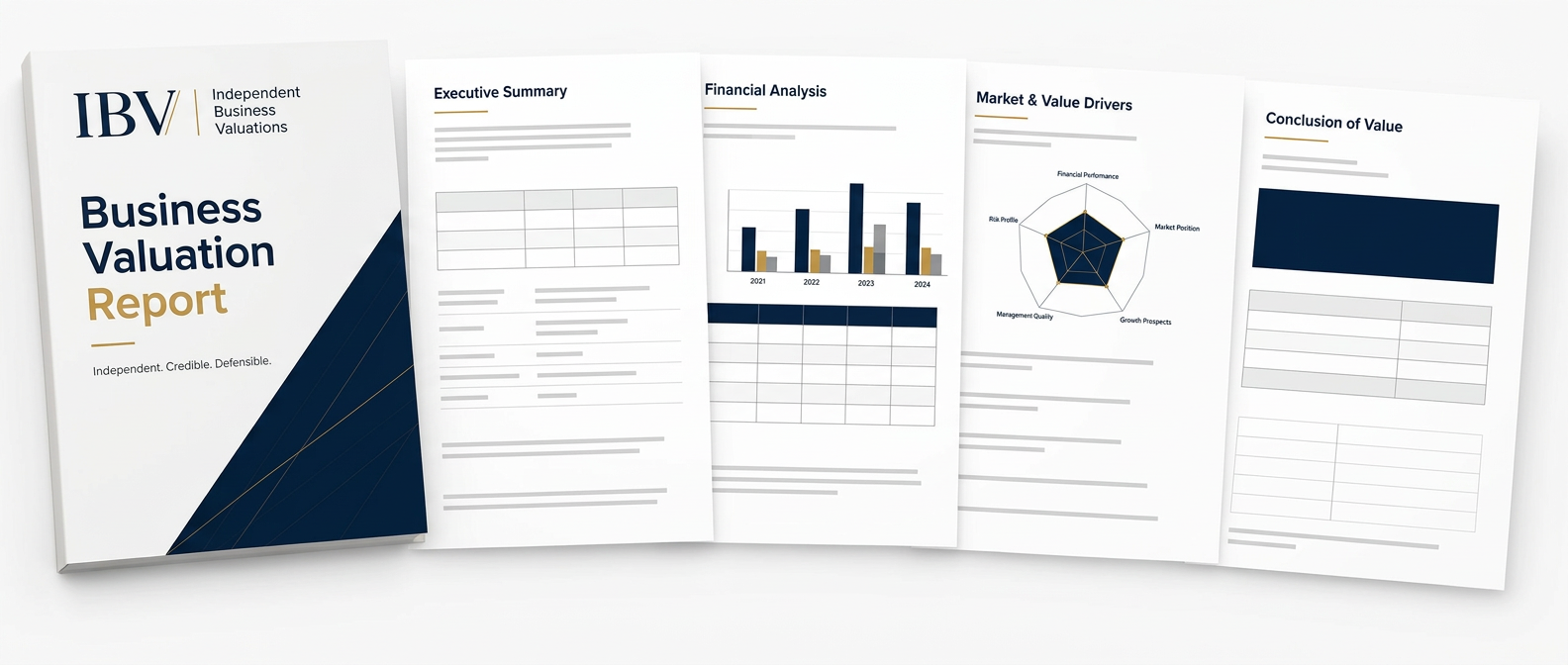
A clear, independent view of value — with the evidence behind it.
- Understand the conclusion — and what drives value.
- Gain an independent perspective. Move forward with confidence.
- Benchmark your business against industry performance.
- Identify strengths, risks and opportunities through SWOT analysis.
WHAT YOU GET IN A LIMITED SCOPE VALUATION REPORT
Inside your IBV™ report
Executive Summary
Conclusion of value · Method selected · Valuer qualifications
Detailed Report
Maintainable earnings · Cap rate / multiple · Premise of value
The Evidence Pack
SWOT analysis · Top Performers Report · RAVDA score
APES 225 voluntarily aligned. Report depth and supporting analysis follow your agreed package and engagement scope.
Free Valuation Call