

Look beyond consolidated turnover in a Melbourne valuation
A business with several outlets, teams or sales channels can have uneven economics beneath one set of accounts. An independent Melbourne business valuation should explain which earnings belong to the instructed operation, what resources sustain them and what would remain after an ownership change.
IBV™ offers direct access to Dr Patrick Hillenbrand, AVI Certified Business Valuer, and a report with its evidence, assumptions and limitations. The IBV™ Independence Guarantee and Fixed Professional Fee agreed in writing support an engagement defined by purpose and date. APES 225 alignment is voluntary; it does not remove the need to confirm intended users and reporting requirements.
Reconcile outlets and channels before assessing maintainable earnings
Prepare results by outlet or channel, then reconcile them to the accounts. Explain where purchasing, marketing, administration and management costs are recorded. An outlet that appears profitable before its share of central costs may contribute less than its sales suggest.
If an online channel and physical stores share stock or staff, clarify allocation and fulfilment costs. Identify whether the period includes a new opening, closure, refurbishment or unusual trading interruption. The goal is to understand representative earnings, not to remove every expense that makes performance look weaker.
City of Melbourne information relates to its municipality. It should not be treated as evidence of conditions at every metropolitan site. Match the period and local coverage of contextual data to the business's own customer and trading records.
Evidence the team that can operate without the current owner
Workforce context can prompt useful questions, but access to a metropolitan labour market does not prove that replacement staff are available at the assumed cost. Record the owner's duties, hours and responsibilities, then identify which functions would transfer to existing employees or require recruitment.
Include remuneration, employment on-costs, training and transition requirements where relevant. Customer relationships may sit with a team, a founder or a particular practitioner; the financial accounts alone do not reveal which. Retention records, contracts and operational documentation help explain transferability without assigning a blanket goodwill premium.

Signed
A clear valuation conclusion starts with an agreed purpose, relevant evidence and disclosed assumptions. The report identifies the interest valued and explains the reasoning behind its conclusion.
Hypothetical Melbourne scenario: a strong outlet supporting a weak one
Imagine a fictional two-outlet business in which one location supplies stock, staff cover and management to the other. Combined revenue is growing, but the second outlet has not demonstrated sustainable earnings after those resources are recognised. This is an explanatory scenario, not a client case or valuation conclusion.
Before a sale valuation, establish whether both outlets will transfer together. If only one transfers, assess the resources it needs independently and any support obligations remaining with the seller. Lease commitments, equipment ownership and agreed working-capital arrangements need consistent treatment.
For a shareholder exit, clarify the holding and intended valuation basis with the relevant adviser. An ownership dispute does not make every agreed amount or method legally applicable; interpretation of governing documents remains a legal question.
Prepare sale or acquisition evidence before relying on the asking price
Business Victoria's buyer and sale-preparation guides encourage financial and legal investigation. Use them to organise accounts, asset and liability information, leases and relevant records. An asking price expresses the seller's position; it does not establish the value of the interest or prove that all required operating assets are included.
For acquisition work, identify what the buyer will receive and which costs change after transfer. For tax-related work, obtain the accountant's valuation-date instructions. IBV can then assess the evidence for the defined question and explain significant uncertainty rather than turn a headline sales figure into an unsupported valuation.
Start your Melbourne valuation
Book a Free Valuation Call to tell us what you own, why you need the valuation and when you need it. We will confirm the documents required, recommend the reporting scope and provide a Fixed Professional Fee quote.
Standard delivery is generally 5–7 business days after complete information and a signed engagement are received.
We serve Melbourne owners through document review and scheduled discussions. Any required site visit or specialist assessment is agreed separately. Tax, legal and transaction advice remains with your professional advisers; a valuation does not guarantee acceptance by an authority or a particular sale price.
Melbourne business resources
These local and Victorian resources help Melbourne owners prepare records and research the trading environment. City of Melbourne information covers its municipality, not the whole metropolitan area; choose sources appropriate to each operating site.
Council advice for your operation
City of Melbourne Business Concierge offers business support, council-requirement guidance and referrals. Use it to explore questions affecting premises, permits or a planned operational change before a sale or acquisition.
City trading conditions
Melbourne Economy Snapshot provides city activity insights for business decisions. Compare the relevant period and municipality with your own site trading rather than assuming city trends apply to all Melbourne outlets.
Checking a business before purchase
Business Victoria’s buyer assessment guide covers financial checks, assets, liabilities and valuation. For a multi-site acquisition, reconcile branch results and shared costs before relying on consolidated turnover or the asking price.
Sale-ready financial and legal evidence
Business Victoria’s sale-preparation guidance outlines financial and legal preparation before sale. Identify leases, assets and records that need review so the proposed transfer and valuation scope are clear.
Frequently asked questions
How is a Melbourne business with several outlets valued?
Start with accounts for each outlet and reconcile them to the consolidated statements. Identify shared staff, internal sales and central overheads to avoid double counting. The analysis should explain which sites generate sustainable earnings and which depend on support elsewhere, rather than assuming every Melbourne outlet performs alike.
Which Victorian lease records matter when selling a Melbourne retail outlet?
For premises covered by Victorian retail leasing rules, obtain the lease, disclosure statement, variations and assignment correspondence. Transfer can involve disclosure and landlord consent considerations. The valuation should identify unresolved occupancy assumptions rather than assume the buyer can continue operating on identical terms; your solicitor should confirm the applicable requirements.
Source: Victorian Small Business Commission: transferring a retail lease
What records matter for Melbourne food outlets in different council areas?
Collect registration or notification records and relevant food safety documents for each premises. Victorian councils classify food premises and determine applicable requirements. Check evidence outlet by outlet and confirm ownership-change requirements with the relevant councils; documentation for one site does not establish the regulatory position of another.
Source: Victorian Department of Health: starting a food business
Can a founder’s salary be added back across a Melbourne outlet group?
Not automatically. If the founder supervises managers, negotiates supply terms or handles marketing, those duties may continue after a sale. Document the work and assess appropriate replacement costs before adjusting earnings. Removing remuneration without recognising necessary replacement management could overstate the profit available to a purchaser.
How should head-office costs be allocated between Melbourne branches?
Use a documented allocation reflecting how branches consume management, payroll, marketing and other shared services. Reconcile allocations to group accounts. If only one branch is being valued, investigate which central functions a buyer would need to replace rather than simply retaining its historic share of group overheads.
Should Melbourne shop sales and online sales be analysed separately?
Where their economics differ, separate sales, fulfilment costs, returns and marketing spending. Identify orders collected or serviced through shops to avoid counting the same transaction twice. Channel records should reconcile to the accounts and show whether the channels are independently profitable or rely on each other.
How do Melbourne outlet openings and closures affect maintainable earnings?
Distinguish establishment and closure expenditure from costs needed to keep the remaining network operating. Provide opening dates, trading histories, fitout invoices and refurbishment plans. A new outlet forecast is not established performance, while recurring refurbishment needs should not disappear simply because the latest expenditure was unusually large.
Does owning a Melbourne shop’s premises increase its business value?
First establish whether the assessment covers the operating business, the property or both. Related-party occupancy arrangements may require an appropriate rental assumption when assessing business earnings. Separately assessed property interests should be clearly identified so property value is not confused with goodwill or counted twice in a combined conclusion.
How is stock transferred between Melbourne outlets treated?
Reconcile transfers to group stock records and remove internal markups from consolidated analysis where appropriate. Review stock ageing, saleability and inventory needed for normal trading. The report should state how stock and working capital are treated rather than assume all recorded inventory is additional to an earnings-based value.
What shows that a Melbourne outlet network can operate without its founder?
Prepare an organisation chart, delegated authorities, operating procedures and evidence of managers’ actual responsibilities. Identify relationships still controlled personally by the founder. The assessment can then distinguish established management capability from a proposed handover; having several outlets does not itself demonstrate that the business operates independently.
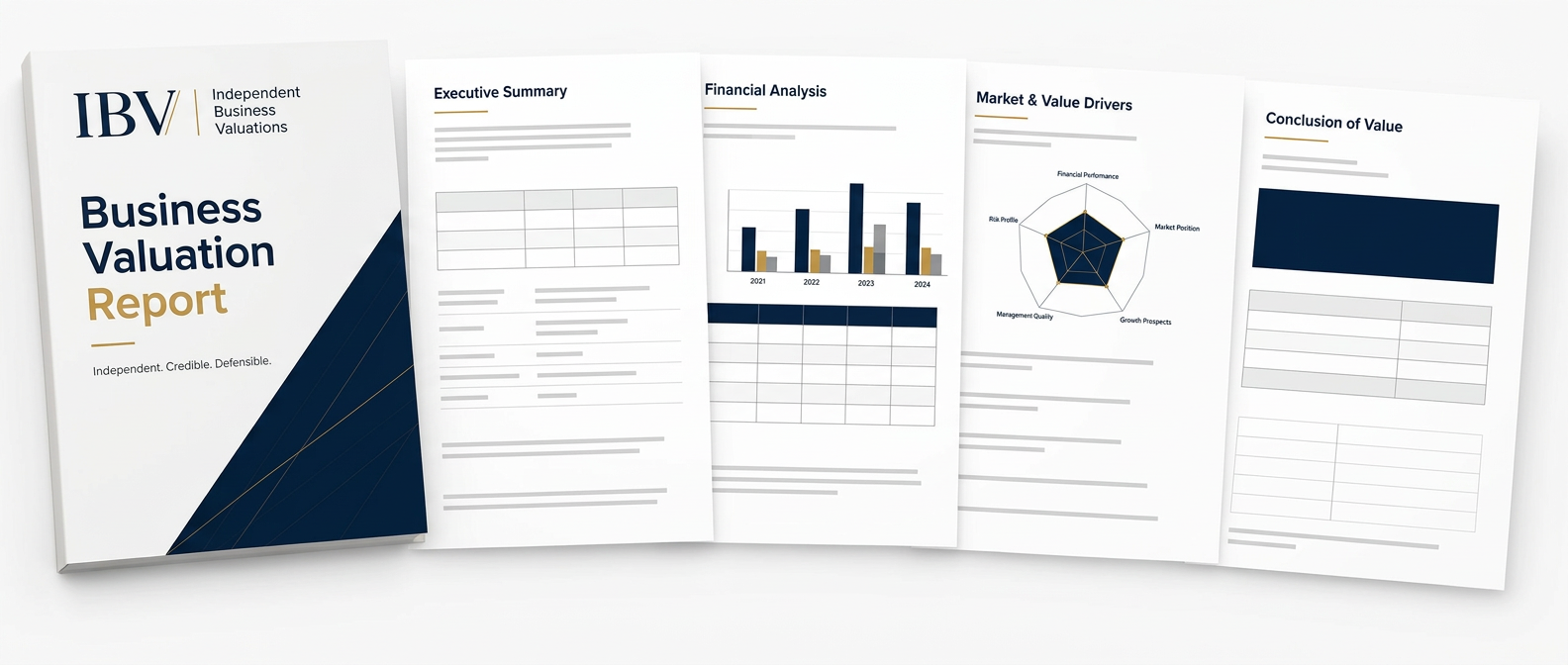
A clear, independent view of value — with the evidence behind it.
- Understand the conclusion — and what drives value.
- Gain an independent perspective. Move forward with confidence.
- Benchmark your business against industry performance.
- Identify strengths, risks and opportunities through SWOT analysis.
WHAT YOU GET IN A LIMITED SCOPE VALUATION REPORT
Inside your IBV™ report
Executive Summary
Conclusion of value · Method selected · Valuer qualifications
Detailed Report
Maintainable earnings · Cap rate / multiple · Premise of value
The Evidence Pack
SWOT analysis · Top Performers Report · RAVDA score
APES 225 voluntarily aligned. Report depth and supporting analysis follow your agreed package and engagement scope.
Free Valuation Call