

Key takeaways
Every adjustment needs evidence, not just a buyer-cost question.
Check that the expense reduced the selected earnings measure, whether it recurs and whether the underlying function remains necessary. A market participant's expected costs under the valuation assumptions matter; an unusual repair does not remove the need for ordinary maintenance.
Adjust expensed owner remuneration—not drawings that never reduced profit.
Reverse only pay already charged in the accounts, then allow for the commercial cost of necessary management and staff duties, including on-costs. Drawings, dividends and distributions that did not reduce earnings are not add-backs, and unpaid owner work may require a deduction.
Family wages and related-party rent require balanced review.
Evidence establishes what relatives actually do and the commercial cost of replacing that work. Examine related-party rent against market terms while respecting enforceable lease rights and obligations relevant to the interest being valued; market rent is not an automatic substitute.
Define the earnings measure before applying a multiple.
Net profit, EBIT, EBITDA and cash flow differ. In the fictional example, normalised EBITDA is $145,000; deducting $15,000 maintenance capital expenditure leaves $130,000 before interest, tax, working-capital movements and other adjustments—not complete free cash flow.
Unsupported income and speculative savings must not inflate value.
Independently established omitted receipts need investigation and accounting or tax advice, not automatic dismissal or acceptance. Future improvements may inform forecasts only where credible evidence, implementation costs and the adopted valuation basis support them.
What normalised earnings are—and why your tax profit is not the answer
Business accounts record historical results under the applicable accounting and tax requirements; they are not automatically a measure of sustainable earnings for valuation. Owner remuneration, related-party arrangements and unusual events can affect the reported result. Private expenditure is not automatically tax-deductible simply because the business pays it, and any incorrect accounting or tax treatment needs separate attention.
Normalised earnings close that gap. A valuer adjusts reported profit so it reflects what a hypothetical owner could expect to earn from the business in future, after paying commercial rates for everything the business needs. The Australian Government's guidance on valuing a business describes earnings-based approaches as one of the main ways a business is valued; normalisation is what makes the earnings figure in those approaches meaningful.
Each adjustment is called an add-back (when it increases earnings) or a deduction (when it reduces them). Owners naturally focus on add-backs. A careful valuation applies both—and the deductions are often where a figure prepared for negotiation and a figure that survives scrutiny part company.
The evidence tests each adjustment must pass
“Would a new owner still pay this?” is a useful starting question, not a complete valuation test. Each proposed adjustment must be supported by evidence and reflect the ongoing economics of the business under the adopted valuation assumptions.
Consider whether the expense recurs, whether the underlying function remains necessary, and what a market participant would reasonably expect to incur. A flood repair may be exceptional while ordinary maintenance still needs an allowance. A claimed saving may sound plausible but require contracts, staffing evidence or achievable implementation plans before it can be recognised.
Check that the item actually reduced the reported earnings being adjusted, and that it has not already been addressed elsewhere. Document the amount, evidence and reason for both add-backs and deductions. Our guide to what your business is worth explains why sustainable earnings matter more than a headline profit figure.
Owner remuneration: the largest and most misunderstood adjustment
In an owner-operated business, the owner's own work is usually the biggest single issue. Some owners pay themselves well above market; many pay themselves little, take drawings, or draw distributions from a trust instead of a salary.
The valuer identifies the owner's remuneration already included in reported expenses and adjusts it to reflect the commercial cost of performing the necessary duties. Drawings, dividends and distributions that have not reduced reported earnings are not added back. The ATO's guidance on salaries, wages and super contributions distinguishes sole-trader payments to themselves from company salary, wage and director remuneration arrangements. If you work 55 hours a week as general manager, estimator and lead salesperson, a buyer cannot replace you with one modest salary. They may need a manager plus part of another role, with superannuation, leave and on-costs.
That replacement cost can be higher than the remuneration already charged in the accounts, including where an owner takes drawings but no wage expense is recorded. In that case the adjustment reduces earnings. It can explain why an owner's expected value and an evidence-based value differ: the business has been benefiting from labour it did not fully pay for.

Signed
A clear valuation conclusion starts with an agreed purpose, relevant evidence and disclosed assumptions. The report identifies the interest valued and explains the reasoning behind its conclusion.
Family members on the payroll
Wages paid to a spouse, children or other relatives need the same arm's-length review. Three patterns are common:
Evidence matters. Rosters, duty statements and payroll records show what work is actually performed. A statement that a family member "doesn't really do anything" carries little weight if they answer the phones every morning.
Paid but not working in the business. The amount already expensed may be added back if evidence establishes that no necessary work or replacement cost is being overlooked.
Working but underpaid or unpaid. The valuer adds the commercial cost of that work, which reduces earnings.
Working and paid about market rate. No adjustment is needed.
Personal and discretionary expenses
Vehicles, phones, travel, meals, school fees or private insurance sometimes pass through business accounts. Where a cost is genuinely personal and a new owner would not incur it, it may be added back. Where the cost is partly business—a vehicle also used for site visits, for example—only the private portion is removed.
Two cautions apply. First, the add-back needs evidence: invoices, logbooks or general ledger detail, not round figures from memory. Second, if personal costs were claimed as business deductions, there may be a tax question that sits outside the valuation. The ATO's record-keeping guidance for selling a business is a reminder that a buyer's adviser will examine the same records. A valuer documents the adjustment; your tax adviser addresses the tax treatment.
One-off, non-recurring and abnormal items
Unusual costs or income—a resolved legal dispute, flood repairs, a profit on selling an old vehicle or a historical grant—need investigation rather than automatic removal. An adjustment may be appropriate where evidence shows the item is not representative of ongoing trading under the valuation assumptions. Ordinary maintenance, insurance recoveries and any related income or costs must also be considered so the adjustment is balanced.
The key word is genuinely. Repairs, recruitment, software changes and legal advice recur in most businesses, just in different forms each year. If "one-off" costs appear in every one of the last four years, a reviewer will treat them as part of normal trading. A credible valuation removes truly unusual items and leaves the ordinary irregularity of business life in place.
Related-party rent and other non-arm's-length arrangements
Many owners hold premises in a separate trust or SMSF and charge the business rent. Related-party rental arrangements should be examined against commercial market terms, supported by a rent review, comparable leases or a property valuer's opinion. Any enforceable lease rights and obligations relevant to the interest being valued must also be recognised: a binding lease is not automatically replaced with today's market rent. Management fees, shared staff and equipment also need review. Related-party loans require separate consideration of their terms and the selected earnings measure, including avoiding double-counting financing adjustments.
This is also where our article on related-party transfers becomes relevant: a related-party transaction is not automatically non-arm's-length, but any market value used for tax purposes needs support, and its market valuation guidance explains what a supportable valuation should document.
Depreciation, capital expenditure and what EBITDA leaves out
First define the earnings measure. Net profit after tax, EBIT (earnings before interest and tax), EBITDA (earnings before interest, tax, depreciation and amortisation) and cash flow are not interchangeable. A selected multiple or capitalisation rate must be consistent with the earnings measure, valuation basis and interest being valued. The ATO's market valuation guidance emphasises supportable, documented inputs and assumptions.
Depreciation is an accounting allocation of an asset's cost. Maintenance capital expenditure is cash investment required to sustain operations; it is not the same item and may differ significantly in amount and timing. EBITDA excludes depreciation and amortisation but does not deduct maintenance capital expenditure. A valuation using EBITDA still needs to account for reinvestment appropriately, without deducting it again if already reflected elsewhere. Our EBITDA multiples guide explains why an unadjusted EBITDA multiple can mislead.
Claims and add-backs that need scrutiny
Business cash receipts must be declared and properly recorded; the ATO's business record-keeping guidance explains the underlying obligations. Evidence of an economic fact does not excuse non-compliance.
Unsupported unrecorded income. A verbal claim of omitted cash receipts must not inflate earnings. Independently established omissions require investigation, reconciliation and accounting or tax advice. Correcting records is different from accepting an unsupported claim, and does not resolve tax obligations by itself.
Costs the business still needs. Advertising, bookkeeping and essential subscriptions cannot simply be removed without evidence that the function or cost can genuinely be eliminated under the valuation assumptions.
Owner salary removed with no replacement. Removing expensed remuneration without allowing for necessary management work overstates earnings. Drawings that never reduced profit are not an expense add-back.
Speculative future savings. Credibly supported operating improvements may inform cash-flow forecasts where consistent with the valuation basis. Savings not yet achieved must be distinguished from historical normalisation and allow for implementation costs, timing and risk.
Double-counted items. Do not adjust the same expense twice or disregard enforceable lease obligations when reviewing related-party rent.
A worked example (fictional figures)
A fictional fit-out business reports profit before interest and tax (EBIT) of $180,000, after charging depreciation of $24,000. There is no amortisation in this example. Interest and income tax are outside this starting measure, so neither is added back again. If starting with profit after tax instead, a separate reconciliation of interest and tax would be necessary.
The following adjustments produce normalised EBITDA, not net profit or free cash flow. Assume that each expense listed was actually charged in the reported result; payroll figures include applicable employment on-costs; evidence supports the private and exceptional items; and no enforceable lease provision requires a different rental treatment.
Normalised EBITDA: $145,000. The adjustments to operating costs first produce normalised EBIT of $121,000; adding back $24,000 depreciation then produces EBITDA of $145,000.
Separately, assume annual maintenance capital expenditure of $15,000, supported by the equipment condition and replacement schedule. Normalised EBITDA less this expenditure is $130,000. That is an illustrative pre-interest, pre-tax operating cash surplus before working-capital movements and other relevant cash-flow adjustments—not complete free cash flow or a defined earnings figure ready for capitalisation. Depreciation of $24,000 and maintenance expenditure of $15,000 are deliberately shown separately.
The owner's add-back-only calculation is $180,000 + $40,000 + $30,000 + $12,000 + $18,000 = $280,000. It omits replacement management and the rent deduction, and does not reconcile depreciation to a defined EBITDA measure. It is therefore not directly comparable with the $130,000 cash-surplus illustration.
Differences in maintainable earnings can have a substantial effect on value when an earnings capitalisation method is appropriate. The size of that effect depends on the selected capitalisation rate or multiple. No valuation multiple is assumed here, and these fictional figures are not a valuation of a real business.
Reported EBIT: $180,000
Add back expensed owner remuneration: +$40,000
Deduct replacement management cost, including superannuation and other employment on-costs: −$135,000
Add back expensed spouse remuneration, with evidence of no necessary work performed: +$30,000
Add back evidenced private vehicle and travel costs: +$12,000
Add back exceptional legal costs from a resolved dispute, assumed not representative of ongoing costs: +$18,000
Deduct the supported related-party rent shortfall under the assumed lease treatment: −$24,000
Add back depreciation charged in EBIT to reach EBITDA: +$24,000
How to prepare your add-backs before a valuation
List each proposed adjustment with the amount, the year, a one-line explanation and the supporting evidence. Separate items you are sure of from items you think might be personal or one-off. Give the valuer your general ledger detail, not only the summary profit and loss.
That preparation keeps the engagement efficient and the conclusion defensible. It also shows a buyer, adviser or the ATO that the adjustments were made on principle rather than to reach a preferred number. If you are unsure which scope suits your purpose, our Fixed Professional Fees page explains the three engagement levels; most purposes where others will rely on the figure begin with a Limited Scope Conclusion of Value.
Frequently asked questions
What are normalised earnings in a business valuation?
Normalised earnings are reported profits adjusted to show what the business would earn under a new, arm's-length owner. Owner remuneration, family wages, personal costs, related-party rent and genuinely one-off items are adjusted so the earnings reflect ongoing commercial reality.
What is an add-back?
An add-back increases the selected earnings measure by reversing an amount already expensed, where evidence and the valuation assumptions justify that treatment. A personal or exceptional cost may qualify, but recurring functions, replacement costs and associated income must also be considered.
Can I add back my own salary?
Only remuneration already charged as an expense can be reversed. The valuer then allows for the commercial cost of performing your necessary duties, including employment on-costs. Drawings, dividends or distributions that did not reduce reported earnings are not added back. If necessary work is underpaid or unpaid, the adjustment can reduce earnings.
Can wages paid to my spouse or children be added back?
Only if they perform no work a new owner would need. If they do work, the valuer keeps a market wage for that work. Rosters, duty statements and payroll records are used to establish what they actually do.
Can personal expenses run through the business be added back?
Genuinely personal costs that a new owner would not incur can be added back if they are evidenced, for example by invoices or a vehicle logbook. Mixed-use costs are adjusted only for the private portion. Any tax implications are a separate matter for your tax adviser.
Can undeclared cash income be included in my business value?
Unsupported claims must not inflate earnings. If omitted receipts are independently established, the valuer investigates and reconciles the evidence, with accounting or tax advice needed to address incorrect records and compliance. Recognising supported economic facts does not excuse failure to declare income.
How is rent paid to my own trust or SMSF treated?
Compare the arrangement with supported commercial market terms, while recognising enforceable lease rights and obligations relevant to the interest being valued. Where a market-rent adjustment is appropriate, above-market rent can increase normalised earnings and below-market rent can reduce them; it is not an automatic substitution for a binding lease.
Is EBITDA the same as normalised earnings?
No. Normalisation can be applied to EBIT, EBITDA or another clearly defined measure. EBITDA excludes interest, tax, depreciation and amortisation; it does not deduct maintenance capital expenditure. Reinvestment and working-capital requirements must be considered appropriately, and any valuation multiple must match the earnings measure.
Why did my valuation come in lower than my broker's figure?
Often because of normalisation. Informal figures frequently add back owner wages and other costs without deducting the commercial cost of replacing the owner's work or adjusting related-party rent. An evidence-based valuation applies adjustments in both directions.
What should I prepare for the valuer about add-backs?
A list of each proposed adjustment with the amount, year, explanation and evidence, plus your general ledger detail for at least three years. Separate items you are certain of from items that need discussion.
Source: APESB: APES 225 Valuation Services (IBV™ aligns voluntarily)
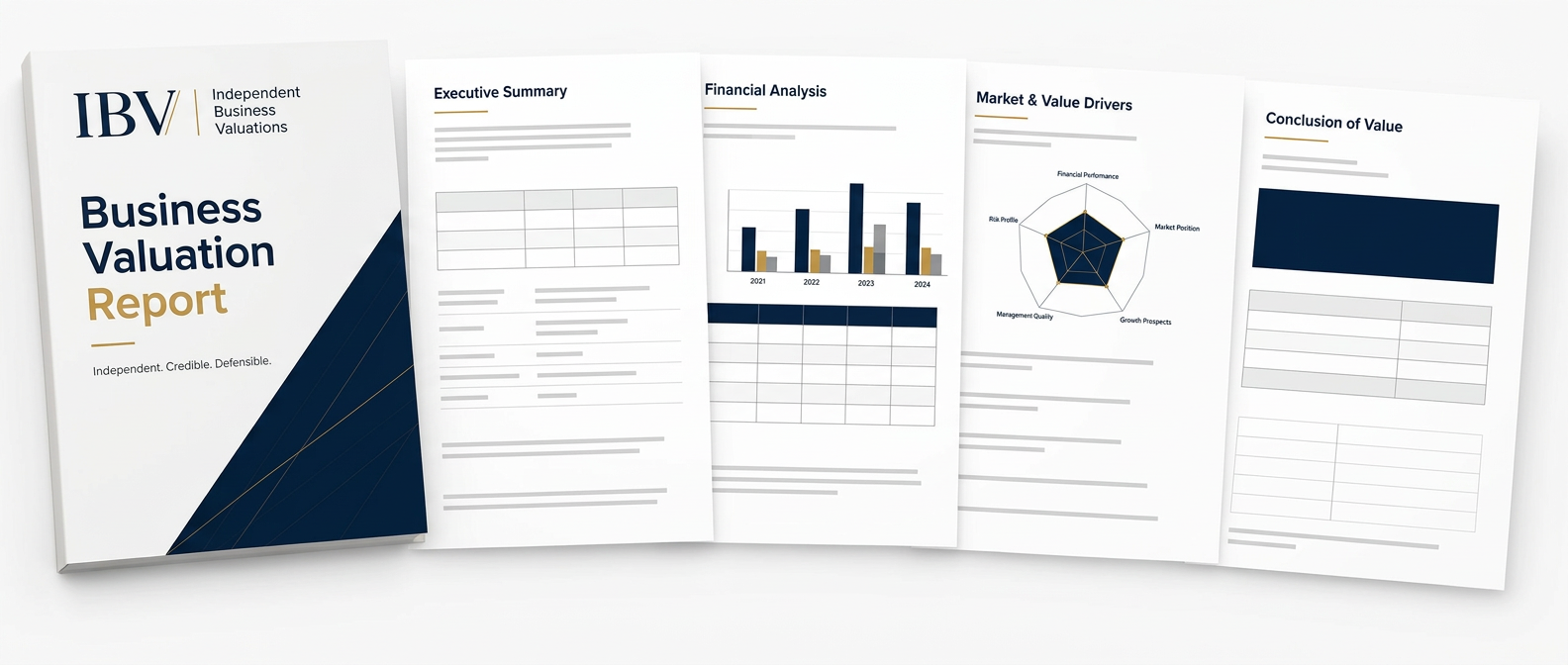
A clear, independent view of value — with the evidence behind it.
- Understand the conclusion — and what drives value.
- Gain an independent perspective. Move forward with confidence.
- Benchmark your business against industry performance.
- Identify strengths, risks and opportunities through SWOT analysis.
WHAT YOU GET IN A LIMITED SCOPE VALUATION REPORT
Inside your IBV™ report
Executive Summary
Conclusion of value · Method selected · Valuer qualifications
Detailed Report
Maintainable earnings · Cap rate / multiple · Premise of value
The Evidence Pack
SWOT analysis · Top Performers Report · RAVDA score
APES 225 voluntarily aligned. Report depth and supporting analysis follow your agreed package and engagement scope.
Free Valuation Call