

Key takeaways
Separate service and project economics.
Analyse technician utilisation separately from fixed-price margins and procurement exposure.
Validate estimating discipline.
Use completed jobs to test whether forecast labour, materials and overhead are achievable.
Identify genuinely accessible cash.
Distinguish liquidity from trust funds, collateral and procurement-to-collection funding needs.
Follow obligations beyond completion.
Assess rectification, guarantees and recovery without assuming every security is a loss.
Keep margin loss separate from payment delay.
Reconcile profitability and delayed receipts without double counting working capital and earnings adjustments.
Profit on paper must survive completion of the work
A trade contractor or construction business can report revenue before the cash and final job outcome are known. The valuation should understand the accounting policy for work in progress, the stage of each material contract and the costs still needed to finish. An order book is not equivalent to a bank balance or an unconditional earnings stream.
Evidence questions for the engagement
Prepare job costing, signed contracts, approved variations, claims, retentions, debtor ageing and subcontractor commitments. Which variations remain disputed? Have expected completion costs been updated? Identify warranties, defects obligations and any performance security. Where jobs are recorded at different stages, explain how their reported margins reconcile to the financial statements rather than relying only on the latest management summary.
Test the economics, not just the accounting total
Owner involvement may include quoting, licensing, site supervision and customer acquisition. These functions need explicit replacement assumptions. Check whether plant is owned, leased or provided by related entities and whether its cost is reflected consistently. Contractor status, licensing and contractual transfer restrictions can require legal advice; the valuation should identify relevant uncertainty without offering a legal determination.

Signed
A clear valuation conclusion starts with an agreed purpose, relevant evidence and disclosed assumptions. The report identifies the interest valued and explains the reasoning behind its conclusion.
A useful reporting deliverable
The key deliverable is a contract completion and working capital reconciliation. It should show how recoverable work, remaining costs and obligations inform the earnings assessment and explain the boundary between operating assets and business goodwill. The report should also distinguish committed work from tenders so unawarded projects do not silently become part of established earnings.
Distinguish production capacity from quoted revenue
Contracting models create different risks. Maintenance work may depend on technician utilisation, travel and callout density; projects may commit labour and materials months before collection. Separate these activities before interpreting consolidated margins. A strong service division can conceal fixed-price installation losses, while a major project may temporarily inflate turnover without proving repeat demand.
For field services, examine productive versus paid hours, first-time completion and return visits. For installations, compare labour allowances with site hours, mobilisation and waiting. Higher charge-out rates mean little if access delays or scheduling erode capacity. Sustainable forecasts should reflect deliverable work rather than desired sales. Identify whether additional revenue requires more supervisors, vehicles, quoting resources or specialist labour and reflect these costs consistently instead of applying growth to the current cost base unchanged.
Reconstruct how estimating becomes margin
Review completed jobs alongside current work for systematic estimating errors. Compare allowances with material usage, subcontract packages, productivity and site overhead. Separate unusual events from recurring omissions such as supervision, waste disposal, accommodation or commissioning. Repeated reliance on optimistic variations to recover estimating shortfalls can indicate weaker economics than headline margins suggest.
Examine approval limits, supplier quote validity and the process for updating rates. Fixed-price commitments can lock in exposure before procurement. Where forecasts assume better buying terms or productivity, seek implementation evidence before applying an immediate uplift. Support margin expectations through particular contracts and proven operating changes, not an unexplained industry adjustment. Record which procurement commitments are fixed and which remain exposed, linking uncertainties to the relevant jobs rather than assume one generic cost increase affects every contract equally.
Model accessible cash, not just bank balances
Construction cash can move differently from profit. Materials may need deposits, payroll may be weekly and claims may be assessed later. Link procurement, site progress, billing and receipts in a monthly funding profile. Investigate whether apparent cash generation depends on accelerated customer deposits or delayed subcontractor payments.
Queensland's trust-account framework distinguishes project and retention trust accounts for eligible arrangements. Such funds should not be assumed freely available for general operations. Do not generalise this state framework nationally; obtain advice on the applicable contracts and jurisdiction. Identify commercial implications for liquidity, working capital and finance. Review borrowing headroom and guarantees rather than assume facilities continue after a transfer. Cash needed to complete customer-funded work should be considered consistently with outstanding obligations and forecast margins.
Trace obligations beyond practical completion
Physical completion may not end economic exposure. Review defects, repeat call-backs, disputed deductions, insurance notifications and remedial spending. Distinguish a known repair from ordinary expected rectification across the portfolio. Consider who performs the work, site access and realistic subcontractor recovery.
Obtain a register of bank guarantees, collateral, expiry conditions and release requests. Face value is not automatically an expected loss, but collateral may restrict cash and renewals may consume borrowing capacity. Legal and insurance advisers assess enforceability and coverage. Reflect supported costs and funding restrictions, specifying whether they affect earnings, net assets or equity reconciliation. Do not assume insurance covers every exposure or deduct a full security amount simply because it remains outstanding. Review whether recorded provisions and forecasts already capture the issue before adding another adjustment.
Test people, customers and procurement continuity
Map who coordinates access, solves technical problems and secures repeat work, beyond job titles. Customer relationships may sit with an estimator, supervisor or coordinator. Check whether drawings, price histories and maintenance records are available to the wider team.
Measure concentration by contribution and unpaid exposure as well as revenue. One principal may represent modest annual sales but dominate claims and future work. Specialist components create dependencies where lead times are long or substitutions require approval. Assess realistic delegation, documentation and transition arrangements. Licences, prequalification, contract consents and credit facilities may need adviser or counterparty confirmation; do not presume transferability. Review the cost of replacing an owner's quoting, supervision and relationship duties while considering whether those responsibilities can reasonably be covered by current personnel.
Hypothetical example: margin erosion and a funding delay
This illustration is not a client case or dispute-recovery prediction. A contractor prices a project on forecast material and labour costs. Revised procurement reveals additional expenses, reducing expected margin. An unapproved variation should not automatically restore the original profit expectation: investigate its basis and recoverability separately.
Customer receipts are also delayed while wages and suppliers remain payable. That creates a funding requirement distinct from margin erosion. Payment procedures differ by jurisdiction; Queensland guidance illustrates its own claims, schedules and adjudication framework, not a universal national outcome. Advisers assess the actual recovery pathway. The valuation should reconcile revised earnings, recoverable balances and finance without double counting a loss. Sensitivities should distinguish a temporary timing gap, an unrecoverable receivable and further completion costs because each affects the business differently.
Sources and further reading
Frequently asked questions
Does a large order book automatically mean a higher value?
Not necessarily. Contract margins, completion costs, cancellation rights, customer concentration and the resources required to deliver the work all matter. Revenue yet to be earned should not be confused with secured profit.
How are owner wages and subcontractors treated?
Sustainable earnings need to reflect the commercial cost of running the business. Owner remuneration, subcontractor arrangements and workforce availability are reviewed using supporting records rather than automatic add-backs.
What project information should I provide?
Alongside financial statements, provide work-in-progress schedules, contract terms, debtor ageing, retention balances, plant details and relevant licence information. Explain outstanding disputes, warranty obligations or material project risks.
Do contractor licences transfer when a trade business is sold?
Do not assume they do. Identify licences held by the entity and individuals, their jurisdictions and conditions. Requirements vary by activity and location; confirm them with the relevant regulator. A valuation assesses the business evidence but does not authorise a buyer to perform licensed work.
How are construction retentions assessed in a business valuation?
Provide balances by project, release conditions, expected timing and any disputes. Retentions can affect cash availability and working-capital requirements even where revenue is recognised. Assess recoverability from contracts and supporting records rather than assuming each ledger balance will be collected in full.
How do defects and warranty obligations affect contractor value?
Disclose open claims, rectification estimates, relevant commitments and insurance information. These may affect future costs and project margins. Provide supporting evidence and distinguish known liabilities from uncertain exposures; legal or technical advice may be required to assess matters beyond the valuation scope.
Do tenders and quotes count as secured construction work?
Separate awarded contracts and approved variations from submitted tenders, quotations and expressions of interest. Provide award status, commencement expectations and cancellation conditions. A pipeline may inform forecasts, but prospective work should not be presented as committed revenue without evidence of the relevant commitment.
How are plant and vehicles treated in a trades valuation?
Identify ownership, finance, leases, condition and replacement requirements. Explain whether assets belong to the trading entity or a related party and reconcile any hire charges. Their treatment must align with the selected valuation method so operating assets and earnings are not counted twice.
How can slow-paying customers affect a construction business valuation?
Provide debtor ageing, collection history, disputed invoices and payment terms. Earnings and cash collection are different measures: recorded revenue may still require funding while a business waits to be paid. Assess recoverability and normal working-capital requirements using the evidence at the valuation date.
Does a profitable project mean the contractor has sustainable earnings?
Not necessarily. Compare project outcomes across relevant periods and examine cost allocation, variations and completion costs. One exceptional job may not represent normal performance. Sustainable earnings should reflect the resources and risks needed to deliver the business’s ongoing work, not only its best project.
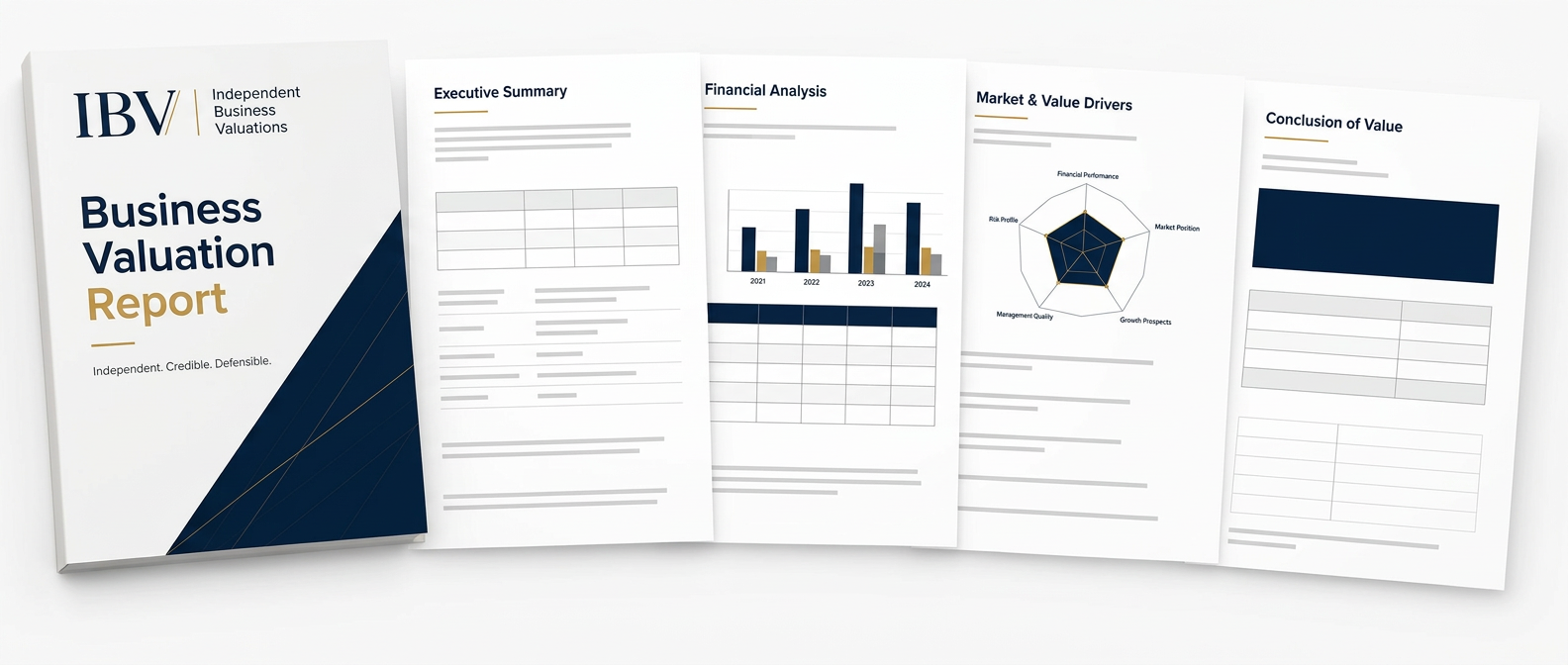
A clear, independent view of value — with the evidence behind it.
- Understand the conclusion — and what drives value.
- Gain an independent perspective. Move forward with confidence.
- Benchmark your business against industry performance.
- Identify strengths, risks and opportunities through SWOT analysis.
WHAT YOU GET IN A LIMITED SCOPE VALUATION REPORT
Inside your IBV™ report
Executive Summary
Conclusion of value · Method selected · Valuer qualifications
Detailed Report
Maintainable earnings · Cap rate / multiple · Premise of value
The Evidence Pack
SWOT analysis · Top Performers Report · RAVDA score
APES 225 voluntarily aligned. Report depth and supporting analysis follow your agreed package and engagement scope.
Free Valuation Call