

Key takeaways
Occupancy must reconcile to receipts.
Assess sessions, attendance, discounts, subsidy receipts and family collections by weekday and age group.
Staffing creates capacity thresholds.
Test growth against qualified staff availability, roster cover and replacement owner duties; use current award classifications and phased 2026 rates.
Subsidised hours do not guarantee revenue.
The 3 Day Guarantee affects eligible families' subsidised hours, not guaranteed places or receipts. Reconcile wage funding with employment costs, fee restrictions and its announced term.
Premises and operating goodwill are distinct.
Define property inclusions, support rent assumptions and review lease continuity.
Approval continuity needs two separate checks.
Distinguish NQF service-approval transfer from the purchaser's own CCS approval. Review phased child-safety obligations and renewal costs without assuming uninterrupted earnings.
Capacity is not the same as sustainable occupancy
A childcare centre’s approved capacity describes a limit, not its realised revenue or profit. The valuation should examine actual attendance patterns, fee collection and the staffing needed to provide care. Clarify whether the engagement covers the operating business, shares in its owner or a business with separately held premises.
Evidence questions for the engagement
Prepare room level occupancy, enrolment and attendance reports, fee policies, payroll, staffing rosters and the lease. How much booked attendance converts to paid revenue? Are concessions, absences or unpaid balances material? Explain the difference between physical capacity and practical capacity under current staffing and room arrangements. De-identified summaries are preferable to disclosing children’s personal information.
Test the economics, not just the accounting total
Consider wage commitments, management coverage, required qualifications and the cost of maintaining facilities. Operating permissions, provider arrangements and change of ownership processes need specialist review where relevant; a valuation is not a finding that approvals will transfer. A related party rent adjustment should be supported and should not quietly include the separately owned real estate in business goodwill.
Ownership changes and approval continuity
A childcare business sale may involve separate National Quality Framework and Commonwealth Child Care Subsidy approval requirements. A service approval may be transferred between approved providers with the required regulatory consent and notification, while Commonwealth CCS approval cannot simply be transferred to a different provider. The acquiring provider must obtain its own CCS approval for the service.
Identify outstanding applications, transition conditions and potential interruption to operations or subsidy receipts before assuming uninterrupted earnings following completion. Confirm transaction-specific requirements with the relevant regulatory authority and qualified advisers; the valuation does not grant approvals or confirm a purchaser's eligibility.
Child safety and regulatory compliance
Child safety reforms introduced progressively during 2025 and 2026 strengthened requirements under the National Quality Framework. Measures commencing on 27 February 2026 included enhanced Working with Children Check requirements, mandatory child-safety training provisions, digital-device safeguards and the National Early Childhood Worker Register. Other reforms commenced earlier; assess the applicable requirements and implementation deadlines rather than assigning the entire package one start date.
Review the centre's compliance history, quality assessments, corrective actions and ongoing costs of meeting applicable requirements. Unresolved regulatory matters may affect future expenditure, operational continuity and business risk, but do not automatically justify an arbitrary reduction in value. This review identifies valuation dependencies; it is not a full regulatory-compliance audit by IBV.

Signed
A clear valuation conclusion starts with an agreed purpose, relevant evidence and disclosed assumptions. The report identifies the interest valued and explains the reasoning behind its conclusion.
A useful reporting deliverable
The deliverable should connect attendance evidence to sustainable earnings through an occupancy and staffing reconciliation. It should flag consent or approval assumptions and explain how premises terms influence continuity. Simple capacity comparisons can be useful prompts for investigation, but without context they do not establish what a particular centre or ownership interest is worth.
Reconcile occupancy with collected revenue
An occupancy percentage needs a defined denominator and a connection to receipts. Compare approved places, places offered, booked sessions, physical attendance and billed sessions by weekday and age group. A strong weekly average can conceal persistent vacancies on particular days or demand in rooms unable to accept more children without operational changes.
Reconcile session reports to invoices, discounts, subsidy receipts, family payments and outstanding balances. Distinguish temporary enrolment incentives from established pricing. Review departures, commencements and waiting-list conversion rather than treating every enquiry as future revenue. Demand evidence should support the forecast period and local catchment, not repeat a capacity target. De-identified records can establish these patterns without circulating children's personal information.
Model staffing as a stepped cost
Staffing expenditure does not necessarily rise smoothly with enrolments. Additional attendance can require another qualified educator before the associated fees cover the full employment cost. Conversely, a vacancy may reduce revenue without permitting a corresponding roster reduction. Model attendance mix alongside opening hours, breaks, leave cover, programming and management duties.
ACECQA explains that educators must work directly with children to count towards educator-to-child ratios, with requirements differing by age and jurisdiction. Qualification requirements also matter to centre-based services. These are operational assessment inputs, not permission to assume a low payroll is sustainable. Review actual rosters, qualifications, agency invoices, overtime and vacancies. Include supported replacement costs where an owner directs the centre or covers absences. Recruitment difficulties can constrain practical capacity even when demand appears strong.
Wage forecasts should reflect the applicable Children's Services Award classifications and rates, including changes introduced from 1 March 2026 and staged minimum-rate increases from the first full pay period on or after 30 June 2026 and the separate Annual Wage Review increase from 1 July 2026, together with any enterprise agreements, worker-retention funding and relevant employment on-costs. Historical payroll alone may not represent the employment cost at the valuation date.
Treat subsidy administration as a cash-flow exposure
Child Care Subsidy supports eligible families, but an enrolment does not establish an unconditional government-backed income stream. Examine how the centre administers enrolments, reports sessions and reconciles receipts with family accounts. Relevant Department of Education guidance helps identify the funding framework; individual eligibility and provider questions need specialist review.
Investigate unresolved adjustments, disputed fees, aged family balances and differences between reported revenue and receipts. Separate ordinary timing from collection problems or potential repayment exposure. Profit can overstate available cash where receivables repeatedly grow. Prepare a forecast covering payroll, rent, suppliers, family collections and subsidy receipts. Assess any separate funding or wage-support arrangements against their documented conditions and duration, not an assumption of permanent support. A valuation does not confirm eligibility or guarantee future payment.
Child Care Subsidy reforms
From 5 January 2026, the 3 Day Guarantee replaced the previous activity test, providing eligible families with at least 72 hours of subsidised childcare per fortnight. Some families qualify for 100 hours. While this may influence demand and affordability, it does not guarantee a childcare place, enrolments, attendance or revenue for an individual centre. Valuation forecasts should assess actual occupancy, local demand, family contributions and subsidy receipts rather than assuming the additional subsidised hours automatically increase earnings.
Worker Retention Payment and wage costs
The Australian Government's Worker Retention Payment commenced in December 2024, supporting a 10% wage increase for eligible workers, rising to 15% from December 2025. The program has been extended to 30 June 2028. Participating providers must meet conditions relating to employee remuneration, workplace arrangements and fee increases. For existing participants, the 5.8% fee-growth cap applies between 8 August 2026 and 7 August 2027, subject to the program rules; services seeking to join have a different commencement date for this cap.
Reconcile funding received against additional wages and employment on-costs, establish whether the centre remains eligible and examine restrictions on future fee increases. Funding should not be treated as unrestricted recurring profit or assumed to continue indefinitely beyond its announced term. Show the effect of funding and supported wages together in forecasts, including sensitivity to funding expiry and the centre's ongoing employment obligations.
Separate premises, operating assets and renewal spending
Identify whether the subject includes the operating business, shares, freehold or selected assets. List classroom equipment, outdoor structures, furniture, kitchen facilities, software rights and improvements with ownership evidence. Assets used by the centre may be owned by another related entity.
Review lease tenure, options, rent reviews, permitted use, assignment conditions and make-good obligations with advisers. If rent is adjusted to a commercial level, explain the evidence and avoid attributing the landlord's property value to business goodwill. Distinguish repairs, replacements and expansion. Outdoor equipment, bathrooms, ventilation and security can consume cash without creating additional places. Review condition reports, maintenance records and quotations. Assess earnings alongside the spending needed to preserve service quality and existing capacity, rather than rely only on recent accounting depreciation.
Build an evidence-led forecast
Link each material assumption to an observable driver: retained enrolments, expected commencements, fees collected, staff availability and premises capacity. Compare previous budgets with results to understand forecasting reliability. Explain whether improvement depends on filling vacancies, changing age mix, extending hours or capital works.
Assess local competition using verifiable service information and documented enrolment experience. New housing or a nearby employer may support enquiries but cannot prove when families will enrol or remain. Change connected assumptions together in sensitivity analysis. Higher occupancy may increase wages, consumables and maintenance; a fee increase may affect retention. Recruitment delays can postpone growth and associated spending. Show the resulting cash-flow implications, not just an optimistic earnings endpoint. Identify gaps restricting confidence and distinguish documented commitments from management expectations.
Hypothetical example: growth with a funding gap
This illustration is not an IBV client matter. A centre has spare approved capacity but limited availability in its most requested age group. Management forecasts revenue from a waiting list. Several families want the same weekdays, some enquiries are stale and additional attendance requires recruitment before proposed commencement dates.
The analysis would test phased enrolments rather than immediate full utilisation. It would include recruitment, replacement management remuneration, additional equipment and the timing gap between wages and collections. Refurbishment would be separated from routine maintenance and checked against premises arrangements. If the owner also holds the building, the operating forecast would use supported commercial rent while property remained outside scope unless expressly included. More approved places need not translate directly into available cash or higher goodwill; the conclusion depends on staffed capacity, collected fees and supportable continuity assumptions.
Sources and further reading
Frequently asked questions
What affects the value of a childcare centre?
Occupancy, fee income, staffing costs, lease terms and the sustainability of earnings all matter. Approval conditions, compliance history and local demand can also influence risk; licensed capacity alone is not a measure of business value.
What records should I provide?
Provide financial statements, recent management accounts, enrolment and occupancy trends, fee schedules, staffing information and the lease. Include relevant approval documents and explain any planned changes to capacity or operations. Use aggregated enrolment data initially rather than identifiable child or family records.
Does the business valuation include the property?
The engagement should distinguish the operating business from any freehold property. If property value is required, separate specialist evidence may be needed; ownership of the premises does not automatically make it part of the business valuation.
How can I check a childcare centre’s quality rating?
Use ACECQA’s national registers to identify the service, approved provider and published quality rating. The rating provides operating context, not a valuation formula. Consider it alongside the centre’s financial performance, relevant regulatory history and the circumstances at the valuation date.
Source: ACECQA: national registers
How should enrolments, attendance and occupancy be compared?
Provide dated enrolment, booked-day, attendance and vacancy schedules and reconcile them to fee income. These measures describe different things: an enrolment does not necessarily represent full-time attendance. Explain seasonal patterns, discounts and recent changes rather than treating approved capacity as achieved revenue.
What staffing information matters when valuing a childcare centre?
Prepare payroll, rosters, qualification information, agency costs and vacancy or turnover records. Identify unpaid owner work and test practical staffed capacity. Forecast the applicable Children's Services Award classifications and rates, including changes from 1 March 2026, staged increases from the first full pay period on or after 30 June 2026 and the separate Annual Wage Review increase from 1 July 2026. Include enterprise agreements, worker-retention funding and employment on-costs rather than relying only on historical payroll.
Source: Fair Work Ombudsman: Children's Services Award changes
Does a childcare service approval automatically transfer to a buyer?
No. National Quality Framework service approval may be transferred between approved providers with the required regulatory consent and notification. Commonwealth CCS approval cannot simply be transferred to a different provider; the acquiring provider must obtain its own CCS approval for the service. Check both systems, outstanding applications and possible interruptions to operations or subsidy receipts with the authorities and qualified advisers. A valuation cannot grant approval or confirm a buyer's eligibility.
Source: Department of Education: service changes and CCS approval
Should I share children’s personal information for a valuation?
Start with aggregated enrolment and attendance data, not identifiable child, family or health records. Agree what further information is necessary and how it will be securely shared. Confidentiality and record-keeping requirements remain relevant during a sale or valuation; obtain advice on your service’s obligations.
How are childcare fees and additional income assessed?
Separate ordinary fees, discounts, additional service income and unusual receipts, and reconcile them to the accounts. Explain fee schedules, collection patterns and any fee-growth restrictions attached to Worker Retention Payment participation. Assess sustainable income alongside the costs of providing care, not simply the highest published daily fee or funding receipts without their associated wage obligations.
How can a new childcare competitor affect the valuation?
Provide evidence about competing services, local demand and recent occupancy or pricing changes. New supply can influence expectations, but does not justify an automatic deduction. The assessment should consider the centre’s particular circumstances and information available at the instructed valuation date.
Does the 3 Day Guarantee automatically increase a centre's value?
No. From 5 January 2026, the 3 Day Guarantee replaced the previous activity test, providing eligible families at least 72 hours of subsidised care per fortnight; some qualify for 100 hours. It does not guarantee a childcare place, enrolments, attendance or revenue for an individual centre. Forecasts must assess actual occupancy, local demand, family contributions and subsidy receipts.
How is the Worker Retention Payment treated in a valuation?
The program commenced in December 2024, supporting a 10% wage increase for eligible workers, rising to 15% from December 2025, and has been extended to 30 June 2028. Reconcile funding against additional wages and employment on-costs and check eligibility, workplace arrangements and fee conditions. For existing participants, the 5.8% fee-growth cap applies between 8 August 2026 and 7 August 2027, subject to program rules. Funding is not unrestricted recurring profit and should not be assumed to continue indefinitely beyond its announced term.
Source: Department of Education: Worker Retention Payment extension
How do child-safety reforms affect childcare valuation assumptions?
Reforms were introduced progressively during 2025 and 2026. Measures commencing on 27 February 2026 included enhanced Working with Children Check requirements, mandatory child-safety training provisions, digital-device safeguards and the National Early Childhood Worker Register; other reforms began earlier. Review applicable deadlines, compliance history, corrective actions and ongoing costs. Unresolved matters may affect continuity and expenditure but do not automatically justify an arbitrary reduction in value. A valuation is not a full regulatory-compliance audit by IBV.
Source: ACECQA: child safety reforms
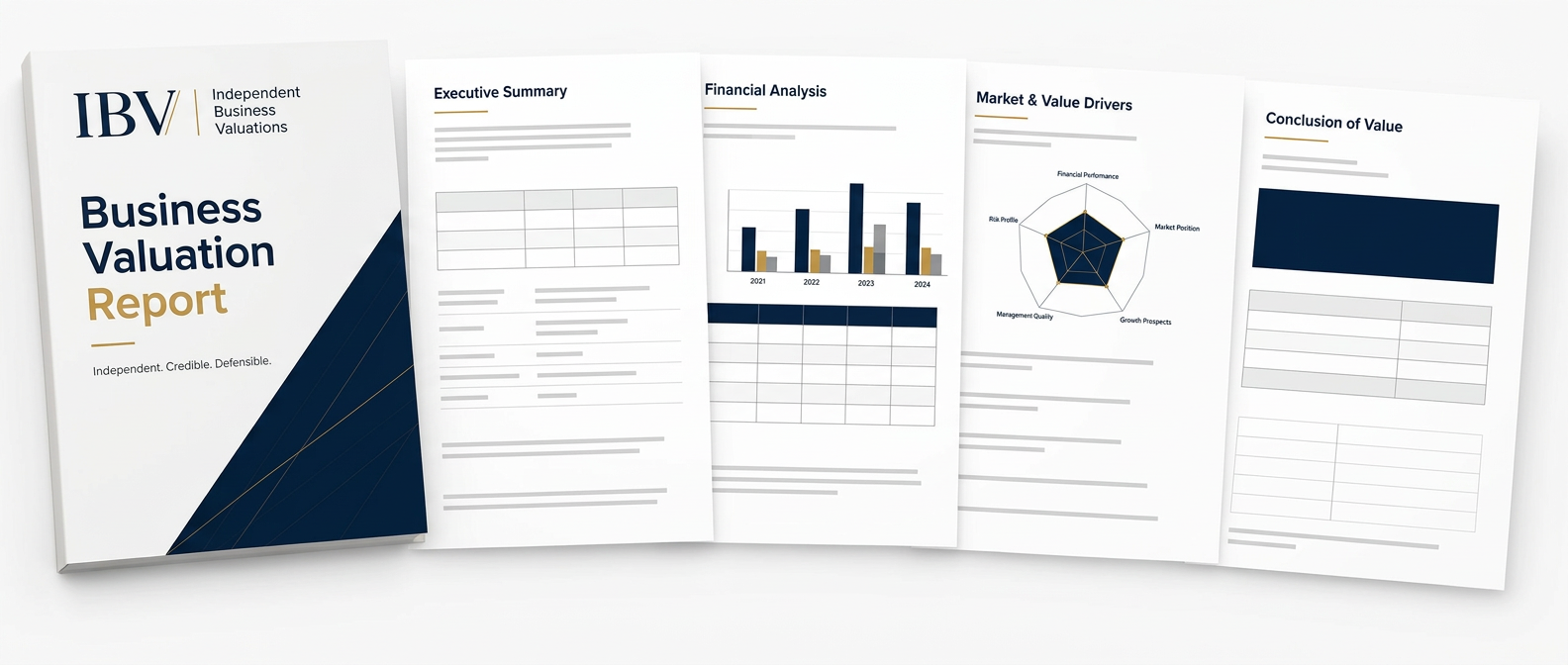
A clear, independent view of value — with the evidence behind it.
- Understand the conclusion — and what drives value.
- Gain an independent perspective. Move forward with confidence.
- Benchmark your business against industry performance.
- Identify strengths, risks and opportunities through SWOT analysis.
WHAT YOU GET IN A LIMITED SCOPE VALUATION REPORT
Inside your IBV™ report
Executive Summary
Conclusion of value · Method selected · Valuer qualifications
Detailed Report
Maintainable earnings · Cap rate / multiple · Premise of value
The Evidence Pack
SWOT analysis · Top Performers Report · RAVDA score
APES 225 voluntarily aligned. Report depth and supporting analysis follow your agreed package and engagement scope.
Free Valuation Call