
Key takeaways
Build a timeline of evidence available at the time
A budget prepared before the valuation date provides different evidence from a spreadsheet reconstructed years later, even if both describe the same period. Create a dated document and event timeline showing what was available then, so the assessment reflects contemporary expectations rather than a story shaped by what eventually happened.
Distinguish newly found evidence from genuinely later events
A document found today may reveal a condition that already existed at the historical date, while a later unexpected event may tell you little about earlier value. Ask the valuer to explain why later information is used and whether it supports an existing condition or merely describes subsequent history.
Reconstruct reasonable expectations instead of inserting actual results
A historical purchaser faced uncertainty, so replacing every forecast with what later happened can distort the value being assessed. Provide budgets, orders and capacity records from the time, and ask the valuer to explain any reconstructed forecast, the evidence behind it and the importance of unavoidable gaps in those records.
Match comparison prices and balances to the historical date
Today’s market comparisons and convenient year end balances may not represent the business or financial conditions at the instructed historical date. Ask for period appropriate evidence and reconciled debt, assets and operating funding needs, with any later sale adjusted for intervening growth, distributions, investment and changes in ownership rights.
Explain missing evidence through its effect on value
A general warning about incomplete historical records does not tell you which uncertainty matters or what to investigate next. Request a clear account of missing facts, supported alternatives and their effect on value, with any range distinguished from separate legal scenarios and advisers deciding how the evidence should be used.
Fix the historical question
A retrospective valuation assesses an identified interest at an earlier date, not what it would sell for today. Confirm the purpose, ownership position and required date with the relevant adviser. Distinguish the date being valued from the date the report is prepared, and establish which legal or transaction assumptions must apply to the historical assessment.
Recover contemporaneous records
Financial statements, management accounts, budgets, contracts and correspondence can help reconstruct the position. Records of customer losses, financing or ownership changes may also be important. Explain when each document was created and what period it covers. Later summaries can be useful, but they should not silently replace evidence of the circumstances known at the valuation date.
Control for hindsight
Subsequent events may clarify a condition that already existed, or may reflect genuinely new developments. That distinction requires judgement and explanation. The analysis should avoid treating an unexpected later outcome as something a market participant necessarily foresaw, while still considering relevant evidence that illuminates the business and its risks at the earlier date.

Signed
A clear valuation conclusion starts with an agreed purpose, relevant evidence and disclosed assumptions. The report identifies the interest valued and explains the reasoning behind its conclusion.
Explain uncertainty and reconstruction
The report should describe the historical evidence, reconstruction steps and limitations caused by missing information. Earnings adjustments and market comparisons need to relate to the instructed period. If a material assumption cannot be resolved, the conclusion should make that uncertainty visible rather than creating an appearance of precision unsupported by the available records or contemporaneous market context.
Use the report within its scope
A historical business value does not by itself determine a tax liability, estate entitlement or litigation outcome. The instructing adviser remains responsible for those questions. Related instructions may include CGT valuation or estate and succession valuation, but each requires its own subject, purpose and evidence requirements to be established before the work begins.
Build a dated evidence chronology
For each significant document, record when it was created, what period it describes and who could access the information at the valuation date. Distinguish a budget approved before that date from a spreadsheet reconstructed years later. Both may contain useful information, but they carry different evidential weight and should not be presented as interchangeable records of contemporary expectations.
Include events that explain the business environment: contract renewals, financing negotiations, capacity constraints and significant customer communications. A chronology can reveal that a seemingly sudden later result had already been signalled. It can also show when an apparent warning was not available to market participants. This supports a disciplined assessment of what was known or reasonably knowable rather than a story organised around the eventual outcome.
Separate later discovery from later development
A report prepared today may discover an invoice, defect or contractual condition that existed at the historical date. That discovery can illuminate the earlier circumstances. By contrast, a subsequent change in legislation, an unexpected customer collapse or a new competitor may represent a development that could not reasonably have been anticipated. The distinction depends on evidence, not simply whether the document itself is dated later.
The ATO's market valuation guidance refers to relevant and reliable information known or reasonably foreseeable at the valuation date. 1 Apply that discipline by stating why later material is being used: to corroborate an existing condition, to test a contemporary assumption or solely to explain subsequent history. Do not allow the third category to determine the earlier value by default.
Reconstruct expectations rather than substitute actual results
Start with budgets, order books, capacity plans and management reporting available at the historical date. Assess whether those forecasts were credible in light of previous forecasting accuracy and known operational constraints. Actual later results can help investigate the record, but replacing every forecast with the eventual result removes the uncertainty a purchaser would have faced.
Where a forecast must be reconstructed, state the building blocks and their dates. Use historical prices, staffing capacity and customer information rather than today's operating model. Explain unavoidable gaps and test their materiality. A reconstructed forecast should be recognisable as a reasoned estimate of contemporary expectations, not a backdated version of management's current understanding or a calculation designed to reproduce the eventual sale price.
Match market evidence to the historical environment
Select comparable transactions and financial data relevant to the period. Check what was publicly available then and whether later published accounts merely report earlier conditions. Do not apply a current industry multiple to historical earnings without analysing the change in growth, risk, financing and market sentiment. Apparent simplicity can conceal a significant date mismatch.
The same discipline applies to debt, surplus assets and working capital. Reconstruct balances at the instructed date rather than carrying forward the nearest convenient year end. If a later transaction is used as corroboration, reconcile intervening distributions, growth, capital expenditure and changed rights. Business Queensland's valuation guidance identifies financial and intangible business information as relevant inputs; historical work requires those inputs to be anchored to the historical business, not its present successor. 2
Make uncertainty specific enough to guide decisions
Identify the missing fact, the range of plausible assumptions and the effect on the conclusion. A generic warning that historical records are incomplete gives advisers little help. A schedule showing that one unavailable customer contract materially affects maintainable earnings identifies a useful next investigation and the limit of the current opinion.
Avoid implying precision through excessive decimal places or a single unsupported assumption. Where appropriate, explain a reasoned range while distinguishing it from alternative legal or factual scenarios. The report should make clear what further evidence could change the assessment and what remains a matter of professional judgement. Legal and tax advisers determine how that historical evidence is used for the particular transaction, dispute or reporting purpose.
Scope, fees and timing
See our fixed-fee valuation packages and confirm the scope and fee before commissioning work. Confirm the purpose, intended users, information requirements and inclusions in a written engagement before work begins. Calculated Value and Limited Scope delivery is 5–7 business days from complete financial information and a signed engagement. Full Conclusion timing is confirmed individually in the engagement letter. Specialist requirements or changes to the instruction may affect suitability and timing; confirm these before relying on an external deadline.
Sources and further reading
Frequently asked questions
How is a retrospective business valuation different from a current one?
A retrospective valuation estimates value at a specified past date using evidence relevant to that time. The report is prepared now, but the economic question belongs to the earlier period. It should distinguish the effective valuation date from the report date and avoid substituting today’s trading conditions or market expectations.
Who should choose the historical valuation date?
Your legal or tax adviser should identify the date required by the transaction, legislation or dispute. The valuer should not select a convenient year-end simply because accounts are available. If several events occurred, agree which event and interest the report addresses before reconstructing the financial position for that period.
What if we no longer have the accounts from that year?
Start with an evidence review rather than assuming a precise value can be produced. Tax returns, bank records, management reports, contracts and accountant files may assist reconstruction. Material gaps must be disclosed, and some instructions may not be supportable. Explain what survives and where additional records might be recovered before agreeing the scope.
Can later financial results be used in a historical assessment?
They can sometimes illuminate conditions that already existed, but they must not be used indiscriminately as hindsight. The key question is what was known or reasonably foreseeable at the valuation date. The report should explain why later information is relevant rather than treating every eventual outcome as an earlier expectation.
Will a later sale price prove what the business was worth years earlier?
Not by itself. Examine the time gap, transaction terms and changes in earnings, assets, debt and market conditions. A later sale may provide useful context, but it does not automatically establish an earlier market value. The analysis needs evidence linking the transaction to the business and circumstances at the historical date.
How do you assess old forecasts that turned out to be wrong?
The question is whether the forecasts and assumptions were reasonable on the information available then, not simply whether they matched later results. Supply original budgets and supporting correspondence where possible. The analysis should distinguish genuine contemporary expectations from forecasts reconstructed later to fit a tax position or a preferred outcome.
Can today’s valuation multiple be applied to historical earnings?
Only if its relevance to the earlier date is demonstrated. Market pricing, financing conditions and perceived business risk can change materially between periods. Historical comparisons should be sought and explained, with limitations disclosed. Applying a current multiple without examining those differences can create an apparently precise but poorly supported conclusion.
What if the business changed ownership or share classes since the date?
Provide the historical register, constitution and agreements as well as current records. The valuation must address the rights and ownership position at the instructed past date. A present-day capitalisation table may omit restrictions, preferences or holdings that were relevant then, so it cannot automatically stand in for historical evidence.
Will you follow APES 225 for a retrospective report?
The report can be prepared on a voluntary APES 225-aligned basis, with scope, methods, assumptions and limitations explained. That alignment is not presented as a mandatory requirement for every engagement or a promise of acceptance. Historical evidence quality remains critical, and recipient-specific instructions must be confirmed before reliance is agreed.
How long does a historical valuation take once we find the records?
We first confirm whether the surviving evidence supports the instruction and agree a Fixed Professional Fee upfront. Standard delivery is 5–7 business days after complete records and a signed engagement. Record recovery and unresolved historical assumptions should be addressed before a delivery date is relied upon. This 5–7 business-day timetable applies to Calculated Value and Limited Scope only; Full Conclusion delivery is confirmed individually in the engagement letter.
A clear, independent view of value — with the evidence behind it.
- Understand the conclusion — and what drives value.
- Gain an independent perspective. Move forward with confidence.
- Benchmark your business against industry performance.
- Identify strengths, risks and opportunities through SWOT analysis.
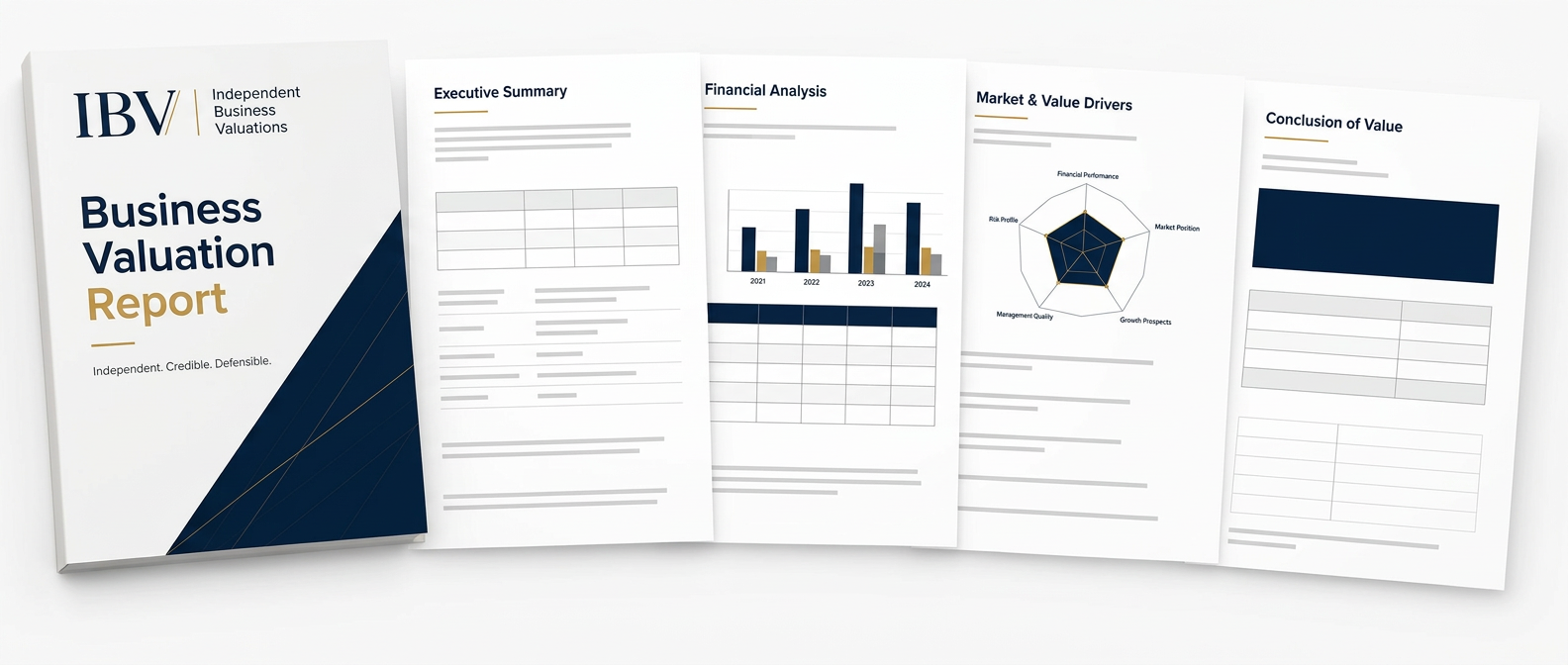
WHAT YOU GET IN A LIMITED SCOPE VALUATION REPORT
Inside your IBV™ report
Executive Summary
Conclusion of value · Method selected · Valuer qualifications
Detailed Report
Maintainable earnings · Cap rate / multiple · Premise of value
The Evidence Pack
SWOT analysis · Top Performers Report · RAVDA score
APES 225 voluntarily aligned. Report depth and supporting analysis follow your agreed package and engagement scope.
Free Valuation Call