

Key takeaways
Set an asking price you can support with evidence
Different buyers may see different opportunities in your business, so an ambitious asking price is not the same as a supported valuation. Build your price explanation around current evidence, keeping benefits available only to a particular buyer separate from the business’s existing value.
Choose improvements that justify their cost before selling
Pre-sale spending is worthwhile only if its likely benefit outweighs the cost, extra cash required and risk of delivery. Compare selling on current performance with completing the improvement, and do not price unfinished work as though its results have already been achieved.
Compare what each offer actually pays and requires
A larger offer may leave you worse off if some payments depend on future results or come with continuing obligations. Ask advisers to separate money paid at completion, later conditional payments, employment income and commitments such as guarantees before comparing the offers.
Focus negotiations on assumptions that materially change value
Some assumptions affect business value much more than small changes to individual sale terms. Test how changes in repeat orders or other important drivers affect the assessment, then use that comparison to decide where to hold firm and where flexibility may make sense.
Keep your personal cash needs separate from value
Your retirement plans and debt repayments matter when deciding whether a sale works for you, but they do not prove what a buyer should pay. Keep those requirements separate from the valuation and revisit your offer comparison whenever payment timing or continuing obligations change.
Define the sale perimeter
Preparing to sell begins with defining the package a buyer would actually acquire. A share sale transfers an ownership interest with its attached assets and obligations; an asset sale transfers the agreed operating components. Set out stock, debtors, cash, borrowings and property separately, together with the handover arrangements. This lets the valuation support a realistic price discussion rather than an asking price for a business package that is not available.
Substantiate sustainable earnings
Provide financial statements, recent trading results and records supporting unusual expenses or owner-related adjustments. Consider replacement wages and expenses a buyer would incur. Revenue growth alone does not establish maintainable profit, particularly where margins, staffing or customer concentration are changing. Supporting information helps distinguish a reasonable adjustment from a seller’s expectation about future performance.
Examine transferability and risk
Leases, contracts, licences and key relationships influence what can continue after a sale. Identify which arrangements require consent and whether the business relies on the current owner. The valuation can reflect these commercial features without certifying that approvals will be obtained. Specialist legal review remains necessary where a proposed transaction depends on transferring rights or obligations.

Signed
A clear valuation conclusion starts with an agreed purpose, relevant evidence and disclosed assumptions. The report identifies the interest valued and explains the reasoning behind its conclusion.
Explain the value and its drivers
The report should connect the selected methods to the business’s earnings, assets and risk profile. It can explain how the conclusion relates to the instructed transaction perimeter and which assumptions are most influential. This provides a reasoned starting point for discussions with advisers, rather than a marketing price chosen to create interest or satisfy a target return.
Separate valuation from sale execution
A valuation does not guarantee an offer or prescribe the eventual deal terms. Buyer funding, synergies, deferred payments and negotiated protections can change the outcome. Owners still preparing records may benefit from vendor due diligence valuation; broader preparation considerations are covered in selling a business, without replacing brokerage or legal services.
Choose a price position you can defend
A seller can use a valuation to distinguish an achievable commercial position from an ambitious opening request. Start by describing the buyer population: an owner operator, an existing competitor and a financial investor may see different opportunities. Do not blend those perspectives into one optimistic number. A standalone assessment gives the owner a reference point; exceptional benefits available to a particular purchaser belong in a separate negotiation discussion.
Prepare a price rationale with three columns: the assumption supporting value, evidence available today, and the consequence if that assumption fails. This makes it easier to decide which claims deserve emphasis in marketing. The government's sale guidance treats valuation and negotiation as separate steps, a useful reminder that an assessed value is an input to a sale strategy rather than the strategy itself. 1
Decide which improvements are worth completing before sale
Not every pre-sale improvement earns back its cost. A new product range may increase potential revenue while introducing unproven demand and inventory exposure. By contrast, moving customer contact information into a usable system may reduce dependence on the owner without requiring speculative expansion. Ask whether an initiative changes established earnings, reduces an identifiable risk, or merely improves presentation.
Compare a sale on current performance with a sale after the proposed improvement. Include the expenditure, additional working capital and execution risk in that comparison. Avoid valuing an unfinished initiative as though the results already exist. An owner might reasonably prefer a lower, evidence-supported price today over a higher possible price that requires substantial further investment. That is a commercial choice, not evidence that either valuation must be wrong.
Read offers as packages of economic commitments
Headline consideration can conceal quite different outcomes. In a hypothetical sale, one buyer offers $1.2 million payable at completion, while another offers $1.4 million with $400,000 dependent on customer retention. The second proposal is not automatically superior. Its value to the seller depends on the conditions, who controls performance after completion, and the chance of actually receiving the deferred amount.
Ask advisers to present completion proceeds, deferred consideration and continuing obligations separately. Identify whether the seller must remain employed, fund stock, provide a guarantee or accept a restraint that affects future income. Keep personal remuneration distinct from payment for the business. A valuation comparison should expose these differences rather than treating every dollar mentioned in an offer as immediately available sale proceeds.
Protect the value of a credible negotiation position
Use sensitivity analysis to decide where to negotiate firmly and where flexibility may be sensible. If a modest reduction in repeat orders materially changes value, defending an aggressive earnings assumption may create more difficulty than conceding a peripheral item. Conversely, evidence that customers remain with the business after staff changes may support confidence in transferable demand.
Prepare a private negotiation map showing the preferred terms, acceptable alternatives and matters requiring further advice. Do not circulate an internal minimum price as though it were an independent valuation conclusion. Government valuation guidance recognises multiple valuation methods and the need for financial and business information; it does not turn an owner's desired retirement amount into market evidence. 2
The useful outcome is a disciplined choice between offers, not simply a larger asking figure. Revisit the comparison when payment terms or retained obligations change, because a seemingly minor contractual revision can materially alter the economic bargain. Keep the valuation reference separate from your personal cash requirements so each can be discussed honestly with the relevant advisers. Record the commercial reasons for accepting different terms, so later discussions remain anchored to the actual offer rather than its headline amount.
Scope, fees and timing
See our fixed-fee valuation packages and confirm the scope and fee before commissioning work. Confirm the purpose, intended users, information requirements and inclusions in a written engagement before work begins. Calculated Value and Limited Scope delivery is 5–7 business days from complete financial information and a signed engagement. Full Conclusion timing is confirmed individually in the engagement letter. Specialist requirements or changes to the instruction may affect suitability and timing; confirm these before relying on an external deadline.
Sources and further reading
Frequently asked questions
Should I value the business before setting an asking price?
An independent valuation can give you an evidence-based reference before you discuss an asking price with a broker. First identify whether you are selling operating assets or shares, and what stays behind. The eventual price can differ because payment terms, buyer competition and transaction risks are negotiated separately from the valuation.
Which records help explain my business to a valuer?
Prepare several years of financial statements, current management accounts, asset lists and details of debt. Include leases, key customer contracts and a breakdown of owner remuneration. Explain any unusual trading periods. These records help connect your sale expectations to the earnings and assets a purchaser would actually acquire, rather than an unsupported headline figure.
Can personal expenses and my salary be added back?
Potential adjustments need evidence and a commercial explanation. A personal expense may be removable, but a buyer may still need to pay someone to perform your role. Supply invoices, payroll records and descriptions of your duties. The assessment considers sustainable replacement costs rather than simply adding every owner-related payment back to profit.
Does the valuation include stock, cash and business debt?
That depends on the agreed sale perimeter. Stock, debtors, cash, loans and working capital should be identified explicitly so the report can be compared with the proposed deal. A business value that excludes debt is not automatically the amount shareholders receive. Ask for the inclusions and exclusions to be stated before work starts.
Will reducing my involvement make the business more valuable?
A business that can operate without constant owner involvement may present less transition risk, but an uplift is not automatic. Document who manages sales, customer relationships and daily operations. The valuation considers whether those functions are transferable and adequately costed, alongside the strength of earnings and other risks at the valuation date.
How recent should the sale valuation be when I approach buyers?
Choose a date that suits your intended marketing and decision timetable, using sufficiently current records. A valuation is a view at a particular date, not a standing promise about future value. Material changes in trading, leases, contracts or financing may mean the report needs review before it is used in later negotiations.
Can strong sales growth outweigh falling margins?
Not necessarily. Rising turnover can coexist with weaker profit, cash pressure or higher investment needs. Provide sales and margin breakdowns, staffing costs and explanations for recent changes. The assessment considers whether growth can produce sustainable earnings, rather than assuming that a larger revenue figure alone justifies a higher business valuation.
Will the report tell me what I take home after selling?
A business valuation does not calculate your final after-tax proceeds. Debt repayment, transaction costs, employee obligations, deferred payments and tax can change the amount retained. Your accountant and lawyer should model the proposed transaction separately. The report provides a value reference for the defined business or interest, not a guaranteed net settlement amount.
Is an APES 225 aligned report a guarantee buyers will agree?
No. IBV voluntarily aligns its valuation work with APES 225; that alignment is not presented as mandatory for IBV or as buyer approval. The useful elements are a clear purpose, supported methods, assumptions and limitations. Buyers can commission their own assessment and disagree with inputs or negotiate different commercial terms.
Source: APESB — Valuation Services
How do I arrange a valuation around my planned sale launch?
Tell us what is being sold, your preferred valuation date and planned launch date, then provide an overview of available records. A Fixed Professional Fee is agreed upfront. Standard delivery is 5–7 business days once complete records and the signed engagement are received. This 5–7 business-day timetable applies to Calculated Value and Limited Scope only; Full Conclusion delivery is confirmed individually in the engagement letter.
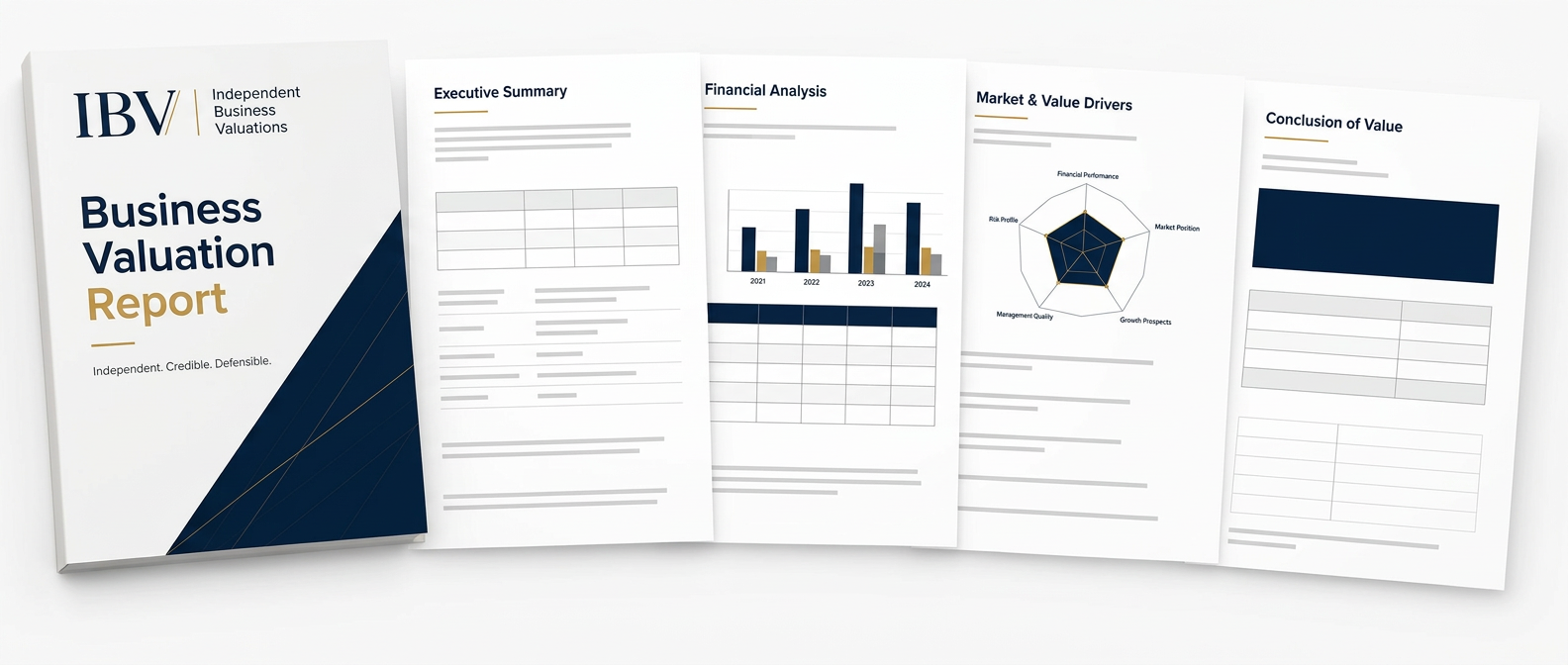
A clear, independent view of value — with the evidence behind it.
- Understand the conclusion — and what drives value.
- Gain an independent perspective. Move forward with confidence.
- Benchmark your business against industry performance.
- Identify strengths, risks and opportunities through SWOT analysis.
WHAT YOU GET IN A LIMITED SCOPE VALUATION REPORT
Inside your IBV™ report
Executive Summary
Conclusion of value · Method selected · Valuer qualifications
Detailed Report
Maintainable earnings · Cap rate / multiple · Premise of value
The Evidence Pack
SWOT analysis · Top Performers Report · RAVDA score
APES 225 voluntarily aligned. Report depth and supporting analysis follow your agreed package and engagement scope.
Free Valuation Call