Key takeaways
Use the implemented superannuation rules rather than earlier proposals
As checked on 17 October 2026, Division 296 applies from 1 July 2026 rather than remaining merely proposed. Ask your adviser to assess the implemented earnings rules and your circumstances instead of treating earlier proposals as the basis for a valuation.
Understand the limited purpose of the transitional election
Current ATO guidance describes an irrevocable election covering all capital gains tax assets held by a self-managed superannuation fund at the end of 30 June 2026. It affects Division 296 fund earnings only, so confirm eligibility and instructions with your adviser rather than assuming an ordinary tax cost reset.
Build a complete register of the fund’s actual holdings
The fund may own company shares or trust units rather than the operating assets held underneath them, which changes the valuation subject. Link every relevant holding to ownership, acquisition and historical tax records, including loss-position assets, so the adviser has a complete comparison rather than selected gains.
Value the fund’s rights rather than the underlying headline
A fund’s unlisted shares or units can have rights and restrictions that make a simple percentage of business value inappropriate. Obtain accounts, debt schedules and governing agreements for the relevant date, then reconcile business value to the fund’s holding without duplicating property or imposing unexplained discounts.
Keep transitional calculations apart from ordinary tax cost records
A transitional valuation should not overwrite the fund’s ordinary capital gains tax records, because the two calculations serve different purposes. Maintain separate working papers and adviser instructions, and leave election questions and the member’s eventual liability to the tax adviser rather than inferring them from one valuation.
Start with applicable legislation
Division 296 is enacted and applies from 1 July 2026. It is an individual tax on portions of taxable super earnings linked to total super balances above the applicable thresholds, not a tax on the entire value of an SMSF asset. Ask your accountant or SMSF adviser whether a separate valuation is needed and specify the asset, purpose and date in the brief. Valuation evidence does not establish a tax election or entitlement. ATO: Division 296 for SMSFs
Map the asset held by the fund
Determine whether the fund owns company shares, trust units or another interest, and identify any intermediate entities. Provide registers, governing documents and ownership charts. A valuation of the trading business alone may not answer the question about the fund’s particular holding, especially where debt, other assets or different classes of interest sit between them.
Confirm the date and evidence
Your accountant should confirm the relevant valuation date and intended use before a report is commissioned. Prepare financial statements, management accounts, funding schedules and significant contracts for that date. Preserve records as they arise, but distinguish sensible document preparation from a claim that a specified date creates an election, a reset or an entitlement for the holder.

Signed
A clear valuation conclusion starts with an agreed purpose, relevant evidence and disclosed assumptions. The report identifies the interest valued and explains the reasoning behind its conclusion.
Explain the interest-specific assessment
If instructed, the analysis can reconcile business value to the value of the fund’s holding, considering liabilities, surplus assets and ownership rights. The report should explain method selection, assumptions and information limitations. It provides valuation evidence for advisers to consider within their own analysis, not a legal determination about how legislation applies to the fund or its members.
Keep planning claims narrow
This service does not establish a new cost base or confirm any reset election or date entitlement. Legislative application must be confirmed by your accountant. For broader reporting needs, see SMSF business-interest valuation; for forward preparation, 2027 valuation planning follows the same requirement to settle the legal question before specifying the valuation work.
Use the enacted regime, not superseded proposals
Status checked for 17 October 2026: current ATO guidance says Division 296 applies from 1 July 2026. Treasury identifies the relevant 2026 Acts as enacted legislation. Describing the whole measure as merely proposed would therefore be misleading. Earlier proposals involving notional unrealised gains should not be used as a substitute for the implemented earnings framework.
For 2026–27, the ATO identifies a $3 million large super balance threshold and a $10 million very large super balance threshold, with additional tax rates of 15% and 10% applying to the relevant earnings components. These are not flat charges on the entire account balance. Individual application, aggregation across super interests and exclusions require the member's adviser to apply the current rules.
Understand what the transitional election actually changes
The ATO's 24 September 2026 update describes a CGT adjustment election applying to all CGT assets held by an SMSF at the end of 30 June 2026. It is irrevocable and operates only when calculating Division 296 fund earnings. It should not be advertised as a general reset of the ordinary CGT cost bases used for all fund tax purposes.
The update states that the election must be made by the due date of the fund's 2026–27 annual return, and that an approved form would be published shortly, with equivalent information in another format permitted. Confirm the current form, instructions and fund eligibility with the adviser before implementation. Do not assume asset-by-asset selection, a universal deadline or automatic benefit merely because an asset has increased in value.
Preserve a complete 30 June 2026 asset register
For an unlisted holding, identify the legal asset owned directly by the fund. Shares in a trading company are not the same asset as that company's equipment or goodwill. Units in an investment trust similarly require analysis of the fund's units and their rights rather than simply reproducing the trust's gross property value.
Create a register linking each holding to acquisition records, ownership confirmation, historical tax records and the valuation evidence for the transitional date. Because the ATO describes an election covering all relevant CGT assets, selective documentation of only appreciated holdings can leave the adviser without the complete comparison. Preserve loss-position assets and interests with uncertain value as well as the obvious high-value holdings.
Value the fund’s security through the ownership chain
Obtain company and trust accounts, interim trading results, debt schedules and governing agreements supporting the holding at 30 June 2026. Reconcile the operating business to equity, then to the fund's particular security. Different share classes, redemption rights, distribution priorities and transfer restrictions can make a simple percentage of enterprise value inappropriate.
Do not impose an unexplained minority discount or assume book net assets establish market value. Where the company owns property, use relevant specialist evidence and avoid adding property value twice through both earnings and assets. If June accounts were finalised later, explain which adjustments concern conditions already existing at the date and which reflect subsequent developments. A later sale is evidence to evaluate, not an automatic retrospective valuation.
Maintain parallel records and explicit implementation limits
Keep ordinary tax cost records separate from the transitional Division 296 working papers. A valuation report should identify the exact purpose so that a preparer does not overwrite the ordinary CGT register with a transitional amount. Reconcile the valuation schedule to fund accounts and preserve the election and adviser instructions with it.
Current ATO material also distinguishes the first income year's end-balance test from later years' opening-or-closing balance rules. A June 2026 asset valuation alone therefore cannot determine a member's eventual liability. The September update anticipated further draft guidance later in 2026. Any unresolved calculation, election or transition question should remain expressly with the SMSF tax adviser, rather than being answered through assumptions embedded in the valuation.
Scope, fees and timing
See our fixed-fee valuation packages and confirm the scope and fee before commissioning work. Confirm the purpose, intended users, information requirements and inclusions in a written engagement before work begins. Calculated Value and Limited Scope delivery is 5–7 business days from complete financial information and a signed engagement. Full Conclusion timing is confirmed individually in the engagement letter. Specialist requirements or changes to the instruction may affect suitability and timing; confirm these before relying on an external deadline.
Sources and further reading
Frequently asked questions
Is Division 296 still only a proposal?
No. The Treasury Laws Amendment (Building a Stronger and Fairer Super System) Act 2026 is enacted and in force. Division 296 applies from 1 July 2026. Whether a particular SMSF asset needs a separate valuation is a different question: ask your SMSF adviser to confirm the purpose, interest and date before commissioning a report.
Source: Federal Register of Legislation — Stronger and Fairer Super System Act 2026
Does the service name mean I can automatically reset an asset's cost base?
No. The page address does not establish an entitlement, election or reset date. A valuation supplies evidence, not a tax election or legal conclusion. Ask your adviser to identify any applicable transitional provision, conditions and measurement requirements before commissioning work; this service does not promise a change to an asset's general CGT cost base.
Why might an unlisted business interest matter for Division 296 enquiries?
An SMSF holding unlisted shares or units needs supportable information about its investments, while Division 296 involves member balances and relevant earnings information. The precise valuation requirement depends on the adviser's confirmed purpose. Valuing the underlying trading business alone may not establish the value of the fund's particular interest or determine a member's tax position.
Is 30 June 2027 automatically the right date for every Division 296 valuation?
No. For 2026–27, 30 June 2027 is the first-year transitional test date for an individual’s total super balance. It does not automatically set the date for every asset valuation or establish that a particular holding needs a separate report. Your adviser must distinguish member balance testing, annual SMSF market-value reporting and any transitional asset measurement, then specify the purpose and date.
What thresholds does the current ATO guidance describe?
For 2026–27, the ATO describes a $3 million large super balance threshold and a $10 million very large super balance threshold, with thresholds indexed in line with CPI. These are part of an individual member tax framework, not automatic valuation fees or asset exemptions. Your adviser must assess the applicable rules across your relevant super interests.
Is Division 296 a tax on the whole value of my SMSF business holding?
That is not how the ATO describes it. Division 296 concerns portions of taxable super earnings linked to total super balances, with additional treatment for very large balances. A holding's valuation alone does not calculate the liability. Your SMSF adviser should explain the earnings, balance and allocation rules applicable to your circumstances using current guidance.
What records are needed to value the fund's actual shares or units?
Provide the ownership chain, registers, governing documents, financial accounts and loan schedules, including intermediate entities. Identify the class and size of the fund's holding. The assessment may need to reconcile operating business value with debt, surplus assets and ownership rights; a simple percentage of turnover or an unrelated whole-business estimate will not necessarily answer that question.
Can an old sale appraisal support the fund's current valuation enquiry?
Possibly as background evidence, but its date, purpose and assumptions need review. A marketing appraisal may concern a different transaction package or ownership interest. The valuation should use evidence relevant to the instructed date and explain limitations, rather than adopt an old asking price as proof of the fund's current investment value.
Will the valuation tell me whether to sell assets or withdraw super?
No. Those decisions require tax, superannuation and financial advice about your circumstances, including applicable restrictions and consequences. The valuation can inform a defined measurement question but does not recommend a withdrawal, establish eligibility or promise a tax saving. Ask your adviser to settle the decision framework before commissioning supporting business-interest value evidence.
How should my SMSF adviser brief IBV before work begins?
Ask for a written brief identifying the current legal basis, fund holding, required date, intended users and records needed. IBV agrees a Fixed Professional Fee upfront. Standard delivery is 5–7 business days after complete records and signed engagement. Neither the engagement nor the report confirms a reset entitlement or tax outcome. This 5–7 business-day timetable applies to Calculated Value and Limited Scope only; Full Conclusion delivery is confirmed individually in the engagement letter.

A clear, independent view of value — with the evidence behind it.
- Understand the conclusion — and what drives value.
- Gain an independent perspective. Move forward with confidence.
- Benchmark your business against industry performance.
- Identify strengths, risks and opportunities through SWOT analysis.
WHAT YOU GET IN A LIMITED SCOPE VALUATION REPORT
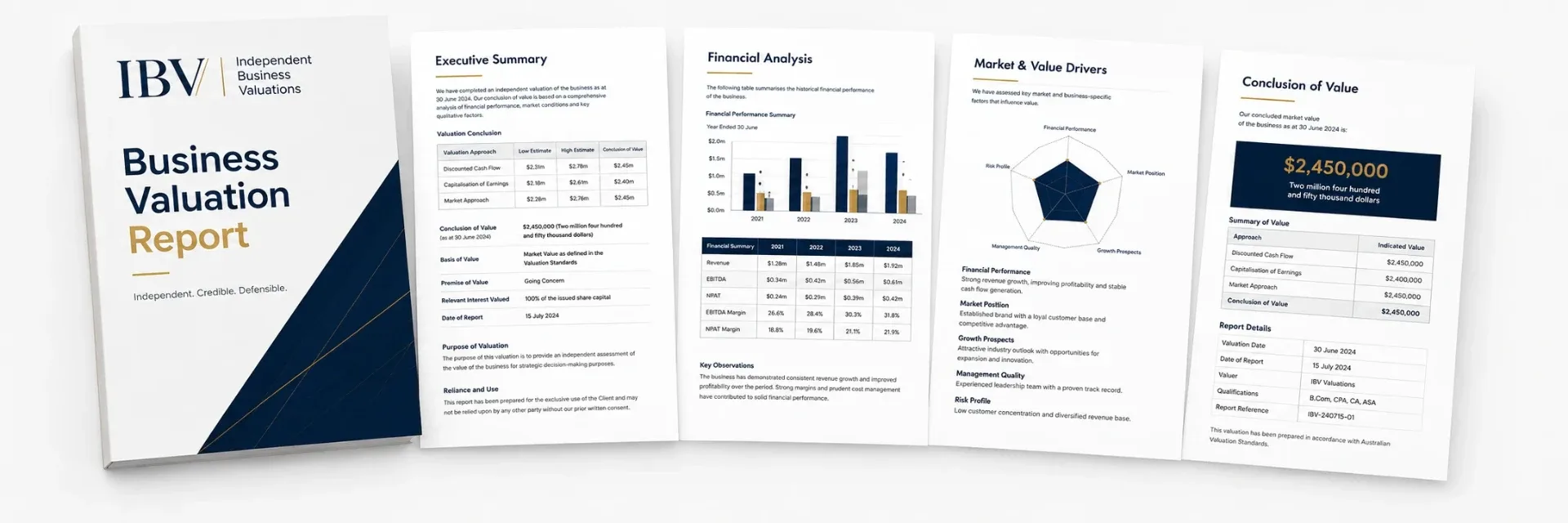
Inside your IBV™ report
Executive Summary
Conclusion of value · Method selected · Valuer qualifications
Detailed Report
Maintainable earnings · Cap rate / multiple · Premise of value
The Evidence Pack
SWOT analysis · Top Performers Report · RAVDA score
APES 225 voluntarily aligned. Report depth and supporting analysis follow your agreed package and engagement scope.
Free Valuation Call