

Key takeaways
Separate partner balances from the business interest value
Partner loans, drawings, capital and accumulated profit entitlements can sit alongside the value of the operating business rather than simply forming one amount. Ask for a reconciliation to the exit date, with the accountant confirming unfinished allocations, so an entitlement is not paid through both the valuation and settlement.
Check whether unfinished work will become collectible cash
Work in progress, often shortened to WIP, means work started but not yet invoiced, and recorded hours do not guarantee payment. Review billing conditions, completion costs and collection evidence, then ask how the valuation treats that work so its contribution is not added again if already captured in earnings.
Allow for the work your departing partner performs
A departing partner may handle sales, specialist work, supervision and administration, so one replacement salary may not reflect the resources the business needs. Map those responsibilities and test remaining capacity and customer retention, adjusting income and costs together rather than assuming all revenue continues without the necessary support.
Confirm what must happen for operations to continue
A partner leaving may require a changed legal structure or consent to keep using contracts, leases and licences, so uninterrupted trading should not be assumed. Ask legal and tax advisers to confirm continuity requirements, and have any separately instructed closure scenario assessed with its own costs and liabilities.
Show the purchase value and settlement adjustments separately
The value of a partnership interest can differ from the final payment once loans, retained liabilities, transferred assets and other entitlements are settled. Request a dated reconciliation separating those items and payment terms, including any goodwill, meaning business value beyond identifiable assets, rather than treating purchase funding as value.
Read the exit mechanism first
A departing partner’s settlement is not necessarily their ownership percentage multiplied by the business value. The partnership agreement, capital accounts, partner loans, unfinished profit allocations and proposed exit date all matter. Ask your advisers to confirm the basis for valuing the specific interest, then reconcile that value with separate settlement balances. This distinguishes what the interest is worth from what must ultimately be paid and how the purchase will be funded.
Document capital and obligations
Provide partnership or ownership agreements, capital accounts, loan records, financial statements and details of guarantees or continuing obligations. Clarify what is being acquired and whether debt balances are settled separately. Accounting capital, ownership percentage and economic entitlement can differ, so the supporting record needs to show how each relates to the particular exit being considered.
Assess continuity after departure
The departing owner may contribute labour, customer relationships, licences or management. Consider replacement costs and any restrictions or transition arrangements relevant to the instruction. An assumption that earnings continue unchanged should be supported, especially where the remaining owners will need to hire staff, renegotiate arrangements or replace work previously performed outside recorded payroll costs.

Signed
A clear valuation conclusion starts with an agreed purpose, relevant evidence and disclosed assumptions. The report identifies the interest valued and explains the reasoning behind its conclusion.
Show the buyout reconciliation
The report should explain the business assessment, the treatment of debt and surplus assets, and the allocation to the instructed interest. Where the agreement prescribes a formula, the output should distinguish applying that formula from expressing an independent market value opinion. This helps parties see whether differences arise from performance assumptions, ownership rights or the mechanism itself.
Separate price from funding terms
Deferred payment, security, tax and release from guarantees require separate agreement and advice. A valuation does not settle those terms or guarantee that either owner can fund the result. Contested instructions may be better addressed through shareholder dispute valuation, while future exit provisions can be considered through buy–sell agreement valuation.
Build an exit balance sheet, not just an earnings multiple
Prepare an exit schedule showing the trading assets, external liabilities and each partner's separate balances at the instructed date. Distinguish fixed capital from current accounts, drawings, accumulated profit entitlements and loans. Historical contributions may explain those balances without determining the current value of the business. Check that amounts described as partner loans are supported by records rather than inferred from an unexplained equity account.
Use a reconciliation from the last finalised accounts to the exit date. Include drawings, introduced capital, asset purchases and distributions during that interval. The purpose is to prevent the same entitlement being paid through both the interest value and a separate settlement adjustment. Ask the accountant to confirm entries that depend on unfinished tax or profit allocation work.
Test the recoverability of unfinished work
Professional and project based partnerships often carry work in progress that has not yet been invoiced. Review job records, contractual billing milestones, completion costs and collection history. Hours recorded at standard rates are not necessarily recoverable revenue. A departing partner's involvement may also be necessary to finish a project or obtain customer approval before an invoice can be issued.
Separate debts already earned from future profits requiring further work. If an earnings approach captures the normal contribution from the project pipeline, adding its gross value again can duplicate value. Conversely, unusual accrued entitlements outside normal operations may need distinct treatment. Document the selected approach and identify where the exit agreement prescribes an accounting treatment different from an independent valuation assessment.
Model replacement capacity at the service line level
Allocate the departing owner's responsibilities across production, sales, supervision and administration. Estimate the resources needed to replace those activities using actual workloads and credible employment or contractor evidence. One replacement salary may be insufficient where the owner performs several specialist roles. Equally, assuming every responsibility requires a separate full time employee may overstate the adjustment.
Examine whether remaining partners have capacity to absorb work without reducing their existing output. Review client concentration and the practical transfer of relationships, not just the existence of a customer list. Model supported changes to revenue and costs together. The continuing business should not be credited with all customer income while ignoring the people and systems necessary to retain it.
Distinguish a continuing operation from a break up
A partner leaving does not always lead to an economically identical continuation. Australian Government guidance notes that a change in partners can dissolve a partnership and may require consideration of a new or reconstituted arrangement. Legal and tax advisers should identify the actual structure and continuity requirements. 1
Check leases, licences, supplier approvals and customer contracts for matters requiring adviser review. If continuity depends on consent, state whether that consent is assumed or evidenced. A going concern assessment should not silently assume that assets and contracts can be transferred without disruption. A separately instructed break up scenario needs its own realisation costs and liability assumptions, rather than a simple reduction to the continuing business value.
Give negotiators a clean settlement reconciliation
Present the assessed interest separately from current account settlement, transferred assets, retained liabilities and any agreed post exit adjustment. Identify the date of each balance so that movements between valuation and completion can be handled deliberately. Commercial payment terms should sit outside the core valuation unless the instruction expressly requires their economic effect to be assessed.
Business Queensland's valuation guidance emphasises financial and operational information, including intangible assets, rather than reliance on a single accounting number. 2 The resulting reconciliation should let the parties discuss what is changing hands without confusing business goodwill, accrued partner entitlements, contractual obligations and the separate question of how the purchase will be funded.
Scope, fees and timing
See our fixed-fee valuation packages and confirm the scope and fee before commissioning work. Confirm the purpose, intended users, information requirements and inclusions in a written engagement before work begins. Calculated Value and Limited Scope delivery is 5–7 business days from complete financial information and a signed engagement. Full Conclusion timing is confirmed individually in the engagement letter. Specialist requirements or changes to the instruction may affect suitability and timing; confirm these before relying on an external deadline.
Sources and further reading
Frequently asked questions
My partner is retiring. What exactly should the buyout valuation cover?
Clarify whether the transaction concerns a partnership interest, company shares or specified business assets, despite the everyday use of “partner”. Provide the governing agreement and proposed terms. We then identify the interest, date and valuation basis, while your accountant and solicitor address tax obligations and the legal mechanics of the exit.
Our partnership agreement has a buyout clause. Is that more important than market value?
The clause may define the required method or basis, but its legal effect needs your solicitor’s advice. Provide the signed agreement and amendments before we begin. We can then scope the valuation to the confirmed instruction rather than assume a general market value report will satisfy the contractual buyout mechanism.
How do you handle unequal capital accounts and partner loans?
We need current capital accounts, loan records, drawings and the agreement governing them. These balances may need separate treatment from the value of the operating business. The report can explain the agreed reconciliation, while your accountant confirms the accounting balances and your lawyer confirms how they affect the amount payable on exit.
My partner does most of the unpaid administration. Does that affect the price?
It can affect the earnings a purchaser or continuing owner could sustain. We examine each owner’s duties and remuneration, then consider supported replacement costs where appropriate. The analysis should not treat unpaid work as permanently free labour, or deduct a full replacement salary without understanding which tasks remain after the buyout.
Can you value the business if the departing partner takes clients with them?
Yes, the proposed arrangements can be examined, but the instruction must state what is assumed about customer retention and ongoing competition. Provide customer revenue data and the draft exit terms. Your solicitor should advise on enforceability of restraints; we assess the commercial implications without assuming all customers stay or all leave.
We own the premises separately. Will that be included in the partner’s payout?
Identify the legal owners of the premises and whether the property is included in the proposed transaction. The operating business may need an appropriate rent assumption even when owners hold the building. A separate property valuation and legal advice may be needed; a business valuation alone does not settle the entire payout.
What happens to profits earned between the valuation date and completion?
That needs to be addressed in the buyout terms rather than left implicit in the valuation. Your advisers should clarify drawings, profit allocations, working capital movements and any completion adjustment. We value the agreed interest at the instructed date, and can discuss additional schedules if the settlement mechanism needs them.
Can we pay the buyout over several years using your valuation?
A valuation can inform the agreed consideration, but instalment terms are a separate negotiation. Timing, interest, security and default risk can affect the commercial package. Ask your solicitor and accountant to structure the payments and tax treatment; tell us if deferred consideration itself needs valuation within the agreed scope.
Can one report be used by both the retiring and continuing owners?
That can be considered if both parties and their advisers agree the purpose, reliance and appointment terms at the outset. Shared use does not make the report binding or settle every exit issue. We need clear instructions about information supplied by each owner and how material disagreements will be recorded and addressed.
What records should we prepare to avoid delaying the partner buyout?
Gather the partnership or ownership agreement, recent accounts, management results, capital and loan balances, asset details and the proposed exit terms. Identify lease and licence transfers early. A Fixed Professional Fee is agreed upfront; standard delivery is 5–7 business days after complete records and a signed engagement. This 5–7 business-day timetable applies to Calculated Value and Limited Scope only; Full Conclusion delivery is confirmed individually in the engagement letter.
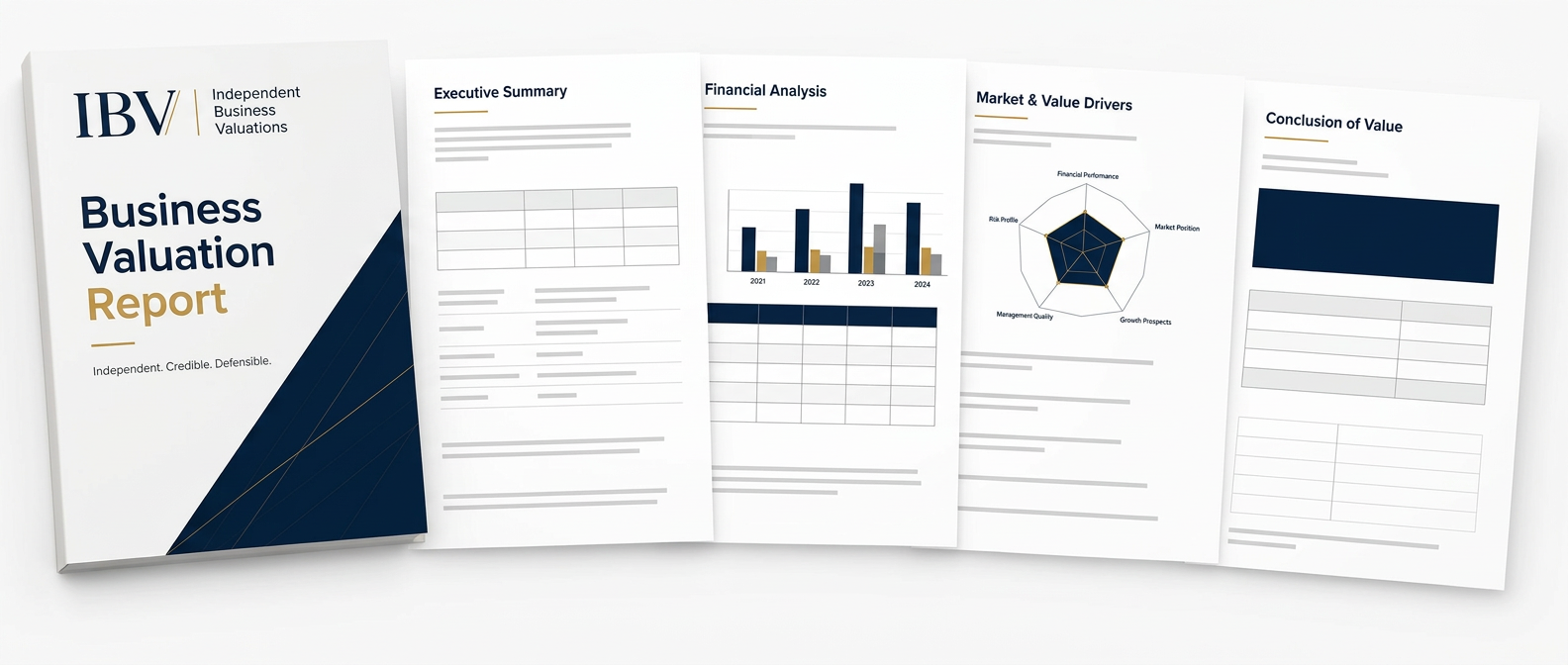
A clear, independent view of value — with the evidence behind it.
- Understand the conclusion — and what drives value.
- Gain an independent perspective. Move forward with confidence.
- Benchmark your business against industry performance.
- Identify strengths, risks and opportunities through SWOT analysis.
WHAT YOU GET IN A LIMITED SCOPE VALUATION REPORT
Inside your IBV™ report
Executive Summary
Conclusion of value · Method selected · Valuer qualifications
Detailed Report
Maintainable earnings · Cap rate / multiple · Premise of value
The Evidence Pack
SWOT analysis · Top Performers Report · RAVDA score
APES 225 voluntarily aligned. Report depth and supporting analysis follow your agreed package and engagement scope.
Free Valuation Call