

Key takeaways
A headline multiple needs a traceable source.
Check the period, sample and definitions behind a benchmark. This article provides no numerical industry ranges or transaction dataset.
Normalise earnings before making comparisons.
Review owner replacement costs, related-party arrangements and exceptional items. EBITDA is not the same as cash available to an owner.
Establish what the price includes.
Distinguish enterprise value, equity proceeds and asset sale prices. Debt, cash, stock, working capital and lease treatment must be compared consistently.
An asking price is not a completed transaction.
Check the status of the evidence, business size, date, risks and ownership rights. Public-company observations may not translate to a small private business.
Supported market multiples can be a primary method or cross-check.
Reliable, sufficiently comparable transaction evidence can support the primary valuation method. Explain earnings definitions and justified adjustments; weak evidence calls for disclosed uncertainty and consideration of other approaches.
Why industry EBITDA multiples need reliable evidence
This guide does not publish numerical industry multiples, transaction tables or a CSV download. A benchmark is only useful when its source, period, sample and definitions can be assessed. Without that context, a range can look authoritative while combining businesses and transactions that are not meaningfully comparable to the subject.
Check what the earnings measure means
EBITDA describes earnings before specified accounting charges; it is not the same as cash available to an owner. Ask whether reported figures have been adjusted and whether owner replacement costs, related party arrangements and exceptional items are treated consistently. An unsupported add-back can change the comparison as much as the choice of benchmark.
Check what the price includes
Is the comparison based on enterprise value, equity proceeds or an asset sale price? How are debt, cash, stock and normal working capital treated? Are leases accounted for consistently? A price divided by an earnings figure is not informative if the numerator and denominator describe different business boundaries or financing assumptions.

Signed
A clear valuation conclusion starts with an agreed purpose, relevant evidence and disclosed assumptions. The report identifies the interest valued and explains the reasoning behind its conclusion.
Assess the evidence behind the observation
Identify whether the information concerns a completed transaction, an asking price or an indicative offer. Consider the date, business size, concentration, growth evidence and ownership rights transferred. Public company observations may reflect liquidity and scale that a small private company does not share. These differences require analysis, not an automatic adjustment taken from an unexplained table.
Use supported market comparisons as a valuation method or cross-check
An appropriately supported market-multiple methodology can be the primary valuation method when sufficiently comparable, reliable transaction evidence exists, or provide a cross-check against another method. A useful comparison memo states the source and definitions, explains similarities and differences, and identifies why an observation was included or excluded. It should connect market evidence with the subject’s earnings, capital needs and risks. Where evidence is weak, say so and consider other approaches rather than manufacturing a narrow result from an uncertain sample.
What an EBITDA multiple actually represents
A multiple expresses a relationship between a defined value and a defined earnings measure. In a typical enterprise-value comparison, the numerator represents the operating business and the denominator represents EBITDA for a specified period. Before calculating anything, establish whether those are genuinely the definitions used by the source. An equity price divided by EBITDA is not automatically comparable with an enterprise-value observation.
EBITDA means earnings before interest, tax, depreciation and amortisation. It can help compare operating performance without some financing and accounting differences, but it is not a complete measure of economic cash generation. A business must still collect customer debts, fund stock, maintain equipment and meet other operating commitments. Two businesses with equal EBITDA can therefore have different funding needs and different values.
Why an industry label is only a starting filter
Within the same industry, businesses can differ in scale, service mix, geography, contracts and exposure to individual customers. A recurring-revenue service business and a project-based operator may sit under one broad category while having very different earnings durability. Treating the category as a complete risk assessment hides the characteristics a buyer would actually investigate.
The transaction context matters too. Was the acquired business distressed, rapidly growing or dependent on one key person? Did the purchaser obtain control? Were there competing bidders or benefits specific to that buyer? These questions help explain observed prices. They do not justify applying an arbitrary premium or discount without evidence.
A useful screening process starts with the business model and economics, not just the industry name. It then asks whether the observation's size, earnings definition, date and transaction terms are sufficiently similar to warrant further analysis. A small set of well-understood observations can be more useful than a large table whose inputs cannot be checked.
Normalise the earnings before discussing the multiple
Start with a reconciliation from reported earnings to the earnings measure proposed for valuation. Identify each adjustment, its documentary support and whether it changes the operating boundary. Commercial owner remuneration, related-party rent, unusual income and exceptional costs deserve separate examination. An expense labelled “one-off” is not automatically removable if similar costs recur in practice.
For example, an owner may add back their entire salary while continuing to assume that the business's management work gets done. The appropriate analysis asks what duties need replacement and what a commercial replacement would cost. Similarly, removing all premises rent because a related entity owns the property can overstate earnings if the purchaser would need to pay rent to occupy it.
Use adjustments consistently across periods. An unusually favourable trading year should not be selected solely because it produces a higher outcome. Explain changes in margins, volumes and cost structures so that maintainable earnings reflect the evidence rather than the owner's preferred result.
A worked example without an invented industry benchmark
The following figures are purely illustrative; they are not observed market multiples or an estimate of an IBV client's value. Suppose reported EBITDA is $300,000. Records support removing a genuinely exceptional $20,000 expense, but also show that replacing the owner's operational work would cost an additional $50,000. On those assumptions, the adjusted figure is $270,000, not $320,000.
The arithmetic is $300,000 plus $20,000 less $50,000. Holding the valuation multiple constant, the adjustment to earnings would directly affect the indicated operating value. The appropriateness of that multiple must still be independently assessed. The example demonstrates why evidence behind adjustments matters; it does not establish what multiple should be used or whether an EBITDA approach suits that business.
Next consider two otherwise similar operators reporting the same adjusted EBITDA. One needs recurring equipment replacement and substantial inventory funding; the other has modest capital requirements and collects fees promptly. Their cash economics are different. A valuer needs to account for those differences consistently through the chosen approach rather than assume equal EBITDA means equal value.
Check lease treatment and transaction boundaries
Lease accounting can alter reported EBITDA and the liabilities shown on the balance sheet. Some comparisons reflect rent as an operating expense; others involve accounting treatment that moves some lease-related charges below EBITDA. Mixing those conventions can distort both the earnings comparison and the reconciliation to equity value.
Obtain lease schedules and ask how the source treats lease obligations. The intention is consistent treatment, not a universal rule that all leases must be added or deducted in the same way. Premises, equipment and finance arrangements need to be assessed within the transaction and valuation definitions actually being used.
Working capital deserves similar care. Ask whether the price assumes a normal level of inventory, debtors and operating creditors is delivered. Stock is not automatically an extra amount to add to an earnings-based conclusion; it may already form part of the operating assets supporting those earnings. Explicit inclusions reduce the risk of counting the same economic component twice.
Distinguish enterprise value from shareholder value
An operating-business indication is not automatically the amount attributable to shareholders. Relevant debt, cash and non-operating assets may need reconciliation, subject to the definitions and assumptions of the engagement. If the instruction concerns a particular holding, its voting, distribution and transfer rights also require consideration.
Actual sale proceeds introduce another layer. Transaction costs, conditional payments, warranties and payment timing can affect what the seller receives. A strategic buyer's expected savings may influence their offer without establishing the appropriate value for an unrelated tax or shareholder purpose. Keep the valuation basis separate from a particular negotiated outcome.
When another method deserves more weight
An EBITDA multiple can become unhelpful where earnings are negative, highly unstable or unrepresentative of the business's future economics. A loss does not automatically mean zero value, but a future recovery cannot simply be assumed. Asset evidence, credible forecasts or other market information may provide a more appropriate foundation.
A discounted cash-flow approach can examine future cash generation where forecasts are supportable, although additional model detail does not repair weak assumptions. An asset approach may be relevant where asset ownership drives value or continued operation is uncertain. Method selection should follow the business and available evidence.
Read how to value a business in Australia for the wider method framework and what is my business worth? for the underlying value drivers. An appropriately supported earnings multiple may form the primary basis of a valuation or provide a cross-check against another method. Its reliability depends on the quality of the market evidence, consistent earnings definitions and justified adjustments.
Bring the analysis back to the business
The industry guides describe operating evidence to prepare. A formal engagement should define the interest, purpose and date, with adviser review for legal or tax use. See the central fees page. Many standard valuations can be completed within approximately 5–7 business days once all required information, clarifications, signed engagement documents and payment have been received. More complex engagements may take longer. Timing is confirmed before work begins.
Sources and further reading
This guide provides general information, not legal or tax advice. Examples are illustrative, not client cases or market benchmarks. Your adviser should confirm the requirements applicable to your transaction.
Frequently asked questions
Can an industry EBITDA multiple determine my business value?
Not on its own. Size, earnings quality, growth, customer concentration and transaction terms affect comparability. A broad industry figure needs testing against evidence relevant to the specific business.
Is EBITDA-based value the amount shareholders receive?
Not necessarily. An earnings-based operating value may need reconciliation for debt, cash, other assets and working-capital assumptions. The value of a particular ownership interest can also depend on its rights.
Why do earnings adjustments need supporting records?
Adjustments change the earnings base to which a multiple may be applied. Owner wages, unusual costs and related-party charges should be reviewed against evidence so that sustainable earnings are not overstated.
Source: ATO: market valuation of assets
What is maintainable EBITDA in a business valuation?
It is an assessed earnings measure reflecting evidence about ongoing operations, not automatically the latest accounting figure. Review historical accounts, owner duties, related-party arrangements and unusual items. Adjustments need support and consistent treatment; an add-back does not become valid merely because it increases the result.
How should lease costs be compared in EBITDA valuations?
Check the lease-accounting treatment in both the earnings measure and price evidence. Different conventions can make apparent multiples misleading. Provide lease schedules and the accounting basis so the valuer can reconcile the comparison rather than assuming all EBITDA figures include premises costs in the same way.
Can listed-company multiples be applied to a small private business?
They may provide context, but direct comparability should not be assumed. Consider scale, business mix, liquidity, growth and the interest represented by the data. The relevance of each observation must be assessed and explained, rather than applying a public-market figure simply because the industry label matches.
What should I check before relying on an industry-multiple table?
Ask for the source, date, sample, transaction status, business-size coverage and definitions of price and earnings. Without that information, the range may not be usable evidence for your business. Publication alone does not establish the reliability or comparability of a benchmark.
Can an EBITDA multiple value a loss-making business?
A straightforward positive-earnings multiple may not be suitable where earnings are negative or unstable. Assess the circumstances, assets, credible forecasts and available market evidence before selecting a method. Losses do not automatically establish zero value, but future profitability should not be assumed without supporting evidence.
How do capital expenditure and working capital affect EBITDA analysis?
EBITDA does not itself measure all cash needed to sustain operations. Review replacement expenditure, receivables, inventory and payment cycles. Businesses with similar EBITDA can have different cash requirements; the selected valuation approach should account for those requirements consistently rather than treating EBITDA as distributable cash.
Can a buyer’s expected synergies justify a higher valuation multiple?
A particular buyer may anticipate savings or benefits unavailable to other participants. Their treatment depends on the instructed basis of value and evidence. Distinguish buyer-specific expectations from general market assumptions; a negotiated strategic price is not automatically the appropriate conclusion for every valuation purpose.
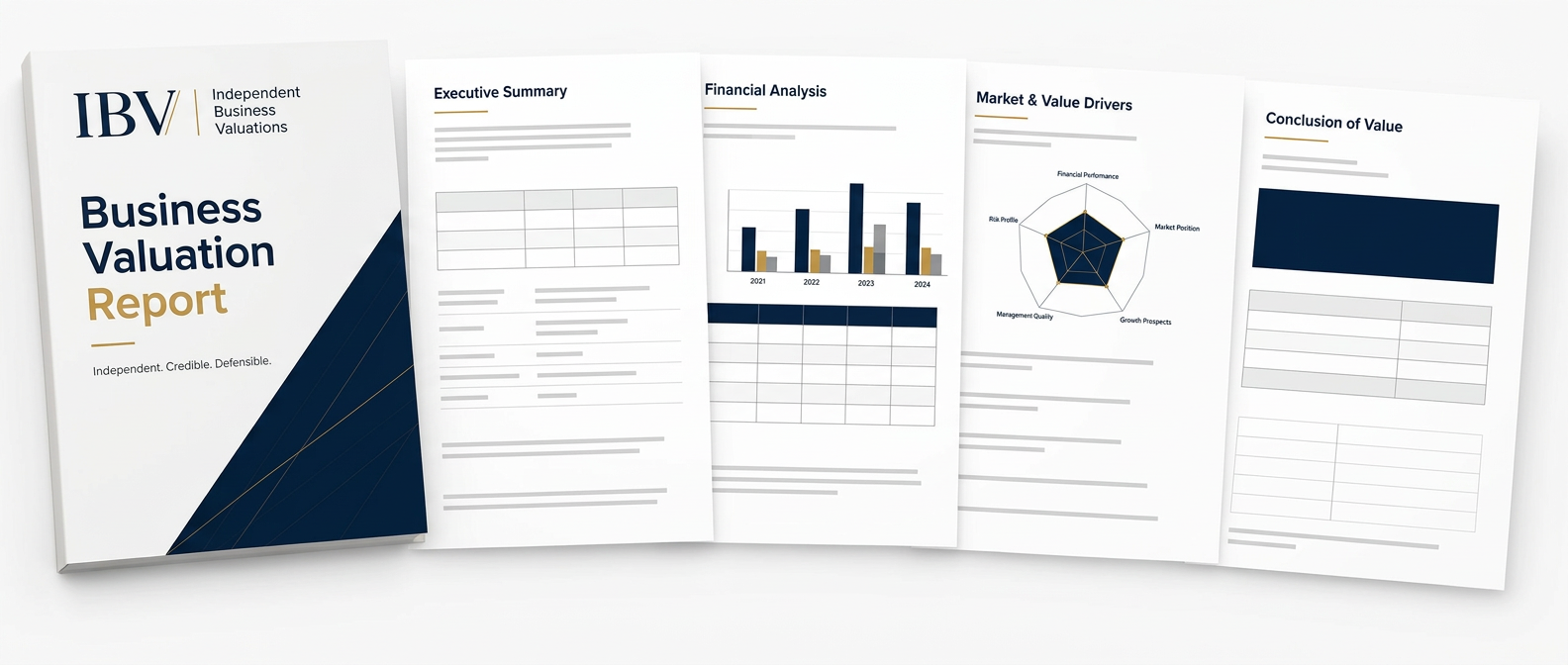
A clear, independent view of value — with the evidence behind it.
- Understand the conclusion — and what drives value.
- Gain an independent perspective. Move forward with confidence.
- Benchmark your business against industry performance.
- Identify strengths, risks and opportunities through SWOT analysis.
WHAT YOU GET IN A LIMITED SCOPE VALUATION REPORT
Inside your IBV™ report
Executive Summary
Conclusion of value · Method selected · Valuer qualifications
Detailed Report
Maintainable earnings · Cap rate / multiple · Premise of value
The Evidence Pack
SWOT analysis · Top Performers Report · RAVDA score
APES 225 voluntarily aligned. Report depth and supporting analysis follow your agreed package and engagement scope.
Free Valuation Call