Use this as a discussion aid
This page is a written checklist, not a quiz, tax event identifier or automated advice service. It does not process answers or tell you which tax rules apply. Transactions involving business assets, shares, units or changes in ownership can require different analysis. An appropriately qualified adviser must review the facts and law before any tax conclusion is relied upon.
Describe what actually happens
Write down the parties, entities, assets or interests involved and the steps proposed or already completed. Include agreements, relevant dates, consideration and any non-cash elements. Distinguish the date documents were signed from other transaction milestones. Do not assume that a transaction’s informal label supplies the legal analysis or fixes the valuation date.
Map ownership and relationships
Prepare an ownership diagram before and after the transaction. Identify related parties, different share classes, trust interests and entities holding property or other assets separately. Ask your adviser which steps require further investigation and whether more than one valuation subject or date is relevant. A business’s trading name does not establish which legal person owns an asset.

Signed
A clear valuation conclusion starts with an agreed purpose, relevant evidence and disclosed assumptions. The report identifies the interest valued and explains the reasoning behind its conclusion.
Ask the adviser to define the valuation instruction
If market value evidence is required, ask for written confirmation of the purpose, effective date, interest and intended reliance. The valuer should not be asked to certify eligibility for a concession or assume that a proposed restructure receives a particular treatment. Future legislation, transitional provisions and any potential reset treatment require current, transaction specific adviser review.
Record facts, uncertainties and next actions
Create a transaction chronology and question list. Mark what is documented, what is proposed and what remains unresolved. Ask who will confirm legal ownership, contract interpretation and tax reporting obligations. This gives the adviser an organised starting point and helps prevent a valuation report from being used for a purpose its instructions did not address.
Seek an appropriate next step
Read CGT valuation information after the adviser has clarified the question, or discuss a scope. This checklist provides no tax calculation, event classification or guaranteed outcome. Fees are on the central fees page. Standard delivery is 5–7 business days after complete information and a signed engagement are received.

A clear, independent view of value — with the evidence behind it.
- Understand the conclusion — and what drives value.
- Gain an independent perspective. Move forward with confidence.
- Benchmark your business against industry performance.
- Identify strengths, risks and opportunities through SWOT analysis.
WHAT YOU GET IN A LIMITED SCOPE VALUATION REPORT
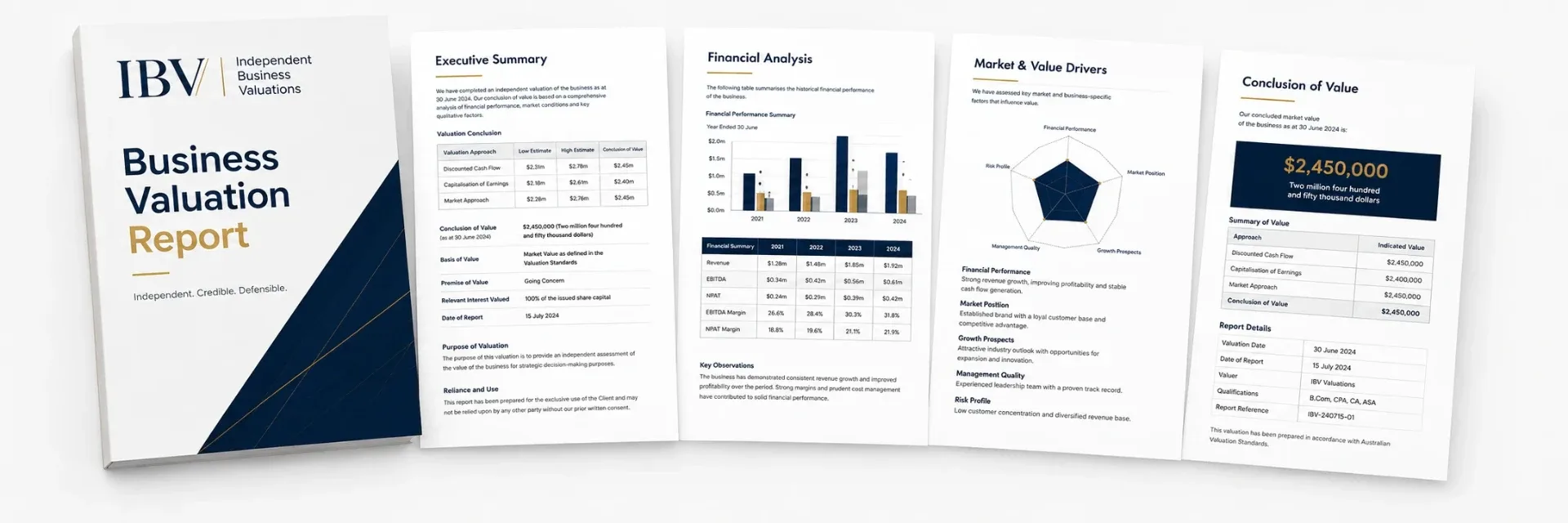
Inside your IBV™ report
Executive Summary
Conclusion of value · Method selected · Valuer qualifications
Detailed Report
Maintainable earnings · Cap rate / multiple · Premise of value
The Evidence Pack
SWOT analysis · Top Performers Report · RAVDA score
APES 225 voluntarily aligned. Report depth and supporting analysis follow your agreed package and engagement scope.
Free Valuation Call