What this page does and does not do
This page helps you identify records and questions for a valuation discussion. It does not collect answers, calculate a result or generate a valuation range. You will not receive an automated report by working through it. A reliable conclusion requires a defined engagement and an assessment of the actual business and interest.
Write down the valuation question
Record the purpose, effective date and exact interest: business assets, shares, units or another specified interest. Note the intended users and the decision they need to make. Ask whether property, investment assets or related entities are outside the scope. An owner’s desired sale proceeds and the value of the operating business are not necessarily the same question.
Assemble the financial evidence
Prepare historical financial statements, current management accounts, debt and lease schedules and an ownership diagram. List unusual items and support each proposed adjustment. Explain the owner’s work and likely replacement responsibilities. Reconcile differences between accounting reports rather than selecting whichever version produces the most favourable earnings. Mark any unavailable records for discussion.

Signed
A clear valuation conclusion starts with an agreed purpose, relevant evidence and disclosed assumptions. The report identifies the interest valued and explains the reasoning behind its conclusion.
Map the operating dependencies
Identify key customers, suppliers, staff, premises and licences. Ask what could continue after a change in ownership and what requires consent, recruitment or further investment. Review stock quality, asset maintenance and the working capital needed to keep operating. These factors cannot be reduced to a generic industry selection without losing important business specific information.
Prepare a one-page scoping brief
A useful output from this checklist is your own brief: the interest and date, business model, records available, unusual events, key dependencies and deadline. Add questions your adviser needs answered and identify missing documents. Keep passwords, sensitive personal information and confidential customer files out of an initial enquiry; discuss secure evidence arrangements where needed.
Move from preparation to an engagement
Use the industry guides to refine the evidence questions and request a scope when ready. Legal or tax conclusions require adviser review. Pricing is maintained on the central fees page. Standard delivery is 5–7 business days after complete information and a signed engagement are received.

A clear, independent view of value — with the evidence behind it.
- Understand the conclusion — and what drives value.
- Gain an independent perspective. Move forward with confidence.
- Benchmark your business against industry performance.
- Identify strengths, risks and opportunities through SWOT analysis.
WHAT YOU GET IN A LIMITED SCOPE VALUATION REPORT
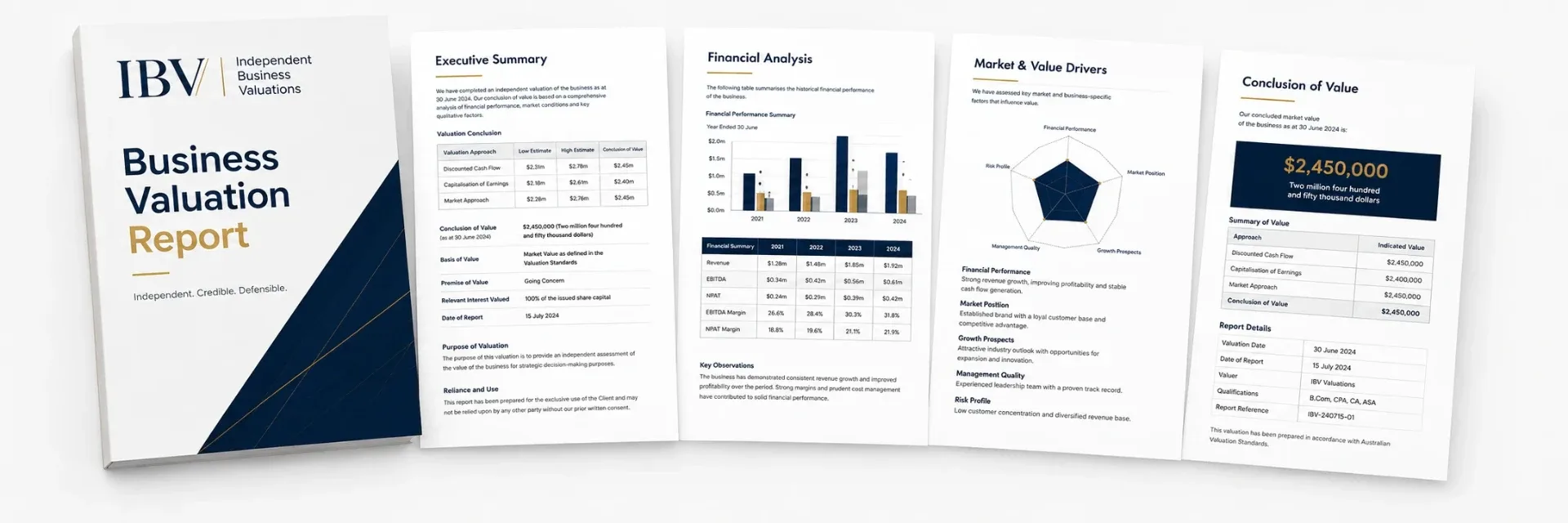
Inside your IBV™ report
Executive Summary
Conclusion of value · Method selected · Valuer qualifications
Detailed Report
Maintainable earnings · Cap rate / multiple · Premise of value
The Evidence Pack
SWOT analysis · Top Performers Report · RAVDA score
APES 225 voluntarily aligned. Report depth and supporting analysis follow your agreed package and engagement scope.
Free Valuation Call